
MARITIMEPOSTS.COM — Developing Indonesia’s shrimp aquaculture sector requires orchestration across ministries and government agencies. The complexity of shrimp farm governance means that the sector cannot be addressed by a single institution, but requires integrated policies from upstream to downstream.
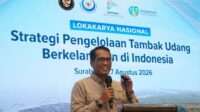
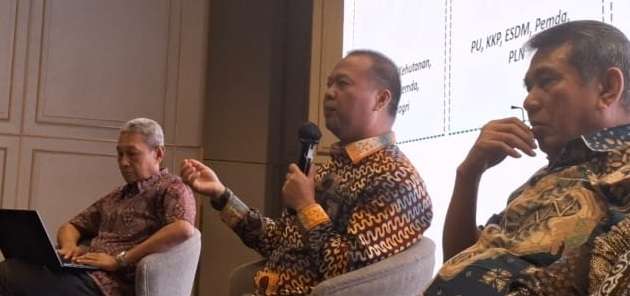
This was stated by Cahyadi Rasyid, Assistant Deputy for Aquaculture at the Coordinating Ministry for Food Affairs, in his presentation at the National Workshop on Indonesia’s Sustainable Shrimp Management Strategy, held in Surabaya on Thursday, August 27, 2026.
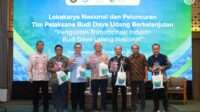
The workshop brought together central and local governments, academics, business representatives, aquaculture farmers, research institutions, civil society organizations, and various stakeholders involved in sustainable shrimp aquaculture development.
According to Cahyadi, shrimp aquaculture has a particularly strong cross-sectoral character.
“Issues in shrimp farming areas are not limited to production techniques. They also involve spatial planning, land status, infrastructure, energy, licensing, financing, supervision, environmental health, food safety, and international trade,” he said.
Therefore, coordination across ministries and government agencies is needed to connect these various authorities within a unified framework for area-based management.
Six Pillars of Authority
In his presentation, Cahyadi described shrimp farming areas as development spaces involving at least six major pillars of government authority.
The first pillar is spatial planning and land status, covering RTRW, RTRL, forest areas, KP2B, LSD, and LP2B. These matters involve the Ministry of Agrarian Affairs and Spatial Planning/National Land Agency (ATR/BPN), Ministry of Marine Affairs and Fisheries, Ministry of Forestry, Ministry of Agriculture, local governments, and Ministry of Home Affairs.
The second pillar concerns infrastructure and energy, ranging from primary, secondary, and tertiary irrigation networks to estuary dredging, production roads, electricity networks, and raw water supply.
“This aspect requires the involvement of the Ministry of Public Works, the Ministry of Marine Affairs and Fisheries, the Ministry of Energy and Mineral Resources, PLN, and local governments,” he said.
The third pillar is licensing and standardization, including KKPR, Environmental Approval, PBG/SLF, Good Fish Farming Practices (CBIB), NIB, and Standard Certificates.
The fourth pillar concerns financing and investment, including KUR, LPDB, LPMUKP, banking services, fisheries insurance, and fiscal incentives.
The fifth pillar involves governance and supervision, including program planning, the state budget, fertilizer assistance, extension services, regional policies, and law enforcement oversight.
These overlapping authorities demonstrate that shrimp farm management cannot be separated from the broader regional development system.
Smallholder Shrimp Farm Irrigation Needs Policy Support
One of the issues highlighted in Cahyadi’s presentation was the revitalization of irrigation systems serving smallholder shrimp farms.
According to him, Presidential Instruction No. 2 of 2025 remains largely focused on irrigation networks serving agricultural areas. Yet in several coastal production centers, irrigation systems for rice fields and shrimp ponds are closely interconnected.
“Therefore, stronger coordination is needed among the Ministry of Public Works, Bappenas, the Ministry of Agriculture, and the Ministry of Marine Affairs and Fisheries so that irrigation revitalization can be viewed as a single system flowing from upstream to downstream. This concept is not only about water channels serving rice fields, but also about how water management systems can support smallholder shrimp farming areas all the way to the estuary,” he explained.
Several regions have been identified as priorities for attention, including Tulang Bawang, East Lampung, and South Lampung in Lampung; Gresik and Sidoarjo in East Java; and Takalar and Pinrang in South Sulawesi.
For smallholder aquaculture farmers, water quality and availability are fundamental to productivity. Poor water-management infrastructure can increase production costs while also increasing risks to environmental and commodity health.
Irrigation revitalization for shrimp farming, therefore, is not merely an infrastructure issue. It is also part of a broader strategy to increase productivity and improve the welfare of aquaculture farmers.
AMR Threatens Export Security
Beyond area management and infrastructure, Cahyadi also highlighted a serious challenge related to antimicrobial resistance (AMR).
Data from January–February 2026 showed that 8 of 14 Indonesian shrimp export rejections by the United States were caused by antibiotic residues.
One processing unit was even placed under FDA Import Alert 16-129 following the detection of nitrofurans.
The figures serve as a warning that increasing shrimp production must go hand in hand with stronger food-safety safeguards.
“International markets do not simply require large volumes of shrimp. Products must also meet increasingly stringent standards for safety, quality, traceability, and health requirements. KKP surveillance in 2025 showed that in brackish-water commodities such as shrimp, resistance to enrofloxacin reached 15.54 percent, while resistance to tetracycline reached 1.92 percent,” he explained.
For freshwater commodities such as tilapia, catfish, and pangasius, resistance levels were even higher: 63.89 percent for enrofloxacin, 37.5 percent for tetracycline, and 36.11 percent for oxytetracycline.
In aquaculture environments, resistance to tetracycline was recorded at 14.71 percent, oxytetracycline at 11.76 percent, and enrofloxacin at 8.82 percent.
These figures demonstrate that AMR control cannot be treated solely as a downstream issue. It must begin with farming practices, the use of veterinary medicines, environmental monitoring, and product testing before products enter the market.
A regulatory framework is already in place through Minister of Marine Affairs and Fisheries Regulation No. 22 of 2024 on Good Fish Farming Practices and food safety, Ministerial Regulation No. 19 of 2024 concerning restrictions on the use of certain antimicrobials in fish medicines, and Ministerial Regulation No. 31 of 2024 on antimicrobial-resistance control in aquaculture.
The challenge is ensuring that these regulations are effectively implemented at the field level.
Priority Programs and the 2,000-Hectare Model
In his presentation, Cahyadi also outlined several strategic aquaculture development agendas.
One is the modeling and replication of 2,000 hectares of integrated shrimp farms. Other initiatives include the revitalization of 14,090 hectares of saline tilapia ponds along the northern coast of West Java and the development of 40,000 thematic inland aquaculture sites.
These programs demonstrate that the government is beginning to move from an individual business-unit approach toward more integrated area-based development.
However, programs of such scale also require stronger coordination. Without cross-sectoral orchestration, various initiatives risk operating independently and failing to fully address fundamental constraints in the field.
For this reason, one important proposal is the establishment of a Working Group for Sustainable Shrimp Aquaculture Development under the Deputy for Maritime Resources Coordination at the Coordinating Ministry for Food Affairs.
The working group is expected to provide a coordination platform for addressing obstacles involving multiple ministries and agencies, including regulatory issues, social conflicts, and various challenges in area development.
From Upstream to Global Markets
Cahyadi’s presentation ultimately conveyed one important message: shrimp aquaculture must be viewed as a system.
“Production at the farm level does not stand alone. It depends on certainty over spatial planning and land, water availability, infrastructure, energy, licensing, financing, environmental quality, farmer capacity, food safety, and market access. Therefore, Indonesia’s national shrimp development strategy requires integration from upstream to downstream,” he explained.
From irrigation channels to estuaries.
From spatial planning to shrimp ponds.
From the use of fish medicines to testing laboratories.
From smallholder farmers to export markets.
Every link in the chain is interconnected.
Amid the government’s efforts to increase Indonesia’s shrimp production and competitiveness, the challenge is not simply how to produce more shrimp, but how to ensure that production is safe, high-quality, sustainable, and capable of delivering tangible economic benefits to coastal communities.
Cross-ministerial and cross-agency coordination is therefore more than an administrative requirement. It is a foundation for area-based shrimp governance capable of bringing together the interests of production, the environment, aquaculture farmers, and global markets.
If this orchestration can be successfully established, the development of Indonesia’s shrimp aquaculture sector will generate more than a high-value export commodity. It can also create more productive coastal areas, healthier ecosystems, and more empowered aquaculture communities.
Editor: K. Azis