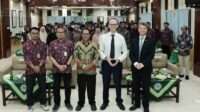

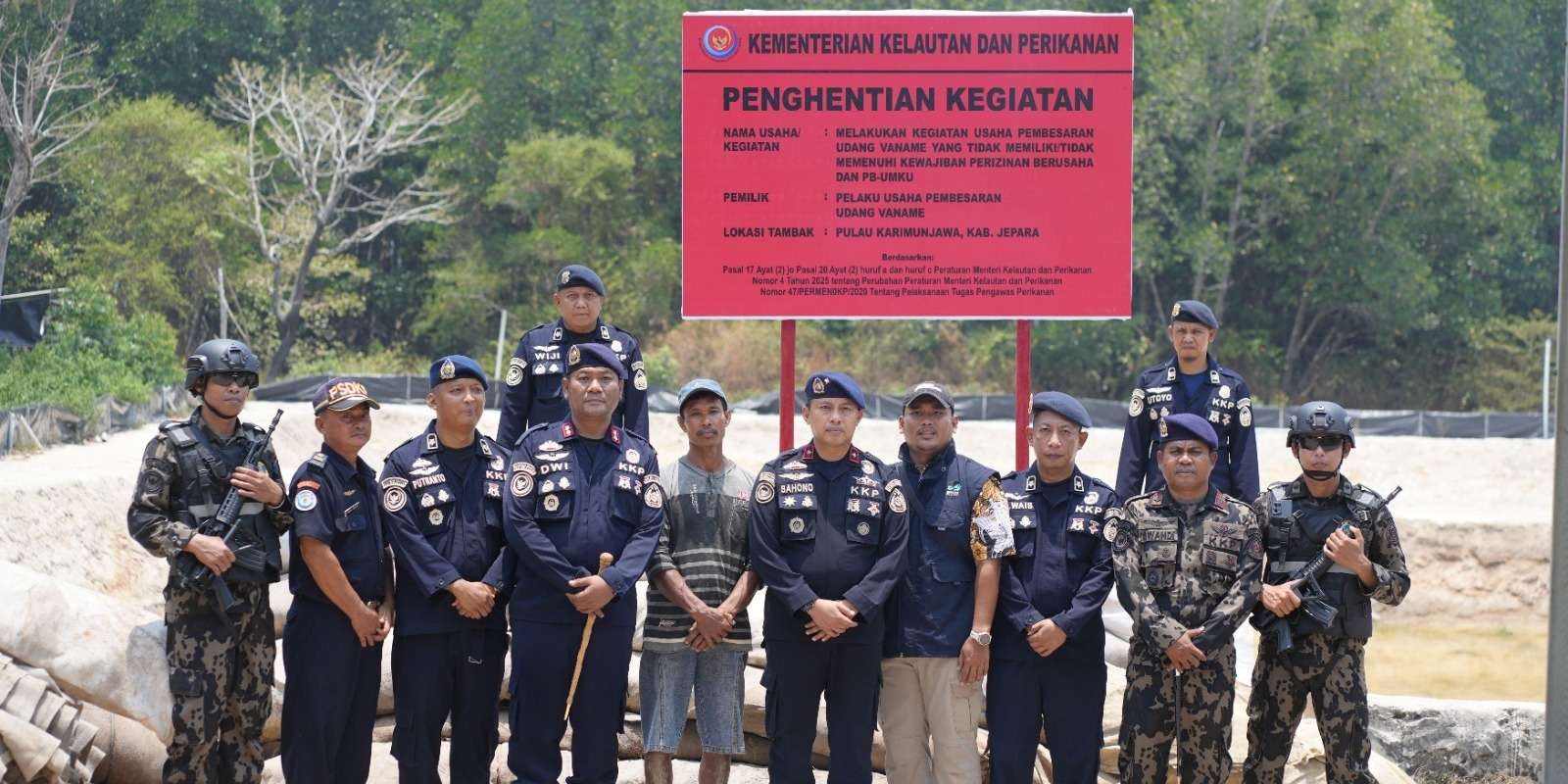
Minister of Marine Affairs and Fisheries Sakti Wahyu Trenggono said the enforcement action aims to preserve Karimunjawa’s marine and coastal environment while protecting local livelihoods, particularly those of fishers who depend on fisheries resources.
MARITIMEPOSTS.COM – Indonesia’s Ministry of Marine Affairs and Fisheries (KKP) has sealed two shrimp farming sites covering a total area of 7.71 hectares on Karimunjawa Island, Jepara Regency, Central Java, over alleged violations of licensing requirements.
The action is part of efforts to monitor aquaculture activities that could threaten coastal environmental sustainability and the long-term viability of fisheries resources.
The sealing operation was carried out by a team from the Cilacap Marine and Fisheries Resources Surveillance Station (PSDKP) on Sunday, October 11, 2026, following up on monitoring findings and public reports that some shrimp farms were still operating despite allegedly failing to comply with applicable regulations.
The operation was witnessed by the Karimunjawa Subdistrict Head and representatives of the businesses involved.
Minister of Marine Affairs and Fisheries Sakti Wahyu Trenggono said the enforcement action aims to preserve Karimunjawa’s marine and coastal environment while protecting local livelihoods, particularly those of fishers who depend on fisheries resources.
According to Trenggono, all fisheries businesses, including shrimp aquaculture operations, must meet licensing requirements and take into account environmental carrying capacity and the sustainability of fish stocks. Monitoring and enforcement will be strengthened to ensure that business activities do not harm fishing communities or damage aquatic ecosystems.
Director General of Marine and Fisheries Resources Surveillance Pung Nugroho Saksono explained that monitoring shrimp farms in Karimunjawa forms part of the government’s statutory fisheries surveillance responsibilities.
Based on surveillance findings validated in coordination with the Karimunjawa Subdistrict Head, 33 shrimp farming sites covering approximately 42 hectares in total have ceased operations since 2023 and 2024.
Pung emphasized that the cessation of farming activities does not mark the end of surveillance. KKP will continue conducting regular inspections and monitoring to ensure that the sites do not resume aquaculture operations in violation of applicable regulations.
From a regulatory perspective, Law No. 31 of 2004 on Fisheries, as amended by Law No. 45 of 2009, governs fisheries activities with due consideration for the conservation of fish resources and their environment.
The legislation also emphasizes the prevention of pollution and damage to fish resources and their supporting ecosystems.
In addition to complying with fisheries regulations, shrimp farming activities in Karimunjawa must adhere to local spatial planning provisions. Jepara Regency Regional Regulation No. 4 of 2023 concerning the Jepara Regency Spatial Plan for 2023–2043 stipulates that the Karimunjawa area is not designated for shrimp aquaculture.
Pung stressed that, in line with the Minister’s directive, his agency will continue conducting periodic inspections and surveillance to ensure that farms whose operations have been suspended do not resume activities and that all fisheries operations comply with applicable regulations.
The enforcement action underscores the importance of implementing licensing and spatial planning rules in coastal management. In island regions such as Karimunjawa, regulatory compliance is essential to maintaining a balance between economic activities, marine ecosystem conservation, and the sustainability of coastal communities’ livelihoods.
Source: Public Relations Office, Directorate General of Marine and Fisheries Resources Surveillance, KKP