
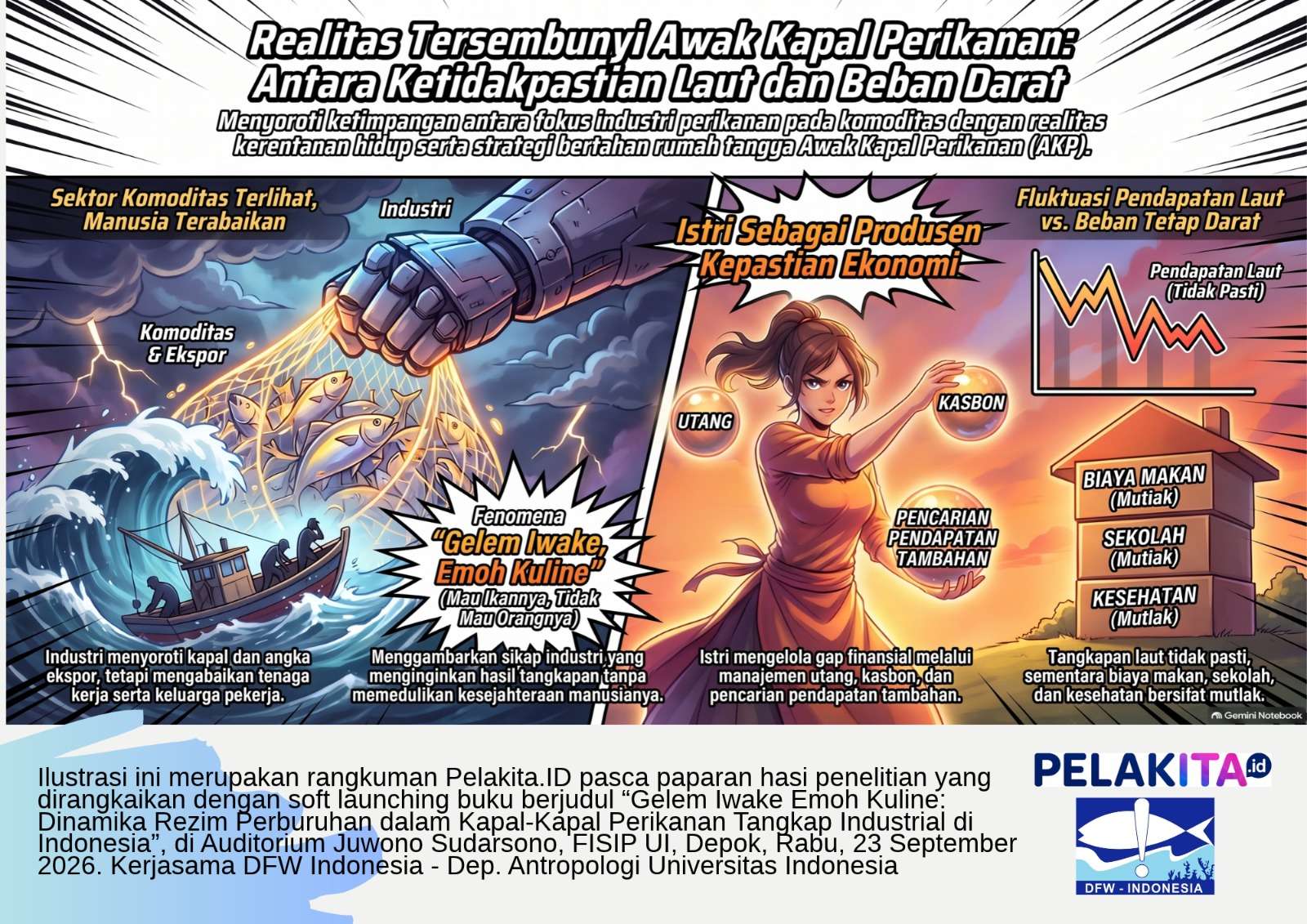
The expression “Gelem iwake, emoh kuline” takes on a critical meaning here: the industry wants the fish and the profit, but is reluctant to confront the “skin”—the labour, suffering, risks, and human vulnerabilities that make it possible for the fish to reach the market.
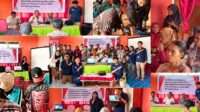
MARITIMEPOSTS.COM — On September 23, 2026, I had the opportunity to join, via Zoom, an important event in Salemba: the launch of a research book produced through a collaboration between DFW Indonesia and the Department of Anthropology at the University of Indonesia. As the founder of maritimeposts.com, I attended not merely as a journalist covering the event, but as a witness to an intellectual effort that courageously seeks to expose the darker realities of Indonesia’s maritime sector.
For years, we have been captivated by the impressive statistics of Indonesia’s rising fisheries exports. Yet this research offers a sobering counterpoint.
Behind those celebrated foreign-exchange figures lies the sociological reality of fishing crew members, or Awak Kapal Perikanan (AKP), whose lives and labour have systematically been pushed away from the centre of public attention. The argument is straightforward: Indonesia’s fisheries system continues to rest on an exploitative structure that prioritises commodities while turning a blind eye to the human “odour” of the struggle behind them.
There is a fundamental flaw in the way the fisheries industry understands its own world. Based on a synthesis of the research findings, there is an ontological “veil” separating what the state and market choose to prioritise from what actually lies at the heart of the industry.
What is readily visible is fish as a commodity, vessels as instruments of production, exports as economic achievements, and the sea as a resource to be continually extracted. What remains largely invisible are AKP workers as human beings with rights and dignity, the families who absorb the social costs of their labour, and the living spaces that sustain the social reproduction of fishing households.
The expression “Gelem iwake, emoh kuline” captures this contradiction: the industry wants the fish and the profit, but is reluctant to confront the “skin”—the labour, suffering, risks, and human vulnerability that make the fish available to the market.
The problem, therefore, is not merely administrative neglect. It reflects a structural way of seeing in which human beings become a hidden cost of maintaining the smooth operation of capital accumulation.
The Epistemology of Advocacy: A Multi-Sited Reality
The knowledge presented in this study is not the product of superficial observation. The book emerged from a process of Collaborative Ethnography, in which fishing crew members were no longer treated merely as research subjects but as co-producers of knowledge.
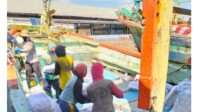
The depth of the research was built through 51 days aboard fishing vessels, where researchers reconstructed the realities of maritime labour through personal diaries, photographs, and videos. A multi-sited ethnographic approach followed crucial nodes of the fisheries labour system—from the landing centre at Muara Baru and ports in Java and Bitung to the “labour-supply pockets” found in remote villages.
The findings provide empirical evidence that a fishing vessel is not an isolated world. Rather, it is a critical node within a vast network connecting capital, families, ports, and the fate of inland communities.
Six Layers of Uncertainty Surrounding the Lives of Fishing Crew Members
The research reveals six interconnected layers of uncertainty.
Ecological Uncertainty
Ecological uncertainty forms the first layer shaping the lives of fishing crew members, particularly those living and working in coastal areas increasingly exposed to tidal flooding, climate change, sea-level rise, and land subsidence. These environmental changes threaten not only living spaces but also access to work, safety, housing, and the long-term sustainability of household livelihoods.
Infrastructure Intervention
The next layer of uncertainty emerges through large-scale infrastructure interventions that reshape coastal landscapes and the relationship between communities and the sea. Projects such as the approximately 575-kilometre Giant Sea Wall (GSW), for example, are presented as technical responses to the threat of flooding, but they may also alter access, mobility, patterns of activity, and livelihood spaces for coastal communities dependent on the sea.
Spatial & Institutional Uncertainty
Alongside ecological and physical transformation, fishing crew members face uncertainty over space and institutions. Access to fishing grounds, ports, settlements, and supporting facilities does not always operate within a simple governance framework. Overlapping authorities, regulations, and institutional interests can leave communities continually adapting to rules that change or that they do not fully understand.
Livelihood Uncertainty
Livelihood uncertainty is perhaps the most immediate experience in the lives of fishing crew members because their work depends heavily on sea conditions, catches, seasons, operating costs, and mobility. Income can fluctuate from one fishing trip to another while household needs continue regardless, meaning that declining catches or rising operating costs can quickly become a source of household economic pressure.
Household Strategies
Under these conditions, households do not simply remain passive. They develop strategies to sustain everyday life. Debt, consumption adjustments, livelihood diversification, support from relatives, and stronger social networks become important mechanisms for filling the gaps when income from fishing is insufficient. These strategies also reveal how survival is often sustained through forms of social labour that remain largely invisible in formal economic calculations.
Gendered Consequences
The final layer raises a more fundamental question: who ultimately bears the risks generated by all these uncertainties?
When fishing crew members face uncertainty at sea, many of its consequences continue on land through care work, household financial management, family provisioning, debt management, and other forms of social reproductive labour that are often carried by women. Ecological, economic, and institutional crises are therefore not gender-neutral: the same risks can produce very different burdens for men and women.
The Giant Sea Wall and the Collision of Two Regimes
A critical question emerges around the KLH/BPLH plan for the Jakarta Giant Sea Wall. The GSW is intended to reduce ecological uncertainty, particularly tidal flooding and coastal erosion. From an anthropological perspective, however, such a massive intervention may also generate new forms of livelihood uncertainty for fishing crew members and their families if it transforms living spaces without an integrated social commitment.
The research also points to a deeper structural problem: the crisis experienced by fishing crew members emerges from the collision of two major regimes that have never been fully synchronised.
The first is the Hunting Regime—a system focused primarily on fish production and the extraction of labour at sea. The second is the Coastal Planning and Development Regime—a system that aggressively transforms the physical spaces where workers and their families reproduce their everyday lives.
These two regimes eventually meet and collide at the household level. While one side demands labour productivity to produce fish, the other changes or displaces the living spaces of workers on land, forcing households into exhausting negotiations simply to maintain a degree of everyday certainty.
Household Sociology: Wives as the Last Line of Defence
Within an uncertain fisheries labour ecosystem, the wives of fishing crew members are not merely recipients of household income. They are economic actors who work continuously to maintain the household and absorb the risks generated by maritime labour.
While their husbands face uncertain return schedules, fluctuating catches, failed trips, and safety risks at sea, wives on land are expected to create a degree of certainty through the management of daily consumption, school expenses, healthcare, and other household needs.
The burden becomes heavier because household obligations remain constant even when income is uncertain. Wives manage instalments and debts, meet social obligations, organise household spending, and absorb the consequences when fishing income declines or vessels return late.
Household economic resilience, therefore, is shaped not only by labour at sea but also by reproductive labour and risk management taking place quietly on land. In this sense, wives become the last line of defence preventing uncertainty at sea from becoming a full-blown household crisis.
They manage the economic “gap” through strategies that are often improvised and stressful: reducing household consumption, expanding kinship networks for social assistance, managing kasbon debt, and critically assessing whether their husbands should continue going to sea or seek alternative employment.
Recruitment Systems and the Social Trap
The recruitment process for fishing labour resembles a labyrinth structured around dependency. Within it are actors whose roles often remain beyond public scrutiny:
- Vessel owners and operators, as holders of capital.
- Intermediaries: brokers, sponsors, labour recruiters, escorts, and tekong.
- Local actors: land-based juru kidang and juru kidang or officers.
The system is reinforced by coordination networks involving associations and lawyers. At the same time, there are coercive pathways involving certain community-organisation members and officials. The kasbon mechanism is therefore not simply a form of borrowing. It can function as a mechanism of labour control, trapping workers in a cycle of dependency and exploitation that is difficult to escape.
A Call for the Future
These findings make one point clear: fishing crew members are not merely numbers in economic statistics. They are human beings living within a social system shaped by structural vulnerabilities, commercial interests, and public policies that do not always adequately account for the human dimensions of maritime labour.
Indonesia needs to reconsider how its maritime policies understand the relationship between commodities and the people who produce them.
The challenge is to move beyond seeing “fish as commodities” and recognise the “human beings behind the commodities.”
maritimeposts.com will continue to follow and document this field of maritime anthropology. We should not simply enjoy seafood on our dining tables while remaining indifferent to the “smell of the sea” and the human suffering borne by those who catch it. The challenge is to place human dignity back at the centre of Indonesia’s maritime policy and governance.
Written by Kamaruddin Azis, Founder of maritimeposts.com
Sorowako, September 24, 2026