
Indonesia’s Kampung Nelayan Merah Putih program demonstrates that lasting coastal development requires moving beyond isolated equipment handouts. Real economic development begins with an honest, evidence-based understanding of the coast and the people who depend on it.
MARITIMEPOSTS.COM – For decades, public intervention in Indonesia’s coastal communities followed a well-intentioned but fundamentally flawed pattern: distributing physical equipment.
Traditional government assistance overwhelmingly focused on delivering standalone capital assets—boats, outboard engines, and fishing nets. While these handouts aimed to boost operational capability at sea, they consistently failed to lift fishing families out of persistent poverty.
The structural flaw in this traditional model lay in its total isolation from the realities of land-based operations. A new fishing vessel or net provides minimal economic uplift if a fisher faces crippling operational bottlenecks the moment they return to shore.
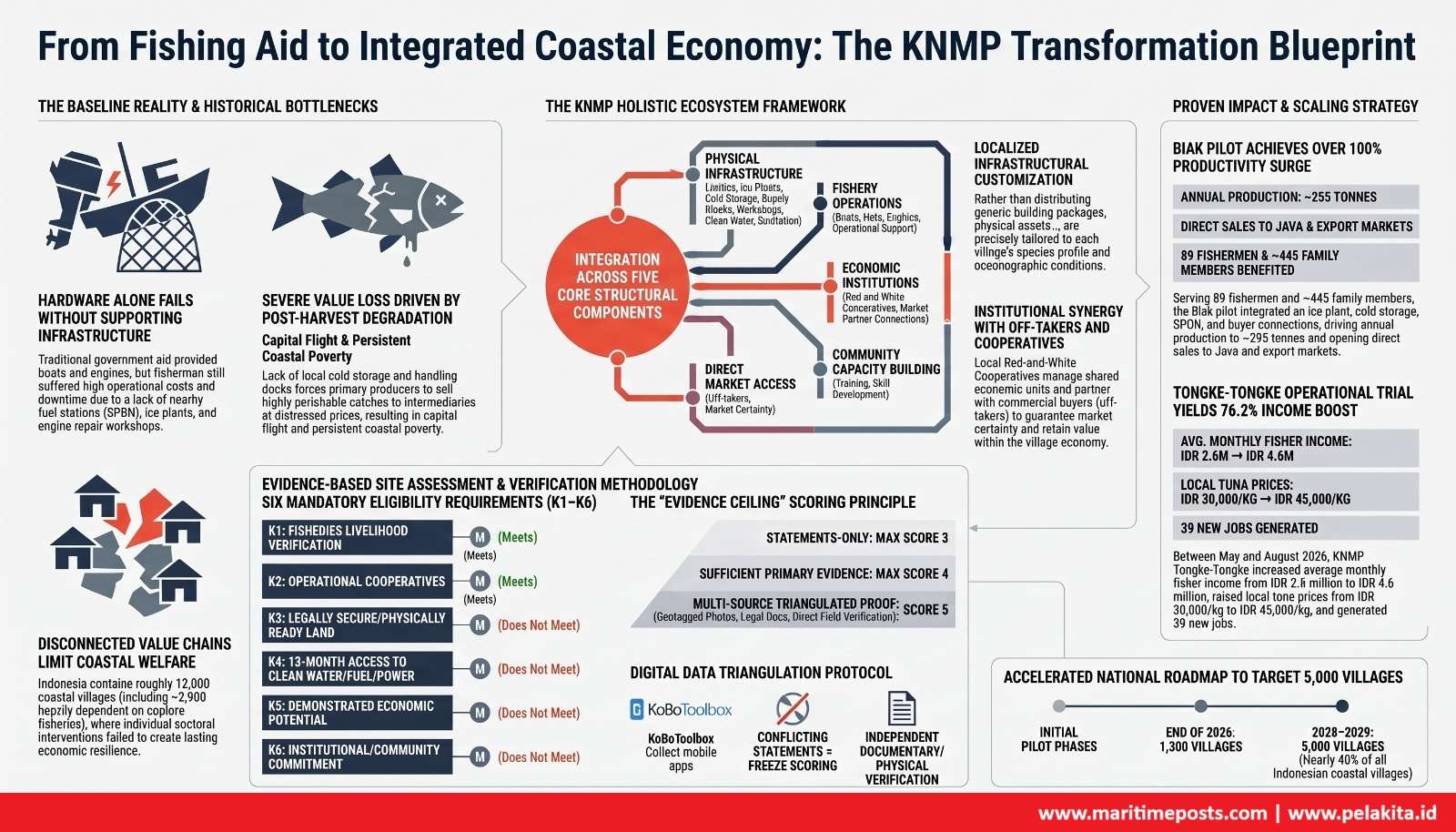
Across Indonesia’s coastline, primary producers face rapid post-harvest catch degradation, a complete lack of localized cold storage and ice manufacturing facilities, exorbitant fuel costs, extended vessel downtime due to nonexistent local repair workshops, and coercive debt cycles that force distress-selling to intermediaries at severely discounted prices.
Without supporting post-harvest infrastructure, high capture yields quickly erode into financial loss.
To dismantle these systemic barriers, the Ministry of Marine Affairs and Fisheries (Kementerian Kelautan dan Perikanan/KKP), led by Minister Sakti Wahyu Trenggono, initiated the Kampung Nelayan Merah Putih (KNMP)—or “Red and White Fishing Village”—program.
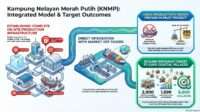
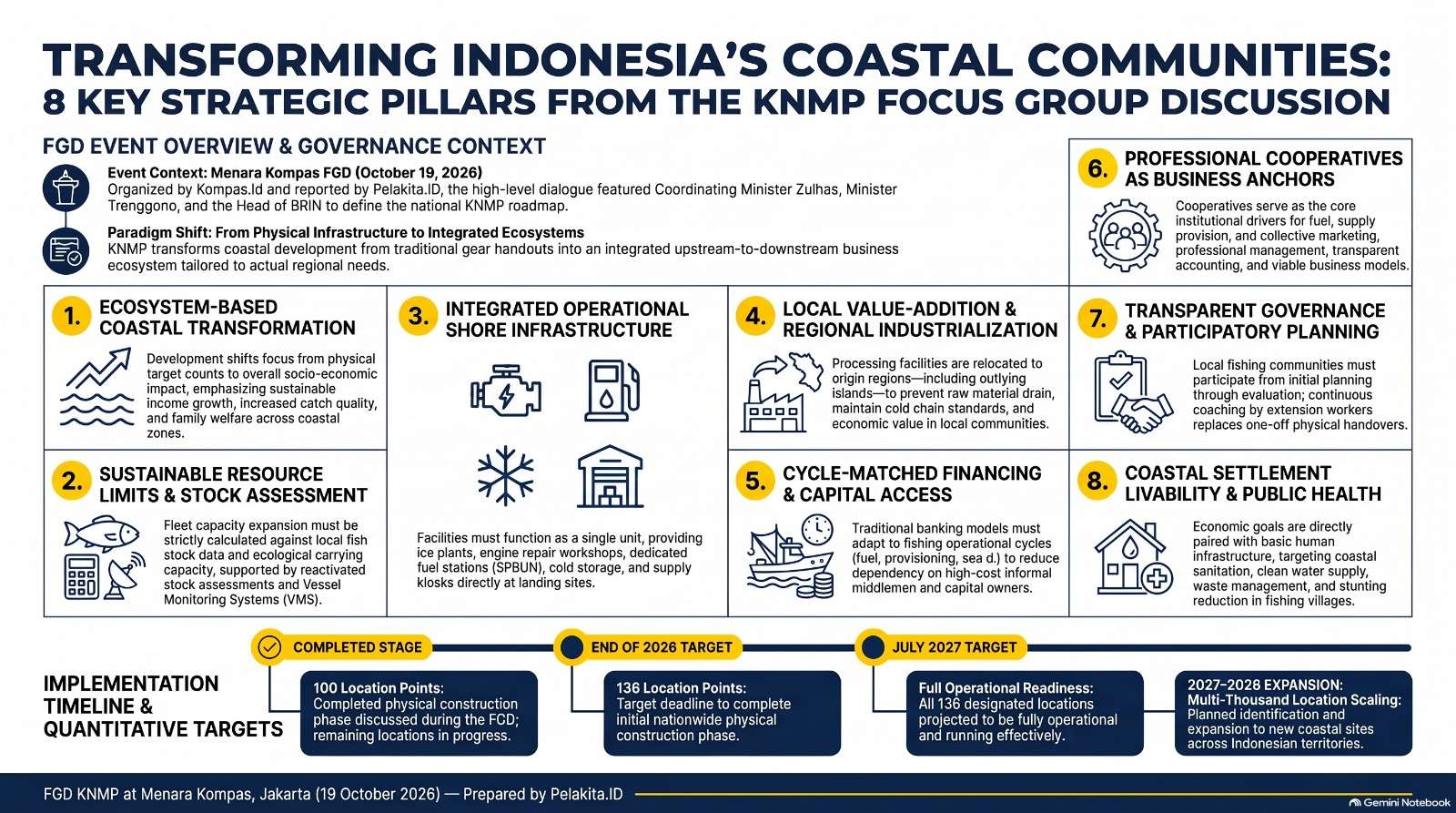
KNMP represents a fundamental paradigm shift away from piecemeal equipment handouts and toward the construction of an integrated, horizontally connected coastal economic ecosystem anchored at the village level.
Traditional Aid vs. The KNMP Integrated Model
| Development Dimension | Traditional Aid Model | The KNMP Integrated Ecosystem Model |
| Primary Focus | Standalone equipment handouts (boats, engines, nets). | Comprehensive village-level fisheries business ecosystems. |
| Post-Harvest Handling | Neglected; results in rapid fish spoilage and distress selling. | On-site ice plants, cold storage, landing docks, and processing units. |
| Operational Logistics | Unregulated fuel costs and long travel distances for supplies. | Localized dedicated fuel stations (SPBN) and supply kiosks. |
| Maintenance & Support | High downtime due to lack of local repair facilities. | Integrated vessel and engine repair workshops. |
| Market Access | Reliance on intermediaries; local capital flight. | Direct buyer (off-taker) connections and cooperative-led marketing. |
| Economic Governance | Individualized, fragmented aid delivery. | Formalized local economic institutions (Cooperatives/BUMDes). |
“The state’s policy mandate cannot conclude with the completion of physical assets. True development requires ensuring that facilities are actively managed, operationalized, and embedded within the continuous economic life of the coastal community.”
Strategic Imperatives: Why KNMP Exists
The implementation of the KNMP framework is driven by urgent national macroeconomic priorities, food security demands, and international productivity benchmarks.
As global population projections approach nearly 10 billion by 2050, international supply chain disruptions—amplified by geopolitical tensions and post-pandemic realities—highlight the strategic necessity for nations to secure resilient domestic food production.
For Indonesia, expanding domestic animal protein sources is both a public health necessity and an economic priority. Marine and aquaculture resources offer a vital foundation for national protein self-sufficiency, particularly as land-based livestock prices remain high.
Closing the Global Productivity Gap
Indonesia’s extensive marine biodiversity contrasts sharply with its historical productivity when compared to international fisheries leaders:
China, annual fish production stands at approximately 83 million tonnes, supported heavily by large-scale aquaculture and industrial infrastructure networks. Vietnam, annual production reaches roughly 25 million tonnes, driven primarily by advanced aquaculture technology and structured value chains.
To deepen this strategic policy realignment, KKP is also examining comparative regulatory structures such as Peru’s fisheries governance model.
Peru explicitly restricts corporate and industrial fleet dominance within nearshore zones, preserving these primary coastal waters for small-scale artisanal fishers as the principal value producers. By safeguarding local access rights and equipping smallholders with shore-based processing infrastructure, Indonesia can bridge its productivity gap while protecting local livelihoods.
Rather than relying strictly on wild-capture yields, Indonesia is concentrating policy and development capital on high-value tropical species native to its waters—such as tropical fish and mud crab (kepiting bakau)—mirroring Norway’s targeted national focus on salmon.
KNMP serves as the localized infrastructure foundation required to link rural primary producers with these broader industrial supply chains.
Scope and Scaling Targets
To achieve systemic economic transformation across Indonesia’s estimated 12,000 coastal villages—of which approximately 2,900 are heavily dependent on capture fisheries—President Prabowo Subianto and Minister Trenggono have established aggressive national implementation benchmarks:
Initial Pilot Funding: Governed by an early pilot budget support of approximately IDR 22 billion to establish proof-of-concept models.
2026 Phase Target: Scale the KNMP model to 1,300 fishing villages by the end of 2026.
2029 National Target: Expand program coverage to 5,000 fishing villages by 2029, encompassing nearly 40% of all coastal settlements in Indonesia.
2027 Planning Scope: Formalize Detailed Engineering Designs (DED) and Cost Estimates (Rencana Anggaran Biaya/RAB) for 1,000 prospective sites by December 31, 2026, building upon an initial phase of 1,599 identified locations.
Early Proof of Concept: Realized Impact and Case Studies
Empirical data from early implementation sites confirms that integrating physical assets, community institutions, and market channels generates immediate improvements in income, yield quality, and cost efficiency.
The Biak Pilot Blueprint (Papua)
Developed in Samber-Binyeri Village, Biak Regency, Papua, this early pilot targeted 89 active fishers supporting 445 family members. Before intervention, fishers traveled long distances for fuel, lacked ice for catch preservation, and experienced long periods of operational downtime when engines broke down.
KKP constructed an integrated facility containing an ice manufacturing plant, cold storage, a dedicated fishermen fuel station (Stasiun Pengisian Bahan Bakar Nelayan/SPBN), vessel repair workshops, culinary facilities, and direct commercial buyer links.
Productivity: Experienced a production increase of over 100%, reaching approximately 295 tonnes annually. Market Access: Established direct off-taker buyer channels transporting catch directly to markets in Java and designated export destinations.
Desa Tongke-Tongke Transformation (Sinjai, South Sulawesi)
Implemented through a multi-ministerial partnership combining KKP, the Ministry of Cooperatives, the Ministry of Finance, and the Ministry of State-Owned Enterprises (BP BUMN), Tongke-Tongke operationalized its jetty, ice plant, and cold storage through a local cooperative framework.
During its operational trial period from May to August 2026, the site yielded significant socioeconomic improvements:
Tongke-Tongke Empirical Results
- Average Fisher Income: Increased by 76.2%, rising from IDR 2.6 million to IDR 4.6 million per month.
- Raw Catch Value: Raw tuna prices rose from IDR 30,000 to IDR 45,000 per kilogram.
- Employment Creation: Generated 39 new local jobs and directly integrated 80 cooperative members into the local KNMP ecosystem.
- Value-Addition & Logistics: Shifted marketing strategy from shipping whole fish to Makassar to processing raw catch on-site into tuna loins sent directly to Jakarta. Across 5 major shipments totaling 65 tonnes (valued at ~IDR 2.54 billion), processing catch locally saved IDR 1.5 million in shipping costs per shipment.
Aggregate Early Footprint
Across the initial 65 operational KNMP sites, participating coastal communities collectively processed and marketed 273.6 metric tons of fishery products, generating IDR 11.10 billion in direct, verified financial transactions.
Rigorous Planning & Preparation for KNMP 2027
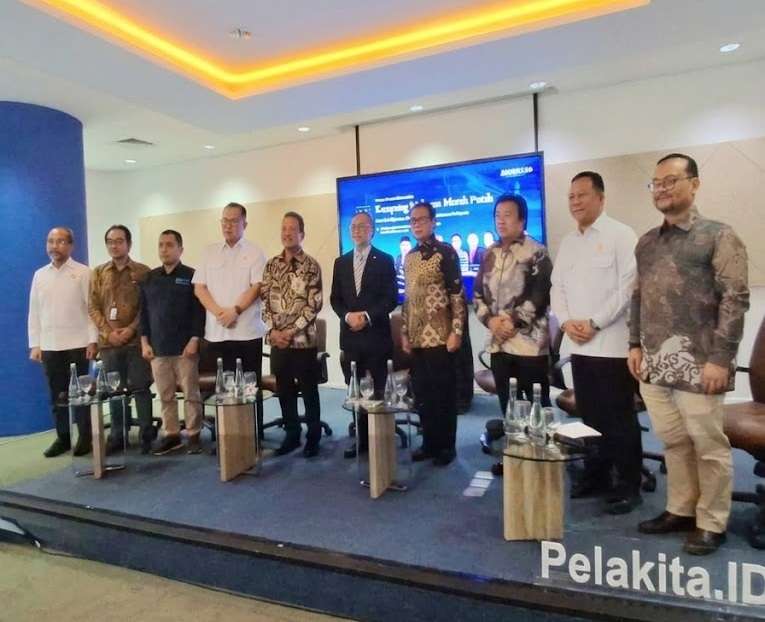
To scale the KNMP model across thousands of villages without administrative guesswork or misallocated civil works, KKP established the KNMP 2027 Task Force. Led by Task Force Chair Mohammad Abdi Suhufan (Senior Expert to Minister Trenggono) alongside KKP Fisher Protection and Empowerment leadership (Dr. Ady Candra and Dr. Ilham), the initiative enforces rigorous, evidence-based planning.
Recent real-time evaluations across active KKP dashboards revealed that physical construction progress across initial development sites stood at approximately 15 percent.
This baseline metric highlighted an urgent operational mandate: accelerating site readiness, technical designs, and land verification so that tangible development progress can be formally presented during President Prabowo Subianto’s annual address before the People’s Consultative Assembly (MPR) in 2027.
Training of Trainers (ToT)
In October 2026, KKP conducted an intensive four-day Training of Trainers (ToT) program in Jakarta. The initiative trained 62 Task Force members representing seven strategic maritime regions. Facilitated by technical policy experts including Dr. Irwan Muliawan and Dr. Maulana Firdaus (from BRSDM KP / BPPSDMKP KKP), alongside senior experts Baso Syaifuddin, Hartono, Kamaruddin Azis, and Dr. Simon Boyke Sinaga, the ToT established a standardized methodology for field evaluation, evidence verification, scoring, and data quality control.
University & NGO Partnerships
To eliminate reliance on subjective paper proposals submitted by local governments, KKP partnered with universities, non-governmental organizations (NGOs), and field facilitators. Field evaluation teams execute direct field observations, structured interviews with fishers, and Focus Group Discussions (FGDs) to construct accurate site profiles.
The 5-Stage Blueprint from Infrastructure to Market Integration
- Infrastructure Development: Constructing customized physical assets engineered specifically for efficient post-harvest handling, cold storage, landing logistics, and fuel distribution tailored to local production volumes.
- Community Capacity Building: Executing technical training, managerial mentoring, and entrepreneurship programs to equip local residents with the skills required to run commercial facilities.
- Institutional Strengthening: Formalizing and scaling local cooperatives or village-owned enterprises (BUMDes) to serve as primary operational vehicles managing shared economic units and joint enterprises.
- Market Connection: Implementing supply chain disintermediation to shorten distribution channels, linking primary producers directly with commercial off-takers and export networks to retain higher profit margins locally.
- Operational Sustainability: Establishing decentralized management protocols, maintenance structures, and transparent governance to guarantee long-term asset stewardship and continuous commercial viability.
The Task Force operates under a firm milestone: completing all Detailed Engineering Designs (DED) and Cost Estimates (Rencana Anggaran Biaya/RAB) for 1,000 validated sites no later than December 31, 2026.
Methodological Framework: Eligibility, Scoring, and Quality Control
The core of the KNMP 2027 evaluation framework is a strict separation between fundamental eligibility qualification and quantitative scoring. Before a site receives numerical scoring across assessment dimensions, it must pass six mandatory eligibility requirements, designated K1 through K6.
The K1–K6 Mandatory Eligibility Criteria
| Criterion | Dimension | Mandatory Standard & Verification Requirement | Status Classification |
| K1 | Livelihood Verification | Local economy must genuinely depend on marine/fisheries activities. Cross-checks official KUSUKA database against field realities and mandates data deduplication across subsectors. | Memenuhi (M) / Tidak Memenuhi (TM) |
| K2 | Institutional Operation | Economic entities (Cooperatives/BUMDes) must be actively operating, not merely legally registered. Requires proof of active transactions, membership logs, and regular Annual Members Meeting (Rapat Anggota Tahunan/RAT) minutes. | Memenuhi (M) / Tidak Memenuhi (TM) |
| K3 | Land Security | Land must be legally clear, unencumbered by disputes, compliant with spatial plans, and available. Must be verified through geotagged photos with embedded geographic coordinates. | Memenuhi (M) / Tidak Memenuhi (TM) |
| K4 | Essential Infrastructure | Site must possess uninterrupted, 12-month access to clean water, electricity, and fuel (BBM/SPBN). Must factor in travel distances and seasonal dry-season shortages. | Memenuhi (M) / Tidak Memenuhi (TM) |
| K5 | Economic Baseline | Realized production and raw material availability in capture fisheries, aquaculture, or processing must be documented through direct field observation of landing sites. | Memenuhi (M) / Tidak Memenuhi (TM) |
| K6 | Stakeholder Commitment | Verified local government commitment (work plans, dedicated local budget allocations) and documented community buy-in gathered via structured interviews. | Memenuhi (M) / Tidak Memenuhi (TM) |
Field Verification Status Rules: Assessors may temporarily assign a Butuh Data Verifikasi (BDV) status during initial site surveys if documentation is pending.
However, BDV is strictly a temporary classification; every outstanding BDV flag must be formally converted to Memenuhi (M) or Tidak Memenuhi (TM) prior to final submission. An unresolved failure under criterion K6 (local government and community commitment) results in absolute disqualification.
Evidence Ceiling Scoring Protocol (Scores 3–5)
To prevent inflated assessments driven by local optimism, the evaluation framework applies the Evidence Ceiling (Batas Bukti) principle, presented during the ToT by facilitators Baso Syaifuddin, Dr. Irwan Muliawan, and Dr. Maulana Firdaus:
- Score 5 (Maximum Score): Reserved exclusively for indicators supported by multi-source, triangulated primary evidence. Requires official legal documentation, geotagged coordinate-stamped photos, and direct physical field observation that corroborate one another.
- Score 4: Applied when primary physical evidence is sufficient and cross-verified, but minor gaps remain in supplementary secondary documentation.
- Score 3 (Evidence Ceiling Cap): The maximum allowable score whenever an assessment relies strictly on interview testimony, stakeholder statements, or single-source opinion without physical documentation or independent verification.
Triangulation Protocol for Conflicting Information
When field claims contradict administrative records (e.g., a village head claiming year-round clean water access while local fishers report severe dry-season shortages), assessors must execute a mandatory 4-step triangulation protocol established by Dr. Irwan Muliawan and Baso Syaifuddin:
- Withhold Score: The numerical score is immediately withheld while the discrepancy remains unresolved.
- Document Claims: Record the conflicting statements in detail, identifying sources and context.
- Independent Field Verification: Conduct physical field inspections, review technical records, or audit administrative data.
- Final Scoring: Assign the final numerical score based strictly on verified physical facts.
Digital Synchronization via KoBoToolbox
Assessors enter field data, upload geotagged media, and log interviews using the mobile KoBoToolbox / KoBoToolbox Collect application for real-time synchronization. Before final data submission, teams conduct a mandatory pre-submission review to verify that no unresolved BDV entries remain, score writeups match assigned numbers, photos contain verified coordinate metadata, and all Score 5 entries meet the multi-source triangulation standard.
Challenges, Conservation, and Actionable Steps for 2027
Translating an ambitious national blueprint into functional coastal enterprises presents several operational, financial, and environmental challenges.
Implementation Challenges
- Logistical Access: Reaching remote small-island locations introduces material transport delays and local price variations during construction.
- Fuel Subsidies & Energy Transition: Fleet fuel consumption represents a massive financial commitment, with national fuel subsidies for fishing vessels totaling approximately Rp15.5 trillion. While KKP is researching hybrid propulsion technology to curb fuel demand, field adoption must explicitly address operational vessel safety at sea, battery maintenance lifecycles in saltwater environments, and dockside charging infrastructure readiness.
- Land Grants & Inter-Agency Coordination: Securing clear land titles requires prolonged coordination across the Ministry of Agrarian Affairs and Spatial Planning/National Land Agency (ATR/BPN), state electricity provider PLN, and Pertamina Patra Niaga.
Environmental Safeguards & Resource Management
Increasing post-harvest handling capacity must not lead to overfishing. Higher productivity must operate within ecological limits to protect marine resources from depletion:
- Measured Fish Capture (Penangkapan Ikan Terukur): Enforces localized catch limits aligned with oceanographic stock assessments to ensure catch volume matches sustainable biological thresholds.
- Vessel Monitoring Systems (VMS): Mandates technological tracking of participating fishing vessels to monitor location, maintain regulatory compliance, combat illegal fishing, and enhance crew safety at sea.
- Marine Conservation Areas: Integrates village operations with designated marine protected areas to safeguard critical ocean habitats and maintain long-term fish stock regeneration.
Actionable Priorities for 2027 Execution
To ensure program performance and institutional accountability, KKP’s Task Force and local execution partners must maintain focused progress across three key areas:
Institutional Priorities:
Enforce absolute financial and operational transparency within managing cooperatives to ensure dividend distributions return directly to fisher households. Prevent asset abandonment by requiring binding operational management protocols before ribbon-cutting ceremonies occur.
Maintain active cross-agency coordination between KKP, the Ministry of Cooperatives, the Ministry of Finance, ATR/BPN, PLN, and Pertamina Patra Niaga.
Environmental Priorities:
Mandate real-time VMS compliance across all participating vessel fleets within KNMP locations. Align site processing capacities directly with Measured Fish Capture (Penangkapan Ikan Terukur) biological quotas. Enforce strict marine spatial planning compliance to prevent dockside construction encroachment on marine conservation zones.
Logistical Priorities:
Complete Detailed Engineering Designs (DED) and Cost Estimates (RAB) for all 1,000 target sites no later than December 31, 2026. Design site infrastructure tailored to localized production volumes rather than standardized building templates. Establish localized fuel (SPBN) and clean water supply chains equipped for severe weather and seasonal dry-period shortages.
The Future of Indonesia’s Coastal Enterprise
Indonesia’s Kampung Nelayan Merah Putih program demonstrates that lasting coastal development requires moving beyond isolated equipment handouts. Real economic development begins with an honest, evidence-based understanding of the coast and the people who depend on it.
By integrating customized physical infrastructure, formal cooperative governance, digital field evaluation, and direct market connections, the KNMP initiative offers a practical blueprint for rural economic resilience. When public planning is guided by verified data rather than unverified assumptions, coastal investments build long-term economic capability.
As the program scales toward its target of 5,000 villages, it offers the potential to transform traditional fishing communities into self-reliant centers of coastal enterprise—securing national food protein, protecting marine sovereignty, and building lasting wealth for Indonesia’s fishing families.
“True development success is defined by what happens long after project infrastructure is handed over: whether public facilities remain fully functional, institutional management stays transparent, and economic value continues to cycle within the local community.”