
By Kamaruddin Azis | The Maritime Posts
The sea has always carried two faces for Indonesia.
MARITIMEPOSTS.COM – On the surface, it is a symbol of abundance — a vast maritime frontier supplying tuna, squid, and pelagic fish to domestic and international markets.
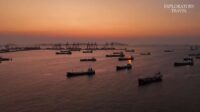
Government officials speak proudly about blue economy ambitions, export growth, and the modernization of fisheries infrastructure. Ports in Jakarta, Tegal, Pati, Indramayu, and Benoa bustle with industrial vessels unloading catches worth billions of rupiah.
But beneath that spectacle lies another reality — one rarely documented in official statistics.
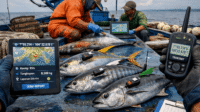
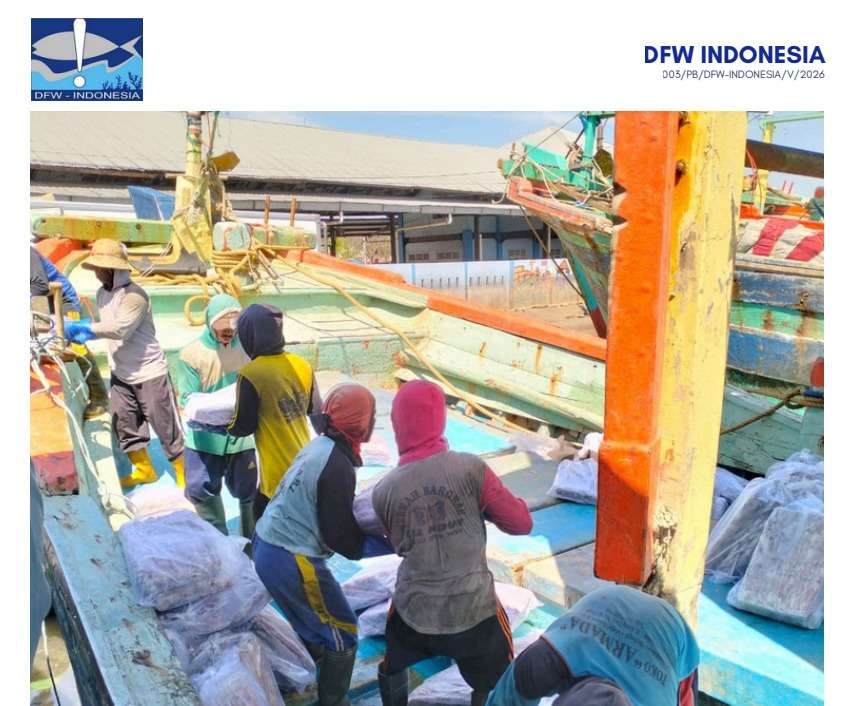
It is the reality of workers who spend six to eight months at sea, surviving storms, exhaustion, machinery accidents, sleep deprivation, and isolation, only to return home with wages so small they barely cover transportation costs back to their villages.
Some return not with salaries, but with debt.
Field investigations conducted between 2024 and 2025 across several major fishing ports reveal what labor advocates increasingly describe as a systemic pattern of wage theft inside Indonesia’s industrial fishing sector.
The findings expose a deeply unequal structure in which vessel owners accumulate enormous profits while lower-level Anak Buah Kapal (ABK) absorb operational risks, maintenance burdens, and even corporate losses.
In Benoa, Bali, for instance, average take-home earnings for many crew members stand at roughly Rp 900,000 per month — far below any provincial minimum wage in Indonesia. In more extreme cases, workers reported receiving only Rp 500,000 after six months at sea, reducing their labor value to less than Rp 3,000 per day.
For a nation that calls itself a maritime power, the numbers are staggering. Yet the exploitation does not occur through a single dramatic act. It is embedded in systems, normalized through culture, and disguised through contractual ambiguity.
The theft is structural. One case documented during the research illustrates the imbalance with brutal clarity.
A purse seine vessel — identified anonymously as Kapal X — completed an eight-month fishing trip generating more than Rp 6 billion in gross revenue. On paper, such a voyage appears extraordinarily profitable.
But once the vessel returned to port, a long chain of deductions emerged.
Operational costs were subtracted before profit-sharing calculations. More than Rp 150 million was charged for repairs. Another Rp 100 million disappeared into engine component replacements. Docking fees, repainting, spare parts, and numerous undefined expenditures followed.
The final result was devastating for the crew.
Average ABK earnings amounted to only around Rp 1.5 million per month — below the 2025 minimum wage standard in Central Java despite the dangerous nature of their labor and the immense value they helped produce.
One crew member described the experience with visible frustration:
“We never know how much our wages really are. How can we return from eight months of work with only five million rupiah? Expenses were cut by almost half a billion for things we don’t know and have nothing to do with us.”
The testimony captures a central problem in Indonesia’s industrial fisheries: workers are trapped inside opaque accounting systems controlled entirely by vessel owners.
There is no transparency.
No independent auditing.
No equal bargaining position.
And often, no written understanding workers can realistically challenge.
The Four Engines of Wage Theft
Investigators identified at least four recurring mechanisms through which wages are systematically eroded.
Under Indonesia’s traditional profit-sharing model, crew members are supposed to receive a portion of fishing revenue after operational costs are deducted.
In practice, however, vessel owners frequently redefine what counts as “operational.”
Engine repairs, vessel repainting, docking maintenance, spare parts, and capital investments are often included as shared costs. These are not ordinary operational expenses; they are owner responsibilities tied to asset maintenance.
Yet workers effectively subsidize them.
This system — described by researchers as netto semu or “pseudo-net accounting” — allows owners to legally camouflage the transfer of capital burdens onto labor.
The implications are profound.
A worker who has no ownership stake in the vessel is nevertheless forced to finance the vessel’s long-term upkeep through wage deductions.
The more damaged or inefficient the vessel becomes, the more workers lose.
In many industrial fleets, ABK are not protected by fixed salaries.
If fishing trips fail, workers may receive nothing beyond a symbolic transportation allowance known locally as uang nyacar or mbecak. In other words, months of labor can end without meaningful compensation simply because catches were poor or fuel costs were high.
This arrangement transfers business risk almost entirely onto laborers.
In conventional industries, workers are paid regardless of whether a company achieves profit targets. But in sections of Indonesia’s fishing sector, labor itself becomes speculative.
Workers gamble their bodies against the ocean with no guaranteed wage floor.
Life at sea creates dependence.
Crew members cannot access markets, stores, or alternative suppliers during long voyages. Owners exploit this isolation through onboard monopolies commonly known among workers as kasbon grosir systems.
Coffee, cigarettes, instant noodles, sugar, snacks, and toiletries are sold onboard at inflated prices. Purchases are deducted directly from eventual wages.
The mechanism is psychologically devastating because it monetizes fatigue itself.
Workers performing exhausting labor for months are forced to purchase the very items needed to maintain stamina and morale. Even rest becomes commercialized.
One labor organizer described it bluntly:
“The sea becomes a closed economic prison. Workers earn money from the owner, spend money back to the owner, and return home still indebted to the owner.”
Debt Bondage Through Tendoan
Perhaps the most dangerous mechanism is tendoan — the rolling over of debt from one voyage into another.
If a trip fails, operational losses may be transferred to workers. If crew members borrow money for family emergencies, recruitment costs, or onboard consumption, those debts follow them into subsequent contracts.
The cycle becomes nearly impossible to escape.
One union member interviewed during the research reported carrying Rp 250 million in accumulated debt from two unsuccessful voyages. The debt had been imposed unilaterally yet was treated as “normal practice” within the fleet.
The effect mirrors debt bondage systems historically associated with forced labor.
Workers cannot leave because departure means unpaid obligations.
And the debt itself is controlled by the same actors who control employment.
The crisis extends beyond the vessels themselves.
Low wages at sea create hidden labor burdens onshore, especially for women.
Across fishing communities, wives of ABK increasingly sustain household survival through informal work: peeling shellfish, washing clothes, agricultural labor, food vending, and temporary domestic services.
Their unpaid or underpaid labor effectively subsidizes the industrial fishing economy.
Without these survival mechanisms, many fishing households would collapse entirely during long voyages.
This reality reveals an uncomfortable truth:
Indonesia’s industrial fisheries are not merely extracting marine resources. They are extracting resilience from poor coastal families.
Why Young People No Longer Want the Sea
The consequences are now visible in labor recruitment patterns.
Traditional fishing communities are experiencing declining interest in industrial sea work. Younger generations increasingly reject employment conditions marked by danger, uncertainty, and exploitative pay systems.
In response, vessel owners are recruiting workers from farming and construction backgrounds — people with limited maritime experience but high economic vulnerability.
Researchers describe this phenomenon as the “importation of vulnerability.”
The industry no longer attracts experienced seafarers through dignity or opportunity. Instead, it absorbs economically desperate labor with minimal bargaining power.
One of the most powerful narratives sustaining the system is the claim that ABK are “partners,” not employees.
Owners frequently use this language to avoid obligations tied to minimum wage protections, overtime standards, and labor guarantees.
But the relationship is deeply asymmetrical.
Owners determine routes, prices, contracts, supplies, discipline, deductions, and dismissals. Workers possess little real negotiating authority and can be removed at any time.
The language of partnership masks a structure of dependency.
It allows industrial fleets to avoid modern labor accountability while preserving feudal-style control.
Regulatory Gaps and the Limits of Reform
Indonesia has introduced new regulations intended to improve labor protections, including Permen KP 04/2026.
However, labor advocates warn that loopholes remain substantial.
Certain provisions still allow operational cost-sharing “based on agreement.” In practice, such clauses enable owners to continue imposing tendoan systems and other deductions under the appearance of consent.
But consent inside unequal power structures is often coercive. A worker desperate for employment has limited capacity to reject exploitative terms. Without enforcement, regulation becomes symbolic.
The Six Structural Reforms Proposed
Researchers and labor advocates are calling for urgent interventions from the Ministry of Manpower and the Ministry of Marine Affairs and Fisheries.
Among the key recommendations are:
Establishing a “Negative List” of Costs
Repairs, docking, insurance, repainting, and capital maintenance should legally remain the sole responsibility of vessel owners and must never reduce crew wages.
Implementing Hybrid Wage Systems
Workers should receive guaranteed fixed salaries — recommended at 75 percent of regional minimum wage — combined with productivity bonuses tied to catch performance.
Ending Debt Bondage
The tendoan system must be banned entirely alongside the implementation of zero-cost recruitment practices.
Free Recovery Rations
Basic items such as coffee, sugar, and essential stamina supplies should be classified as occupational safety provisions rather than commodities sold for profit onboard.
Democratizing Fish Price Data
Ports and auction authorities should provide official catch-price records directly to worker representatives to prevent unilateral price manipulation.
Joint State Inspections
Integrated inspections between labor authorities and fisheries regulators should audit payroll systems, onboard stores, and contractual arrangements. Serious violations should result in withheld sailing permits or frozen business licenses.
The Sea Cannot Remain Lawless
For decades, Indonesia’s industrial fishing economy has been evaluated primarily through production metrics: tonnage landed, export growth, vessel numbers, and foreign exchange earnings.
But the investigation reveals another measurement that matters just as much:
How much human suffering is embedded inside every kilogram of fish?
The workers at the center of this system are not asking for luxury. Most are demanding something more basic — transparency, fair wages, and freedom from debt traps disguised as employment.
Indonesia’s maritime future cannot be built solely through larger fleets and rising exports while the labor powering the industry remains trapped in exploitation.
Because when billion-rupiah voyages still produce poverty among the crews who make them possible, the problem is no longer inefficiency.
It is injustice. And injustice, left unchallenged at sea, eventually reaches the shore.
Editorial Team