
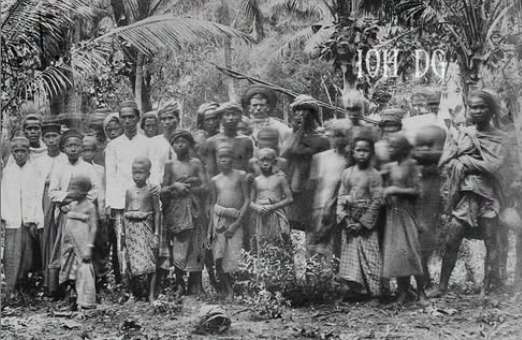
MARITIMEPOSTS.COM – PANGKEP, SOUTH SULAWESI — More than a century ago, a photographer captured a remarkable moment in the life of the people of Sarappo Lompo Island, one of the inhabited islands in the Spermonde Archipelago off the west coast of South Sulawesi.
Preserved today in the archives of the KITLV (Royal Netherlands Institute of Southeast Asian and Caribbean Studies) under catalog number KITLV25875, the photograph dates back to approximately 1901 and bears the Dutch title Bewoners van het eiland Sarrepo, Spermonde Archipel, Zuid-Celebes (“Residents of Sarrepo Island, Spermonde Archipelago, South Celebes”).
The image offers more than a historical portrait. It is a visual record of an island community whose identity has long been intertwined with the sea. Long before modern infrastructure connected Indonesia’s islands, the people of Sarappo Lompo had already developed a maritime way of life centered on fishing, inter-island trade, boatbuilding, and close-knit communal traditions.
Located within today’s Pangkajene and Islands (Pangkep) Regency, the Spermonde Archipelago consists of more than one hundred coral islands scattered across the Makassar Strait. For centuries, these islands have served as important nodes linking coastal communities of South Sulawesi with regional trading networks stretching across eastern Indonesia.
At the turn of the twentieth century, when this photograph was taken, South Sulawesi was part of the Dutch East Indies. Colonial photographers frequently documented landscapes and indigenous communities for scientific, ethnographic, and administrative purposes. While many such photographs reflected the colonial gaze, they have since become invaluable historical records that help contemporary researchers reconstruct the social and cultural history of Indonesia’s coastal societies.
The residents depicted in the photograph likely belonged to maritime communities whose livelihoods depended almost entirely on marine resources. Fishing using traditional gear, sailing between neighboring islands, collecting sea products, and maintaining extensive kinship networks were integral parts of everyday life. These practices continue to characterize many communities across the Spermonde Archipelago, although they have evolved alongside technological and economic changes.
Sarappo Lompo itself remains one of the inhabited islands in the archipelago, where maritime culture continues to shape local identity. Despite increasing connectivity and modernization, many families still rely on fishing and other marine-based occupations, preserving knowledge that has been passed down through generations.
For historians and anthropologists, photographs such as KITLV25875 are more than archival artifacts. They provide visual evidence of clothing styles, settlement patterns, social organization, and material culture that written documents often overlook. Combined with oral histories and local traditions, these images enrich our understanding of how island communities adapted to environmental, economic, and political changes over time.
Today, as Indonesia places renewed emphasis on its identity as a maritime nation, historical photographs from places like Sarappo Lompo remind us that the country’s relationship with the sea is deeply rooted. They reveal that long before contemporary discussions about the blue economy, marine conservation, and sustainable fisheries, coastal communities had already built sophisticated systems of knowledge and resilience based on the rhythms of the ocean.
More than 120 years after it was taken, the portrait of the people of Sarappo Lompo stands as a powerful testament to the enduring heritage of the Spermonde Archipelago—a maritime civilization whose legacy continues to shape the cultural landscape of South Sulawesi and Indonesia as a whole.