
MARITIMEPOSTS.COM — The East Nusa Tenggara (NTT) Provincial Government, together with the governments of Sabu Raijua and Rote Ndao regencies, has begun initiating the establishment of district-level Climate Change Working Groups (Pokja).
The initiative aims to strengthen cross-sectoral coordination and integrate climate change adaptation measures into regional development planning.
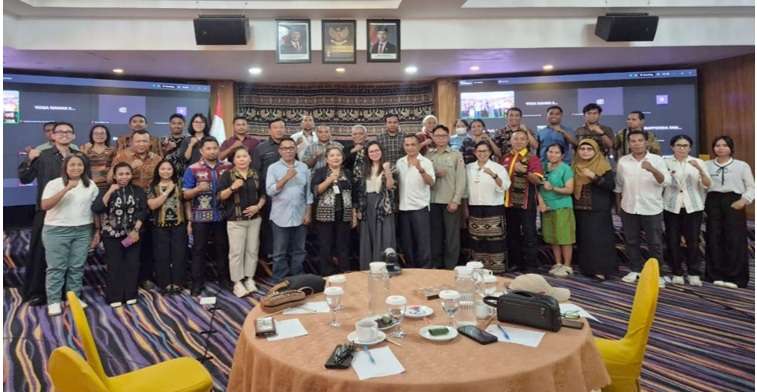
The initiative was discussed during the Initiation Workshop for Climate Change Working Groups in Sabu Raijua and Rote Ndao, held in Kupang on Thursday, October 15, 2026. The workshop was organized through collaboration between the NTT Provincial Government, the Yayasan Konservasi Alam Nusantara (YKAN), and Yayasan PIKUL. Participants included representatives from provincial and district governments, the NTT Provincial Climate Change Working Group, and development partners.
Representatives from Ende and North Central Timor (Timor Tengah Utara/TTU) regencies also joined the workshop online to learn about the process of establishing the working groups. The experience is expected to provide valuable lessons for developing similar initiatives in both regencies.
As island regions dominated by small islands, Sabu Raijua and Rote Ndao face climate change risks affecting water availability, food security, public health, ecosystems, and community livelihoods.
According to an analysis conducted under the Regional Climate Change Adaptation Action Plan (RAD-API) for East Nusa Tenggara Province, Sabu Raijua faces high risks in the energy, food, and water sectors. Meanwhile, Rote Ndao is vulnerable to climate impacts affecting health, food security, and ecosystems.
Theresia M. Florensia, Head of the Regional Development Planning, Research, and Innovation Agency (Bapperida) of East Nusa Tenggara Province, emphasized that climate change is a cross-sectoral issue requiring coordination and collaboration among stakeholders.
“The Climate Change Working Group is essential for formulating evidence-based adaptation measures that reflect each region’s characteristics and risk profile and are integrated into development planning,” she explained.
The East Nusa Tenggara Provincial Government has established the Provincial Climate Change Adaptation Action Plan (RAD-API) for 2025–2045 through East Nusa Tenggara Governor’s Decree No. 124/KEP/HK/2026. The establishment of district-level working groups is expected to help translate this policy into programs tailored to local needs and conditions.
The working groups will serve as coordination platforms for regional government agencies and partners to align climate risk data, establish action priorities, strengthen planning and budgeting, and monitor adaptation implementation.
Strengthening these institutions is also expected to support the development of district-level climate change adaptation action plans and the integration of adaptation priorities into development planning documents, including the Regional Medium-Term Development Plan (RPJMD) and the Regional Government Work Plan (RKPD).
During the workshop, participants discussed the climate conditions and risks facing each regency, existing policies, and the stakeholders who should be involved.
Discussions also focused on agreeing on roles, identifying coordination needs, and developing roadmaps for establishing the working groups in Sabu Raijua and Rote Ndao.
Zadrakh Mengge, Community Resilience Manager at Yayasan PIKUL, which supports climate change adaptation efforts in several regencies across East Nusa Tenggara, highlighted the importance of the Climate Change Working Groups.
“We hope the Climate Change Working Groups will provide a collaborative space to formulate adaptation measures that address community needs, particularly those of vulnerable groups such as farmers and fishers,” he said.
Integrating Climate Adaptation into Development
Imam Fauzi, Head of the Kupang Marine Resources Management Office, also stressed the importance of linking climate change adaptation with marine and coastal resource management, given the dependence of small-island communities on natural resources.
“Climate change presents challenges for managing coastal areas and small islands. Therefore, adaptation efforts must be carried out in an integrated manner, involving local governments, communities, and partners. Sustainable coastal ecosystem management is essential for safeguarding natural resources while strengthening community resilience to the impacts of climate change,” he said.
Climate change impacts are already being felt directly by communities, ranging from difficulties accessing clean water to increasingly unpredictable planting seasons and changing marine conditions that affect livelihoods.
Strengthening policies and institutions must therefore go hand in hand with efforts to address the needs of communities most vulnerable to climate impacts.
Mariski Nirwan, Senior Coastal Resilience Manager at YKAN, said climate change adaptation must become an integral part of regional development agendas, including efforts to incorporate environmental considerations.
“When nature is protected, it can also protect us and help reduce disaster risks,” she said.
“Adaptation efforts require policies grounded in data and local knowledge while taking into account the needs of communities facing the greatest risks,” she added.
Together with its partners, YKAN has supported participatory climate vulnerability assessments at the village level and various community-based adaptation initiatives in Sabu Raijua and Rote Ndao regencies.
This approach also considers the role of ecosystems in reducing climate risks, ensuring that the solutions implemented do not inadvertently create new vulnerabilities in the future.
The workshop will be followed by a series of activities, including stakeholder mapping, agreement on roles and responsibilities, development of roadmaps for establishing the working groups, and efforts to strengthen the integration of climate change adaptation into regional development planning documents.
Through this process, local governments, communities, and partners are expected to develop more targeted adaptation measures suited to local conditions, strengthen community resilience, and safeguard the sustainability of natural resources amid increasing climate change risks.