
Indonesia’s decision to focus on five champion aquaculture commodities ultimately reflects a pragmatic question: where can the country build competitive advantage in an increasingly demanding global seafood economy? The answer identified by KKP is shrimp, tilapia, crab and swimming crab, seaweed, and lobster. Each carries a different combination of market opportunity, production potential, technological requirements and environmental considerations.
MARITIMEPOSTS.COM — Indonesia has no shortage of aquatic resources, but abundant natural resources do not automatically translate into strong economic value. The strategic question for the country’s aquaculture sector is increasingly about which commodities can combine market demand, production potential, competitiveness, and opportunities for value addition.
That question lies behind the Ministry of Marine Affairs and Fisheries’ (KKP) strategy to develop five “Champion Commodities” in aquaculture: shrimp, tilapia, crab and swimming crab, seaweed, and lobster.
The selection reflects a broader attempt to concentrate policy attention and investment on commodities with substantial international market value, opportunities to expand Indonesia’s global market share, and demonstrated or emerging comparative advantages.
The strategy is therefore not simply about producing more fish and other aquatic commodities. It is about determining where Indonesia can compete, where production can be scaled responsibly, and where greater value can be retained within the domestic economy.
Shrimp: The Export Anchor
Shrimp occupies a central position in Indonesia’s fisheries export strategy because of the enormous size of its global market.
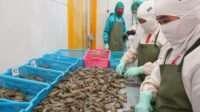
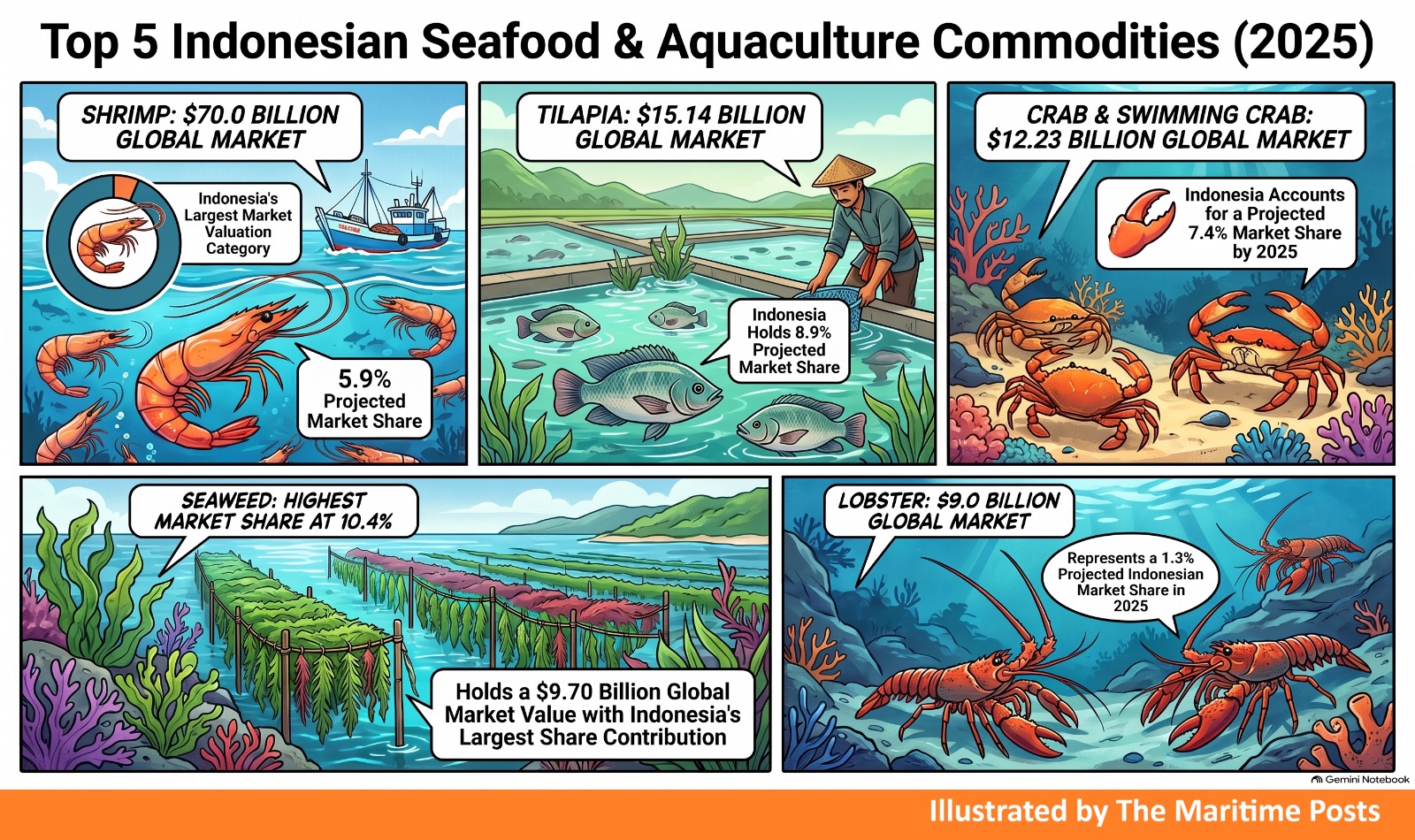
The global shrimp market is estimated at around US$70 billion, while Indonesia currently accounts for approximately 5.9 percent of global market share. These figures make shrimp an important anchor commodity for expanding export earnings and strengthening Indonesia’s position in international seafood markets.
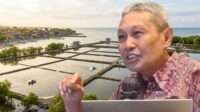
KKP’s strategy places emphasis on modern and integrated shrimp-farming models designed to improve productivity per hectare while strengthening biosecurity, environmental management, production efficiency, and traceability.
The objective extends beyond increasing pond production. Indonesia competes with major shrimp-producing countries, while buyers in markets such as the United States, Japan, China and other destinations increasingly demand consistent quality, food safety, traceability and reliable supply.
For Indonesia, the challenge is therefore twofold: producing competitively while meeting increasingly demanding international standards.
If that balance can be achieved, shrimp has the potential to serve as a major gateway between Indonesian aquaculture and global seafood markets.
Tilapia: From Domestic Protein to Global Product
Tilapia represents a different but complementary opportunity.
With a global market estimated at US$15.14 billion and Indonesia accounting for approximately 8.9 percent of global market share, tilapia combines domestic food-security relevance with export potential.
Unlike several marine commodities, tilapia can be produced across a broad range of inland aquaculture environments. Its relatively accessible production technology and established consumer demand have made it an important source of affordable animal protein.
Its international potential is increasingly associated with processed products, particularly frozen fillets.
This matters because the economic value of aquaculture is not determined only by how many tonnes of fish are harvested. Processing can transform a relatively undifferentiated commodity into a product that meets specific consumer preferences and generates greater value along the supply chain.
For Indonesia, strengthening tilapia production therefore involves more than expanding ponds and cages. It also requires improving genetics, feed efficiency, farming practices, cold-chain systems, processing capacity and access to international markets.
Crab and Swimming Crab: Value Meets Conservation
Crab and swimming crab occupy a distinctive position among the five commodities because their economic value is closely connected to the condition of coastal ecosystems and the sustainability of supply.
The global market is estimated at approximately US$12.23 billion, while Indonesia holds around 7.4 percent of global market share.
These commodities are highly valued in international seafood markets, but dependence on wild capture creates a fundamental challenge: increasing demand can place additional pressure on natural populations if production is not supported by effective management.
KKP’s emphasis on aquaculture and area-based crab development is therefore linked to a broader objective of reducing dependence on wild stocks while creating more predictable supply for processing industries.
The strategy also creates an important connection between aquaculture policy and coastal conservation.
For crab and swimming crab, economic development cannot be separated from mangroves, estuaries, seagrass areas and other coastal habitats that support aquatic life. Protecting the ecological foundations of production becomes part of protecting the commodity itself.
Seaweed: A Commodity Beyond Food
Seaweed may be the most versatile of the five commodities.
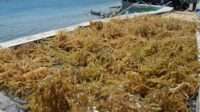
With a global market estimated at around US$9.70 billion and Indonesia accounting for approximately 10.4 percent of global market share, seaweed offers Indonesia an opportunity to participate in multiple industries beyond conventional seafood.
Seaweed can serve as a raw material for food products, cosmetics, pharmaceuticals, animal feed and various industrial applications, including emerging biomaterials.
Its significance also lies in its production characteristics. Seaweed farming is widely practiced by coastal households and can provide livelihood opportunities without the same capital requirements associated with more intensive aquaculture systems.
This makes seaweed particularly relevant to the broader blue-economy agenda.
Yet the challenge is familiar: production volume alone does not necessarily create high economic value.
Indonesia remains challenged to move further into processing, product development and industrial applications so that the country is not primarily positioned as a supplier of raw materials.
The strategic opportunity is therefore to move from seaweed cultivation toward a stronger seaweed-based industrial ecosystem.
Lobster: The Largest Space for Expansion?
Lobster represents perhaps the most distinctive growth opportunity among the five commodities.
The global lobster market is estimated at approximately US$9 billion, while Indonesia currently accounts for only around 1.3 percent of global market share.
That relatively small share indicates substantial room for expansion, although realizing that potential requires technological, regulatory and ecological safeguards.
Indonesia possesses significant natural potential for lobster production, but its historical position in the global lobster trade has also involved the export of wild-caught lobster seed, commonly known as benih bening lobster (BBL).
The strategic direction promoted by KKP seeks to strengthen domestic lobster grow-out and aquaculture so that greater economic value can be generated within Indonesia rather than relying primarily on the export of early-stage biological resources.
The transition is technically demanding. Lobster aquaculture requires suitable technology, feed, water-quality management, disease control, appropriate sites and strong regulatory oversight.
Its development therefore represents more than a commodity expansion strategy. It is an attempt to build domestic technological and production capacity around a high-value marine species.
Why Five Commodities?
Taken individually, the five commodities are very different.
Shrimp is strongly export-oriented and operates in a highly competitive global market. Tilapia combines domestic food security with international demand. Crab and swimming crab connect high-value seafood markets with conservation concerns. Seaweed links coastal livelihoods to food and emerging industrial applications. Lobster offers significant growth potential but requires greater technological and regulatory capacity.
Their common denominator is value-chain potential.
The strategy suggests that Indonesia is seeking to concentrate resources where improvements in production, technology, processing, logistics and market access can generate broader economic effects.
That means the real target is not simply aquaculture production.
It is the aquaculture value chain.
From Production to Value Creation
This distinction is important for Indonesia because increasing production without strengthening downstream industries can leave producers vulnerable to price fluctuations and limit the amount of economic value captured domestically.
A stronger aquaculture strategy therefore requires coordination across several layers: seed and broodstock quality, feed, farming technology, biosecurity, environmental management, cold chains, processing, certification, logistics, finance and market intelligence.
The five champion commodities can become strategic platforms for developing those capabilities. Their success, however, will depend on how effectively national policy is translated into local production systems.
Aquaculture ultimately happens in ponds, cages, coastal waters and farming communities. It depends on farmers, coastal households, workers, processors, traders, researchers, local governments and businesses whose interests and capacities may differ.
The challenge for policymakers is therefore to connect global market ambition with local production realities.
The Blue Economy Test
There is also a larger environmental question. Indonesia cannot build a globally competitive aquaculture sector by treating ecosystems as an unlimited production space.
Shrimp ponds require water and coastal management. Crab production depends on healthy coastal habitats. Seaweed cultivation depends on suitable marine environments. Lobster development requires ecological safeguards. Even freshwater tilapia production must address water quality, feed efficiency and carrying capacity.
This is where the idea of a blue economy becomes more than a slogan. A genuinely sustainable aquaculture strategy has to create economic value while maintaining the ecological systems upon which that value depends.
For coastal communities, this means that the success of the five commodities should not be measured only in export dollars or production tonnage. It should also be considered in terms of jobs, household income, local enterprises, resource sustainability and the resilience of coastal livelihoods.
Five Commodities, One Strategic Question
Indonesia’s decision to focus on five champion aquaculture commodities ultimately reflects a pragmatic question: where can the country build competitive advantage in an increasingly demanding global seafood economy?
The answer identified by KKP is shrimp, tilapia, crab and swimming crab, seaweed, and lobster. Each carries a different combination of market opportunity, production potential, technological requirements and environmental considerations.
The difficult work begins after the commodities have been selected.
Indonesia must build the systems that allow farmers and coastal communities to produce consistently, meet market standards, access technology and finance, process more products domestically, and participate more meaningfully in the value generated by global demand.
If those connections can be strengthened, the five commodities could become more than export products.
They could become anchors for a broader transformation of Indonesia’s aquaculture economy—from resource production toward value creation, from fragmented farming toward integrated value chains, and from short-term output toward long-term blue-economy resilience.
Written by Kamaruddin Azis, founder of maritimeposts.com