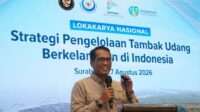

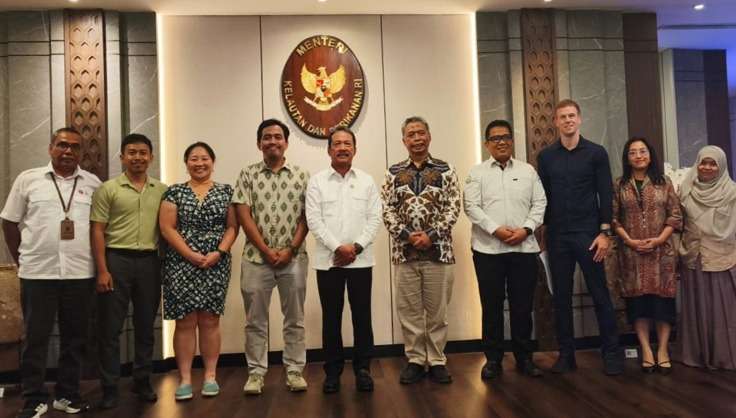
MARITIMEPOSTS.COM – The Research and Innovation for an Advanced Indonesia (RIIM)-KONEKSI Consortium has submitted and presented a policy brief titled “Mainstreaming the Sustainable Aquaculture Framework (SAF) to Support the Implementation of Indonesia’s Blue Economy” to Indonesia’s Minister of Marine Affairs and Fisheries, Sakti Wahyu Trenggono, in Jakarta on July 28, 2026.
The policy brief was jointly developed by the Bandung Institute of Technology (ITB), Monash University, the National Research and Innovation Agency (BRIN), and Yayasan Konservasi Alam Nusantara (YKAN) through the RIIM-KONEKSI partnership, a collaborative initiative between the Governments of Indonesia and Australia.
The document is intended to provide strategic recommendations to the Ministry of Marine Affairs and Fisheries (MMAF) for strengthening aquaculture policies that enhance productivity while ensuring long-term environmental sustainability.
The policy brief was developed in response to the urgent need to balance Indonesia’s ambition to increase national shrimp production with efforts to conserve mangrove ecosystems, particularly in extensive brackish-water ponds that have experienced declining productivity alongside growing pressure on coastal ecosystems.
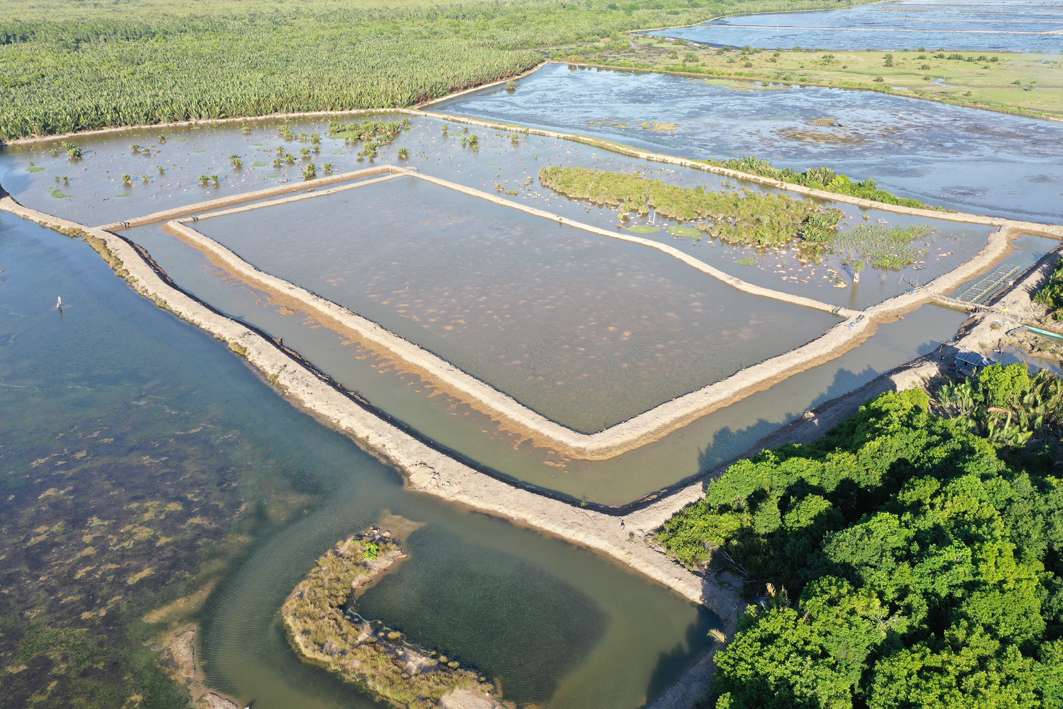
SECURE shrimp pond in Pegat Batumbuk Village, Berau Regency, East Kalimantan. (Photo: Basir/YKAN)
Minister Sakti Wahyu Trenggono emphasized that Indonesia’s shrimp industry must grow in harmony with mangrove conservation, recognizing mangroves as a critical foundation for sustainable coastal development.
“The needs of the shrimp industry must go hand in hand with mangrove conservation. Production and environmental protection are not mutually exclusive. With the right approach, both can progress together to improve the welfare of coastal communities while strengthening the implementation of Indonesia’s Blue Economy,” he said.
Indonesia’s brackish-water aquaculture has experienced declining productivity due to a combination of technical challenges and environmental management issues.
These include suboptimal pond design, inefficient water management, inappropriate use of production inputs such as fertilizers, lime, and pesticides, and the degradation of mangrove ecosystems, which has increased the vulnerability of coastal areas.
These challenges underscore the need for a new approach to pond management that restores productivity without compromising environmental integrity.
To address these issues, the RIIM-KONEKSI Consortium developed the Sustainable Aquaculture Framework (SAF), bringing together researchers from ITB, Monash University, BRIN, and YKAN with support from the Indonesia–Australia partnership.
The framework is being implemented through the Integrated Sustainable Mangrove-Carbon Aquaculture (SMACA) program in Berau Regency, East Kalimantan, from 2025 to 2027, building upon YKAN’s Shrimp Carbon Aquaculture (SECURE) initiative, which began in 2022.
SAF integrates four key dimensions of sustainability: biophysical and climate resilience, biodiversity, socio-economic development, and governance. Under this approach, shrimp farming areas and mangrove restoration sites are designed as a single integrated aquaculture landscape that delivers mutual ecological and economic benefits.
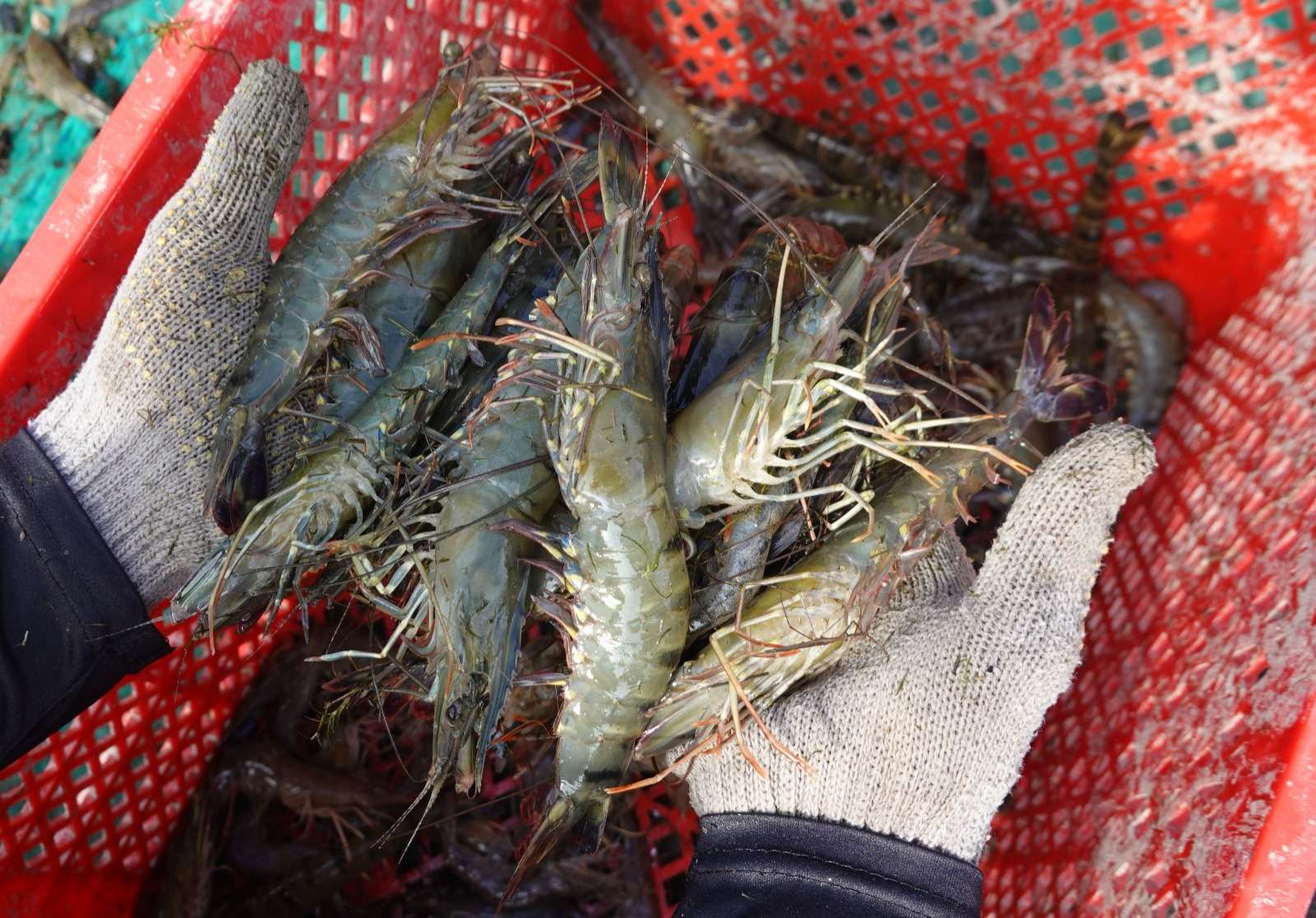
Harvesting black tiger shrimp at the SECURE demonstration pond in Pegat Batumbuk Village, Berau Regency, East Kalimantan. (Photo: Nugroho Arif Prabowo/YKAN)
The model aims to improve pond productivity, enhance environmental quality, and preserve the ecological functions of mangroves as coastal habitats, shoreline protection, and blue carbon sinks.
Project Leader Prof. Djoko Santoso Abi Suroso of ITB said that early implementation has demonstrated SAF’s strong potential for wider application across Indonesia.
“The SMACA and SECURE programs demonstrate that improving shrimp pond productivity can go hand in hand with mangrove restoration. This model has the potential to serve as a prototype for sustainable aquaculture development throughout Indonesia,” he said.
To date, the SECURE program in Berau has engaged 22 shrimp farmers managing approximately 240 hectares of aquaculture ponds integrated with 87 hectares of mangrove restoration. Supported by RIIM-KONEKSI research, the SMACA program continues to refine pond design, hydrological management, ecosystem restoration, and collaborative governance to simultaneously enhance productivity and environmental performance.
YKAN Marine Program Director Muhammad Ilman noted that Berau’s experience demonstrates that higher shrimp production does not require sacrificing mangrove ecosystems.
“Our experience in Berau shows that pond productivity can be increased through improved pond design, better hydrological management, and integrated mangrove restoration. The Sustainable Aquaculture Framework provides concrete evidence that production gains and ecosystem protection can advance together. We hope this framework will serve as a key reference for developing sustainable aquaculture policies in Indonesia,” he said.
The policy brief recommends that the government prioritize the revitalization of existing shrimp ponds rather than expanding aquaculture through mangrove conversion.
It also calls for strengthening ecosystem service-based financing mechanisms, integrating mangrove buffer zones into pond design, enhancing farmers’ technical capacity, and mainstreaming sustainable aquaculture within the implementation of Indonesia’s national Blue Economy policy.
Through the submission of this policy brief, the RIIM-KONEKSI Consortium hopes that the Sustainable Aquaculture Framework will become an important reference for national policymaking, helping Indonesia increase sustainable aquaculture production, strengthen food security, and safeguard the country’s valuable coastal ecosystems.