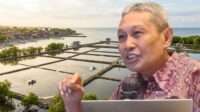

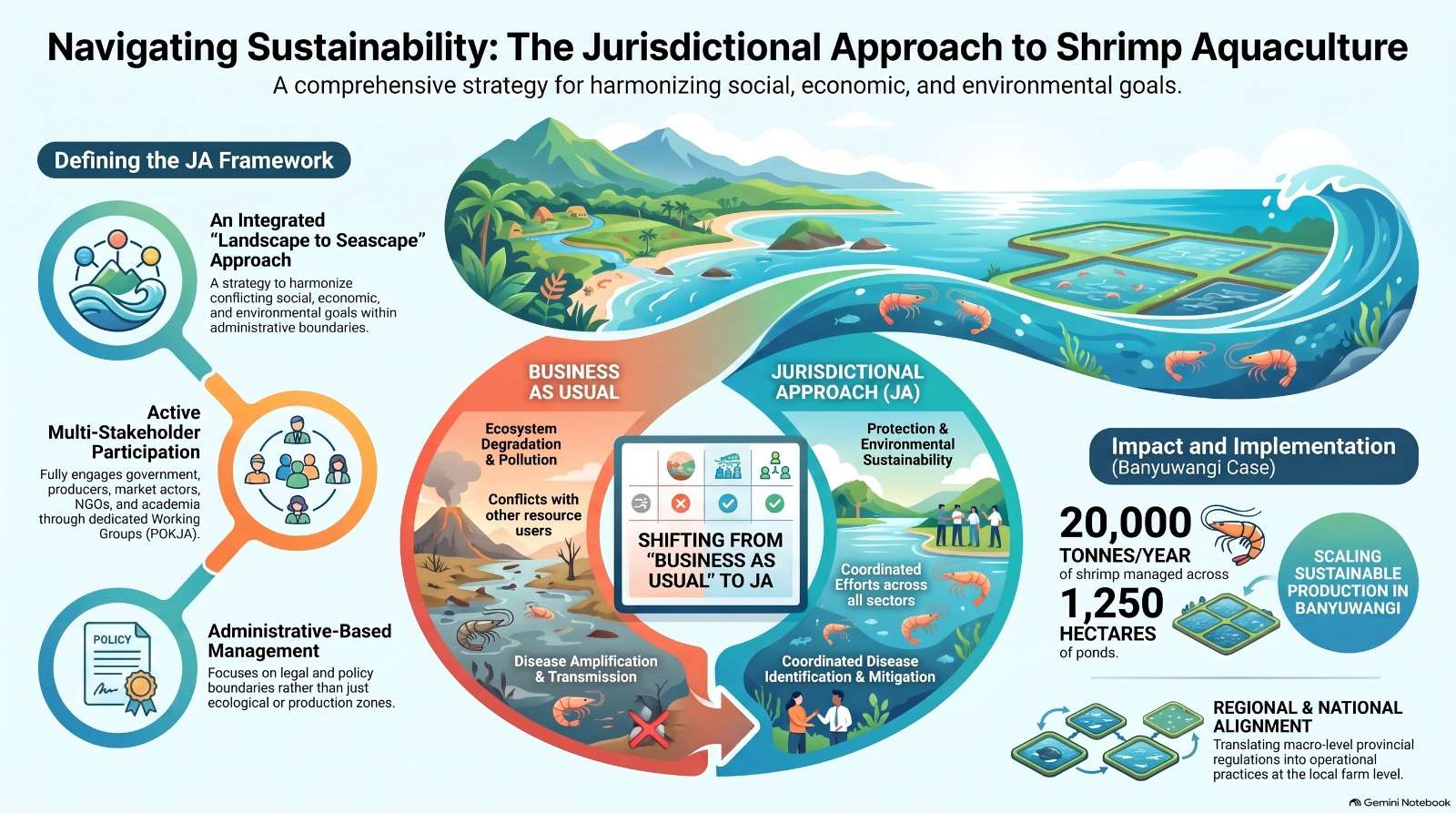
- The jurisdiction-based approach promoted by Conservation Indonesia is highly relevant. This approach shifts the management unit from individual pond plots to administrative areas, enabling spatial planning, licensing, environmental management, and oversight to be coordinated within a single framework. With this approach, problems are no longer addressed separately by individual sectors or institutions.
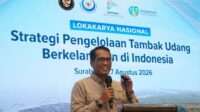
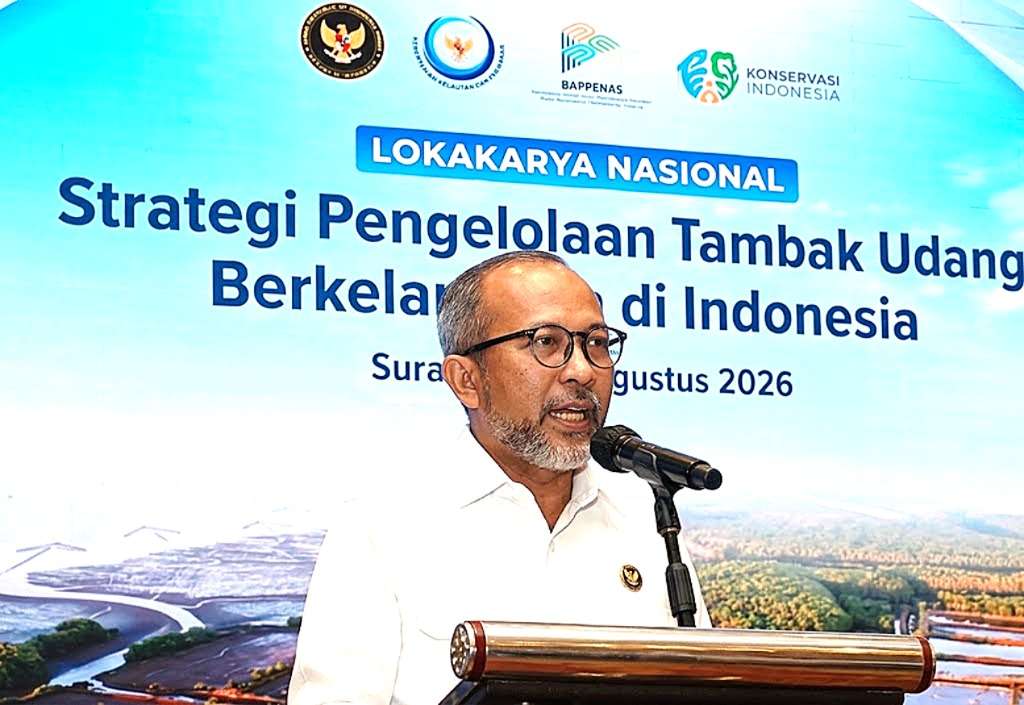
PELAKITA.ID — The Deputy for Maritime Resources Coordination at the Coordinating Ministry for Food Affairs, Dandy Satria Iswara, S.Ip., M.Si., emphasized the importance of changing the approach to shrimp aquaculture management in Indonesia.
According to him, aquaculture-related challenges can no longer be addressed solely at the individual pond level, but must instead be managed within a broader territorial or jurisdictional framework.
Dandy made the statement while opening the National Workshop on Sustainable Shrimp Aquaculture Management Strategies at the Mövenpick Hotel in Surabaya, East Java, on Thursday, August 27, 2026.
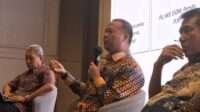
The forum brought together central and local governments, business operators, universities, civil society organizations, and various stakeholders from the fisheries and marine sectors.
Dandy began his remarks by expressing optimism about developments in Indonesia’s fisheries sector.
Over the past five years, he said, fisheries production and export values have continued to move in a positive direction, while several indicators related to ocean health have also improved.
He cited Indonesia’s Ocean Health Index, which increased from 73.17 in 2020 to 77.61 over the past five years.
In East Java, the index related to fishermen’s welfare increased from 94 in 2024 to 104 in July 2026. Meanwhile, the welfare index for fish farmers increased from 95 in 2024 to 103 in July 2026.
“These indicators show promising figures. This means that production is increasing while there are also indications of improving marine environmental conditions,” he said.
Shrimp as a Backbone of the Fisheries Sector
According to Dandy, shrimp occupies a strategic position in Indonesia’s national development agenda. Under the draft 2025–2029 National Medium-Term Development Plan (RPJMN), shrimp production is targeted to increase from approximately 1.1 million tons in 2024 to 1.68 million tons by 2029.
In line with this, shrimp export value is targeted to increase from approximately US$1.7 billion to US$2.8 billion.
The government has also designated shrimp as one of the priority commodities for investment, with a targeted cumulative investment from both foreign and domestic sources of approximately IDR 2.7 trillion.
“Shrimp is not a secondary commodity. Shrimp is one of the backbones of the fisheries sector, and we need to prepare for its development properly,” he said.
East Java, Dandy continued, is an important example of the development of Indonesia’s shrimp ecosystem. Shrimp production in East Java reached approximately 123,000 tons in 2024, making the province one of the largest shrimp-producing centers in Indonesia.
The province also has around 298 fish processing units, the largest number nationally. Meanwhile, the export value of shrimp originating from East Java reached approximately US$732 million in 2025.
“Looking from upstream to downstream, East Java is practically among the best in Indonesia. The ecosystem is already in place and relatively complete,” he said.
Public Complaints as a Warning Signal
However, Dandy warned that these economic achievements must not overshadow the environmental and social problems that continue to occur in aquaculture areas.
He revealed that between 2018 and 2023, there were 94 public complaints nationwide related to aquaculture operations. Forty of these complaints came from Central Java and 21 from East Java.
Ironically, both provinces are also major centers of national shrimp production.
According to Dandy, the substance of these complaints has been relatively consistent. The problems include mangrove clearing and degradation, business licensing that does not comply with regulations, and coastal pollution caused by wastewater discharged from aquaculture ponds.
Over the past two years, similar complaints have continued to emerge in several areas, including Banyuwangi, Jember, Sumenep, Gresik, Probolinggo, Trenggalek, and Lumajang.
“Residents have complained about rivers changing color and turning black, impacts on seaweed production, and aquaculture wastewater treatment facilities that are not functioning properly,” Dandy said.
He said the recurring nature of these problems shows that the government can no longer view aquaculture issues as isolated cases. When complaints persist for years and occur across several districts, they must be understood as governance problems.
“There appear to be problems with administrative governance, licensing, operations, and supervision,” he stressed.
Aquaculture Ponds Never Stand Alone
Dandy questioned the effectiveness of a control approach focused solely on individual aquaculture ponds.
In reality, he said, ponds never operate in isolation. They may be located alongside residential areas, agricultural land, mangrove ecosystems, or fishing grounds. Water flows are also interconnected and are not always managed by a single party.
“No matter how well an individual pond manages its own operations, the impacts on surrounding waters will still be experienced collectively,” he said.
For this reason, he considers the jurisdiction-based approach promoted by Conservation Indonesia to be highly relevant.
The approach shifts the management unit from individual pond plots to administrative areas, allowing spatial planning, licensing, environmental management, and monitoring to be coordinated within a single governance framework.
With such an approach, problems are no longer addressed separately by individual sectors or institutions.
Four Things That Must Be Safeguarded
Dandy identified at least four elements that must be jointly protected in the development of sustainable shrimp aquaculture.
First is community welfare and well-being. The livelihoods and income sources of coastal communities must not become the cost of economic growth.
Second is environmental sustainability, including mangrove protection and maintaining the capacity of coastal ecosystems to support economic activities.
Third is compliance with regulations and licensing requirements. Compliance applies not only to business operators but also requires the government to establish appropriate policies and effective monitoring mechanisms.
“Legally operating aquaculture ponds are the fundamental foundation of all aquaculture activities,” he said.
Fourth is cross-stakeholder coordination. Dandy emphasized that no single institution can resolve the complexities of aquaculture management on its own.
Disciplined communication, strong coordination, and cross-sector collaboration are required to address the various challenges collectively.
Evidence-Based, Not Merely Argument-Based
Dandy hoped the national workshop would not end as a discussion forum but would produce agreements that could actually be implemented.
He called on all participants to build their arguments on facts, data, and up-to-date information so that the resulting recommendations could be defended and held accountable.
“We need agreements that are implementable, from a clear division of roles between the central and local governments to lessons in jurisdiction-based area management from Banyuwangi and Situbondo,” he said.
He also emphasized the importance of establishing communication from the outset. According to him, collaboration requires all parties to sit together, speak openly, present facts, and listen to the perspectives of others.
Dandy quoted a principle of collaboration that he considered relevant to the process: “If you want to go fast, go alone. If you want to go far, go together.”
“We want to go far. Therefore, we need to create a strong foundation. If from the beginning we sit together, speak openly and sincerely, present facts, and listen to one another, we will find common ground,” he said.
Dandy also highlighted the government’s experience in simplifying regulations as a lesson for shrimp aquaculture governance.
He cited the fertilizer subsidy policy, which previously involved around 145 permits, regulations, and recommendations from nearly 40 central and local government institutions. This complexity made the subsidy distribution process lengthy.
Following simplification and coordination, the process was reduced to just three main regulations. As a result, beginning January 1, 2025, farmers were able to access subsidized fertilizer more quickly.
“Once a policy becomes applicable, its impact can be felt immediately. Therefore, our experience in simplifying policies and coordinating across sectors can also be applied to support the shrimp industry,” he explained.
Banyuwangi-Situbondo as a Model
To produce concrete outcomes from the workshop, Dandy encouraged the experiences of area management in Banyuwangi and Situbondo to be developed into models that can be replicated elsewhere.
He proposed the development of technical guidelines outlining the processes, policy requirements, division of roles, and needs of business operators and local governments.
However, he stressed that the guidelines should not be overly rigid. The national framework should provide room for each district and city to adapt implementation to its own local conditions and potential.
“The technical guidelines should not be rigid. There must be room for districts and cities to develop approaches according to their respective conditions. It should be customized,” he said.
Dandy hopes the model can be developed not only in Banyuwangi and Situbondo, but also replicated across other districts and cities in East Java.
Toward a Common Agreement
He added that shrimp aquaculture management must be placed within the broader context of Indonesia’s development agenda.
Various national strategic programs, from pond revitalization to the development of aquaculture technologies, must move forward alongside improvements in community welfare and ecosystem protection.
He therefore called on all workshop participants not merely to exchange views, but also to share current data and information.
“We must sit together, listen to one another, take notes together, and share up-to-date data and information,” he said.
Dandy emphasized that the Coordinating Ministry for Food Affairs is ready to help oversee the outcomes of the workshop if new policies are required, whether in the form of regional regulations or national policies.
Ultimately, he said, the success of sustainable shrimp aquaculture management will not be determined solely by production volumes or export values, but by the ability of all stakeholders to build a governance system that reconciles economic interests, community welfare, and environmental protection.
“Our hope is that this collaboration will produce a common framework that we agree to implement, with a well-defined timeline and clear division of responsibilities,” he said.
With that message, Dandy officially opened the National Workshop on Sustainable Shrimp Aquaculture Management Strategies, while encouraging the forum to become a starting point for strengthening jurisdiction-based shrimp aquaculture governance in Indonesia.
___
Editor K. Azis