

By Hasanuddin Atjo
MARITIMEPOSTS.COM — Weak competitiveness in Indonesia’s shrimp farming industry is believed to be a major reason why shrimp from Ecuador has been able to penetrate the Indonesian market, despite Indonesia having approximately 303,000 hectares of shrimp ponds supporting the livelihoods of nearly one million workers.
The entry of 120 tonnes of Ecuadorian Vannamei shrimp into Indonesia in June 2026 continues to attract attention and close monitoring from various stakeholders, ranging from shrimp farmers (on-farm), upstream supporting businesses (upstream off-farm), to shrimp collectors and large-scale traders.
One major concern is that imports could continue and potentially increase in volume. This concern is not without reason, particularly because regulations governing bonded zones and other economic zones may provide opportunities for such imports, with indications already pointing in that direction.
If this situation continues and efforts to strengthen the competitiveness of Indonesia’s shrimp farming industry remain stagnant or fail to move in the right direction, a number of upstream businesses—including shrimp farms and supporting industries—could be forced to close because they are unable to compete.
The high Cost of Production (COP) is considered one of the main reasons why Indonesian shrimp has difficulty competing in the global market.
The production cost of shrimp in Indonesia is estimated at around US$3.50–4.00 per kilogram, considerably higher than production costs in India and Ecuador, which are estimated at approximately US$1.00–1.50 per kilogram.
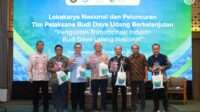
Against this backdrop, a limited dialogue was held on Monday evening, September 8, 2026, at Bandar Tuna Restaurant on Jalan Tentara Pelajar, Makassar. The meeting brought together core representatives of SCI at both national and regional levels, business operators, and academics.
Participants included Prof. Andi Tamsil, Chairman of SCI Central; Hasanuddin Atjo and Muh. Saenong from SCI South Sulawesi; Prof. Zainuddin L., an academic; as well as Syahrun and R. Rhamzani, representing the business community.
First, the government needs to tighten import mechanisms
One of the key points raised during the dialogue was that the government needs to strengthen and tighten shrimp-import mechanisms so that imports do not undermine Indonesia’s domestic on-farm sector, particularly shrimp farmers, or the upstream off-farm supporting industries.
The coordination and approval process surrounding import permits should be carefully reviewed through an integrated approach involving the relevant government institutions and stakeholders.
Monitoring the potential introduction of shrimp diseases and ensuring food safety are also critical issues requiring additional attention. At the same time, the possibility that imported shrimp could leak into and compete directly in the domestic market is considered another significant risk.
Second, collaboration is needed across the shrimp industry
The second key point was the need for stronger collaboration among the government, industry associations, business operators, observers, and other stakeholders to examine the structural challenges facing shrimp industrialization and develop practical solutions.
The shrimp industry needs to be viewed as an integrated system encompassing upstream off-farm activities, on-farm production, and downstream off-farm industries. These three components must be strengthened together rather than allowed to undermine one another.
The urgency is even greater because Japan, one of Indonesia’s potential export destinations, has reportedly begun looking toward shrimp produced in India because of its lower prices. Japan has even established a representative presence in India.
For this reason, the three components of shrimp industrialization need to be collectively strengthened, expanded, and developed in a way that creates mutual support rather than destructive competition. In connection with this issue, a workshop is expected to be organized in the near future.
Third, Indonesia needs a competitiveness roadmap and role models
The third strategic recommendation is the development of a roadmap and role-model strategy for strengthening the competitiveness of Indonesia’s shrimp farming industry, particularly in several major shrimp-producing centers across the country.
At least two different roadmaps and role models should be developed. The first should focus on traditional and semi-intensive shrimp ponds, which account for approximately 97 percent of Indonesia’s total shrimp-pond area, or around 303,000 hectares.
The second should focus on intensive and super-intensive shrimp farming, which represents only approximately three percent of the total pond area.
Although intensive and super-intensive farming occupy a relatively small area, they reportedly contributed approximately 80 percent of Indonesia’s shrimp exports in 2025, when national shrimp exports reached around 200,000 tonnes.
This demonstrates that Indonesia cannot simply pursue one model of shrimp farming. Traditional, semi-intensive, intensive, and super-intensive systems require different strategies, technologies, investment models, production efficiencies, and competitiveness roadmaps.
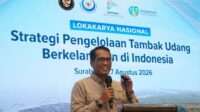
Several participants therefore argued that a national workshop focused on strengthening competitiveness through shrimp industrialization would be highly strategic. The workshop should subsequently lead to the preparation of measurable roadmaps and practical role models that can be implemented and replicated across Indonesia’s shrimp-producing regions.
The ultimate objective should be to build a shrimp industry in which farmers, upstream supporting industries, and downstream businesses grow together, while Indonesia becomes more competitive in the global market without sacrificing the sustainability and resilience of its domestic aquaculture sector.
Editor: Denun