
From Infrastructure to Smart Villages in Papua
TEP 2026 is not a short-term ceremonial program. The government has prepared a full 12-month fieldwork scheme. The process begins with recruitment from April to May 2026, followed by technical preparation and training from June to July 2026. Afterward, all teams will be deployed simultaneously on July 31, 2026, to conduct research, studies, and field assistance until July 2027.
MARITIMEPOSTS.COM – The Ministry of Transmigration has unveiled a new strategic initiative to develop transmigration areas through science-based approaches and community engagement by appointing 10 of Indonesia’s leading state universities to participate in its national program.
“Among all the selected campuses, Hasanuddin University is the only university from outside Java Island,” said Dr. Ilham Alimuddin, one of the facilitators from Unhas for the TEP 2026 program.
Ilham stated that the appointment reaffirms Hasanuddin University’s strategic position as a representation of Eastern Indonesia’s academic strength.
“The presence of Unhas among Indonesia’s elite universities is not only recognition of the institution’s capacity, but also highlights the importance of Eastern Indonesia’s perspective in the future agenda of development and transmigration,” said the lecturer from the Faculty of Engineering at Hasanuddin University.
About TEP 2026
The Ministry of Transmigration is preparing a major initiative that could transform the face of transmigration areas in Indonesia. Through the Patriot Expedition Team (TEP) 2026 program, the government no longer sees transmigration merely as population relocation or the development of new settlements.
Instead, transmigration areas are now positioned as new economic growth centers driven by research, technology, and socio-economic engineering.
“The program was established under the mandate of Ministerial Regulation of Transmigration No. 3 of 2026, which serves as the foundation for a new regional development policy,” Rijal mentioned.
“The approach has shifted dramatically—from an administrative bureaucratic model to development based on data and scientific studies. In other words, future development decisions must be grounded in strong and measurable academic foundations,” he added.
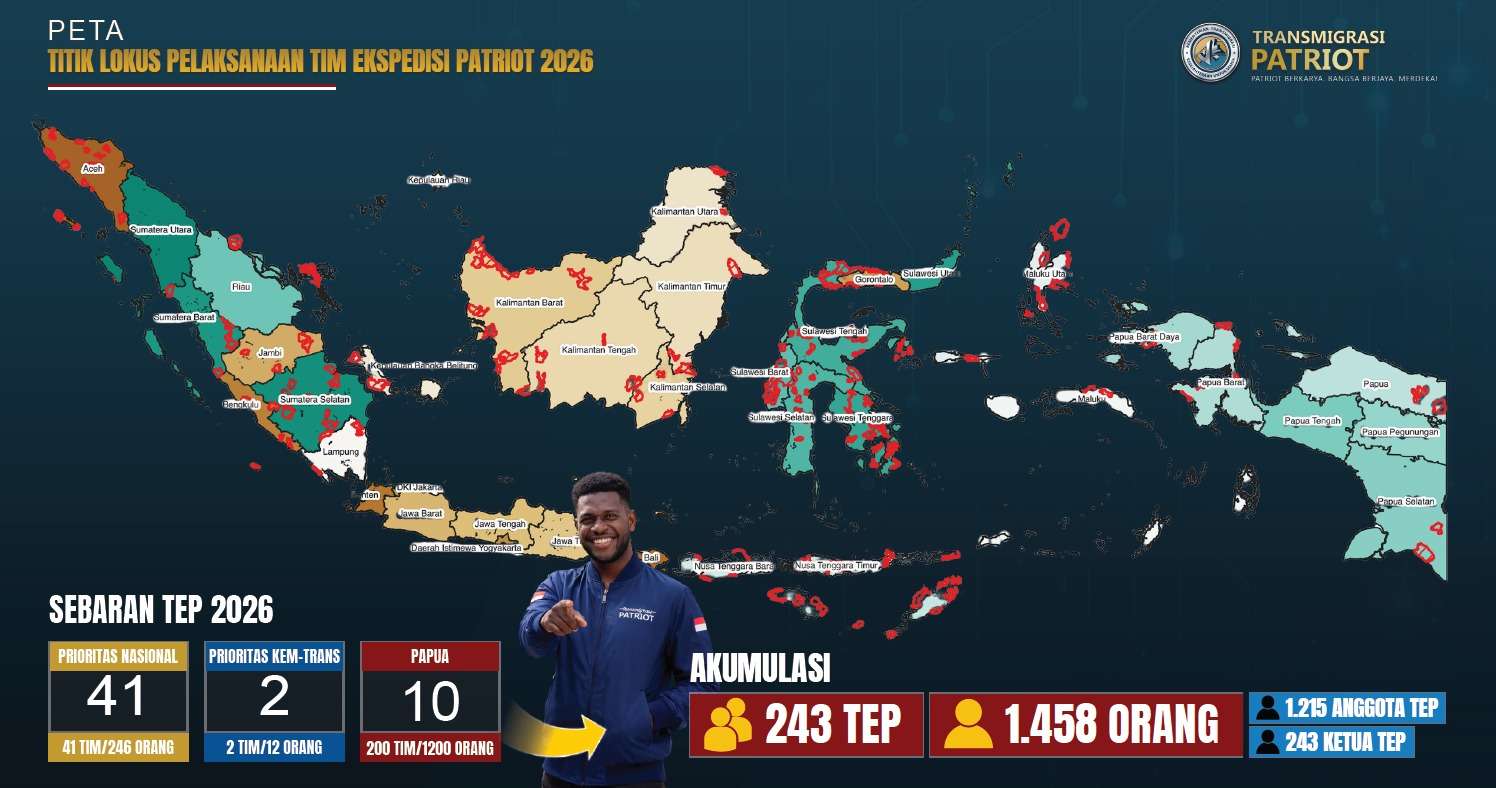
Under the regulation, the government initially targeted the deployment of highly qualified human resources. However, in its implementation, the program architecture expanded on a much larger scale, involving a total of 1,458 personnel divided into 243 teams.
They are not merely field researchers. TEP is designed as a strategic national instrument to produce development recommendations that will later become mandatory references for drafting the 2027–2029 Regional Development Plans.

From Infrastructure to Smart Villages
One of the major strengths of TEP 2026 is its comprehensive development approach. The government has designed twelve interconnected thematic pillars that form a modern and sustainable regional development ecosystem.
The first pillar focuses on governance and agrarian reform. The government seeks to ensure legal certainty over land and community assets in order to minimize land conflicts while creating a healthy investment climate.
At the same time, the development of basic infrastructure and connectivity has become a key priority. Roads, logistics access, and distribution networks are viewed as essential tools to reduce regional economic costs, enabling local products to compete in national markets.
TEP also places strong emphasis on human resource development. Education, healthcare services, and community capacity building are positioned as the main foundations to ensure transmigration areas grow not only physically but also socially and economically productive.
Downstream industrialization is another strategic agenda. Transmigration areas are encouraged not merely to export raw commodities, but to develop processing industries that generate greater added economic value.
In addition, digitalization has become one of the new faces of transmigration development. The smart village concept is introduced to shorten distribution chains, improve bureaucratic efficiency, and expand digital market access for local agricultural products.
The government has also incorporated green economy initiatives, renewable energy development, and tourism based on local culture as part of the future transformation of transmigration regions.
Papua Becomes the Main Focus
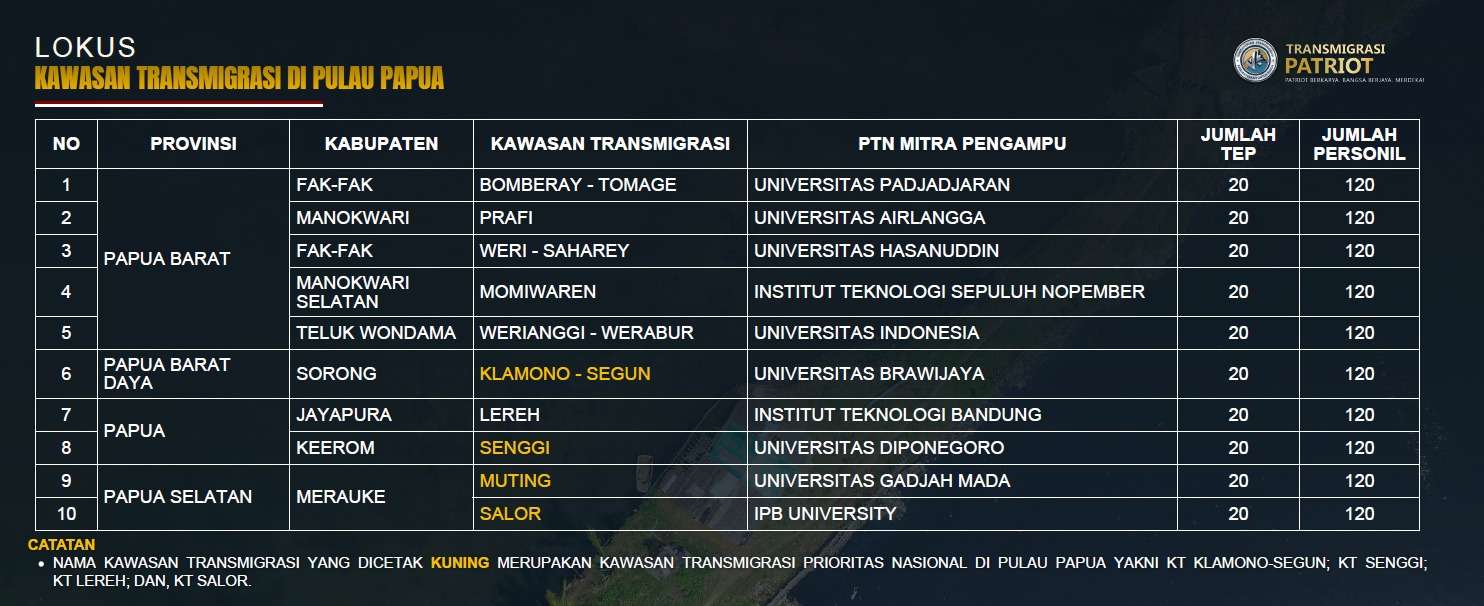
Looking at the personnel distribution of TEP 2026, it is clear that the government is placing enormous attention on Papua. The development approach applied is asymmetrical, meaning each region is treated according to its unique challenges and needs.
In most parts of Indonesia, one location receives only one team consisting of six personnel. In Papua, however, each area receives up to 120 personnel, consisting of 20 team leaders and 100 members.
This move indicates that Papua is being positioned as a National Priority Area requiring accelerated and integrated development.
Several strategic areas receiving focus include Klamono–Segun in Southwest Papua, Senggi and Lereh in Papua, Salor and Muting in South Papua, and Weri–Saharey in West Papua, which has been entrusted to Hasanuddin University.
Interestingly, among the ten partner state universities involved by the Ministry of Transmigration, Hasanuddin University is the only campus from outside Java Island. The presence of Unhas demonstrates that Eastern Indonesia’s development perspective is becoming an important part of the grand design for transforming Indonesia’s transmigration regions.
One Full Year of Field Operations
TEP 2026 is not a short-term ceremonial program. The government has prepared a full 12-month fieldwork scheme.
The process begins with recruitment from April to May 2026, followed by technical preparation and training from June to July 2026. Afterward, all teams will be deployed simultaneously on July 31, 2026, to conduct research, studies, and field assistance until July 2027.
Each personnel member is selected under high academic standards. Team leaders must hold at least a master’s degree, possess internationally reputable publications, and have experience leading research projects.
Meanwhile, team members are required to demonstrate academic capability, research experience, and communication skills in engaging with communities and regional stakeholders.
The government appears determined to ensure that every recommendation produced has strong scientific credibility and can be practically implemented in development policies.
Major Investment for Regional Futures
The seriousness of the government’s commitment is also reflected in the scale of the allocated budget. For Papua alone, the total investment reaches approximately Rp180.4 billion.
The funding supports the operations of 1,000 personnel over one full year, covering living expenses, research equipment, and local facilitation.
Meanwhile, for areas outside Papua, interventions are more focused on optimizing regions that already possess initial development foundations.
This model demonstrates that the government is implementing two strategies simultaneously: concentrated acceleration of development in Papua and targeted strengthening of emerging regions elsewhere.
Transmigration Enters a New Era
Ultimately, TEP 2026 is far more than an ordinary research program. It is a major national effort—supported by ten of Indonesia’s leading universities, including Hasanuddin University—to transform transmigration areas into independent, modern, and globally competitive economic centers.
For decades, transmigration regions have often been viewed as peripheral areas associated with limitations and underdevelopment. Today, that paradigm is changing. The government wants transmigration regions to become spaces for new industrial growth, centers of village innovation, and regional economic hubs capable of supporting national development.
With the support of Indonesia’s best universities, significant fiscal investment, and a data-driven development approach, TEP 2026 has the potential to become an important turning point in the history of Indonesia’s transmigration development.
Editor: Denun