
MARITIMEPOSTS.COM — The Java Sea has once again become the scene of a maritime tragedy after Virgo Transport 8 was involved in an accident while sailing from Surabaya to Banjarmasin on Sunday, September 13, 2026.
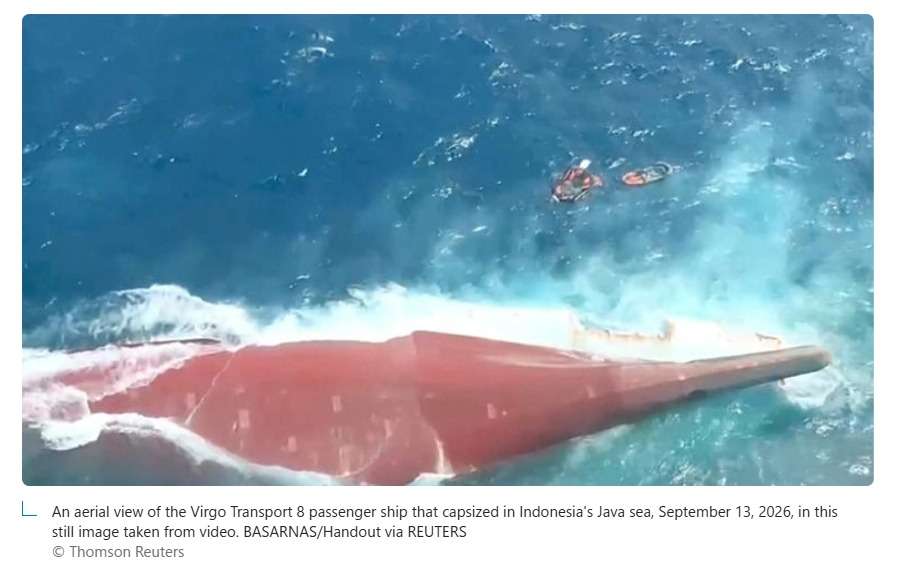
The vessel encountered severe weather, developed a dangerous list, and eventually capsized and partially sank in waters near Masalembo.
The incident quickly developed into a large-scale search and rescue operation because the vessel was carrying hundreds of people. As of Monday, September 14, 2026, the latest reports said that 108 people had been rescued, six people had died, while 129 others remained missing. More than 600 search and rescue personnel were deployed, supported by a number of vessels and aerial assets to search for survivors and victims.
Here are 11 key facts about the Virgo Transport 8 tragedy based on information currently available from authorities and various sources:
1. Virgo Transport 8 Was Sailing from Surabaya to Banjarmasin
Virgo Transport 8 was a vessel operating on the Surabaya–Banjarmasin route, an important maritime connection between Java and Kalimantan. The vessel departed from the Tanjung Perak Port area in Surabaya on Saturday, September 12, 2026, before encountering problems while sailing through the Java Sea.
The route illustrates the critical importance of maritime transportation for Indonesia as an archipelagic nation. For communities, ships are not merely a means of travel but an essential part of a mobility system connecting families, workers, vehicles, goods, and economic activities between islands.
That is why an accident involving a passenger vessel has consequences far beyond a disrupted journey. Behind every name on a passenger manifest is a family waiting, a job that must continue, and a life that depends on the safety of the voyage.
2. The Vessel Was Carrying 243 People
One of the most important facts in this tragedy is the number of people aboard the vessel. The latest reports said that 243 people were on board Virgo Transport 8 when the accident occurred. The figure included passengers and crew members.
According to passenger-manifest data reported by the Associated Press, the vessel was carrying 213 passengers and 30 crew members, in addition to 89 vehicles. However, verification of the manifest remains important because in a mass-casualty maritime accident, the actual number of people aboard may differ from initial administrative records.
The large number of people on board explains why the SAR operation quickly developed into a major emergency response. Every minute matters because the longer survivors remain at sea, the greater the risks of hypothermia, exhaustion, dehydration, and other life-threatening conditions.
3. The Vessel Encountered Severe Weather in the Java Sea
According to Reuters, preliminary information indicated that Virgo Transport 8 encountered severe weather and strong waves before the accident. Reuters reported that powerful waves struck the vessel’s starboard side, causing it to list before eventually capsizing.
However, severe weather should not automatically be regarded as the sole cause of the accident. The exact cause must be established through an investigation examining the vessel’s condition, stability, cargo, vehicle distribution, navigational decisions, engine condition, crew preparedness, and overall safety systems.
This distinction is important so that the tragedy is not reduced to the simple conclusion that the vessel sank because of large waves. In maritime safety, accidents are often the result of multiple factors interacting at the same time.
4. The Vessel Developed a Dangerous List
Before losing contact, Virgo Transport 8 was reportedly experiencing a listing condition, meaning that the vessel was leaning abnormally to one side. Information from maritime authorities indicated that the listing occurred at around 2 a.m., shortly before communication with the vessel was lost.
Listing is a serious condition because a change in the vessel’s angle can affect its stability and its ability to maintain a safe position in rough seas. As the vessel’s inclination increases, vehicles, cargo, and other objects on board may also shift, potentially worsening the vessel’s stability.
For this reason, determining what caused the listing and how it developed will be a critical part of understanding how the vessel eventually capsized.
5. The Vessel Lost Contact
One source reported that after developing a list amid severe weather, Virgo Transport 8 subsequently lost contact. The Banjarmasin Search and Rescue Office received information about the situation and immediately activated a search and rescue response.
Losing contact with a vessel at sea is a serious situation, particularly when hundreds of people are on board. The vessel’s last known position becomes crucial because it provides the basis for determining search patterns and deploying SAR vessels, aircraft, and other assets capable of locating survivors.
In such circumstances, the accuracy of position information and the speed at which emergency information is disseminated throughout the maritime network become essential elements of the safety chain.
6. The Tragedy Occurred Near Masalembo
Koran Kaltim reported that Virgo Transport 8 was involved in the accident in the Java Sea near Masalembo. The area lies along maritime routes connecting various parts of western Indonesia with Kalimantan and other regions farther east.
The location also highlights the geographical challenges faced by SAR teams. Rescuers must operate across a vast expanse of ocean, while the positions of survivors and victims can shift because of currents, wind, waves, and the movement of people or floating objects.
Under such circumstances, a search operation is not simply a matter of locating one fixed point. The search area can expand as time passes and environmental conditions change.
7. Six People Have Been Confirmed Dead
As of the latest update on September 14, six people had been confirmed dead. At the same time, 108 people had been rescued, while 129 remained missing.
These figures are more than statistics. Every victim represents a human story and a network of family, friends, colleagues, and communities that extends far beyond the numbers recorded in a SAR report.
Meanwhile, families continue to wait for information. For relatives of those still missing, the SAR operation is not simply another news story. It represents hope that their loved ones may be found alive, or at the very least that their fate will eventually be confirmed.
8. Hundreds of Personnel Are Involved in the SAR Operation
Reuters reported that the large number of missing people prompted a major search and rescue operation. Around 622 personnel, supported by approximately 12 vessels, were reported to be involved, while additional resources were deployed to strengthen the search.
The operation involves various rescue and security agencies, including Indonesia’s National Search and Rescue Agency, the Indonesian Navy, the police, and vessels operating in the vicinity of the accident.
Teams equipped for underwater searches have also been prepared because some victims could be located around or inside the partially submerged and overturned vessel.
The scale of the operation demonstrates that this is not a minor maritime incident. It is a major maritime emergency requiring inter-agency coordination and support from vessels, aircraft, divers, communications systems, technology, and weather information.
9. Virgo Transport 8 Is a Large Vessel
Virgo Transport 8 is reported to have a gross tonnage of approximately 8,540 GT. The vessel was reportedly built in Japan in 1987 and later operated in Indonesia.
Information about the vessel’s age and operational history is relevant to an investigation, but it should not immediately be used to conclude that the vessel’s age caused the accident.
Older vessels can continue to operate safely if they meet seaworthiness standards, receive proper maintenance, have functioning safety systems, and are operated by competent crews.
Conversely, relatively newer vessels can also face risks if safety systems, operations, cargo, weather conditions, or decision-making are not properly managed.
Therefore, the most important issue is not simply how old the vessel was, but what its actual condition was when it sailed and whether all of its safety systems were functioning as required.
10. The Cause of the Accident Still Needs to Be Investigated
The most important fact that must be emphasized is that the exact cause of the accident has not yet been conclusively determined. Information about severe weather and strong waves forms part of the preliminary chronology, while a full investigation is needed to establish the chain of events that caused the vessel to list and eventually capsize.
The questions that need to be answered go beyond how the vessel capsized. Investigators will also need to determine whether the vessel sailed under appropriate conditions, how weather information was used, how vehicle and cargo distribution affected stability, and how the crew responded when the emergency began.
Other questions concern the readiness of safety equipment, evacuation procedures, communication between the vessel and authorities, the timing of warnings given to passengers, and the effectiveness of coordination once the vessel encountered difficulties.
The answers are important not to assign blame, but to identify weaknesses in the safety system and ensure that they can be corrected.
11. The Virgo Tragedy Is a Reminder of the Importance of Maritime Safety
Ultimately, the Virgo Transport 8 tragedy brings Indonesia back to a fundamental issue facing an archipelagic nation: maritime safety must be at the heart of national connectivity.
Indonesia needs ships to connect its islands. Communities depend on maritime transportation to travel, work, move vehicles, transport goods, and reunite with their families. But connectivity cannot be measured only by the number of routes, sailing frequency, or vessel capacity.
The most fundamental measure of successful maritime transportation is whether passengers arrive safely at their destination.
For that reason, the tragedy in the Java Sea should become an opportunity to strengthen the safety culture of Indonesian shipping. Safety cannot be treated merely as an administrative requirement. It must function as an integrated system from the moment a vessel leaves port until it reaches its destination.
Weather information must become an integral part of operational decision-making. Vessel conditions must be properly assessed. Stability and cargo distribution must be monitored. Crews must have the competence and preparedness to respond to emergencies. Passengers must receive clear safety information. Regulators, meanwhile, must ensure that oversight is effective not only after an accident occurs but throughout the vessel’s operational life.
The most important lesson from a tragedy is not how long we remember it, but how seriously we improve the system afterward.
The Java Sea has long served as a lifeline for millions of Indonesians. Every voyage across it should therefore be built upon one simple but fundamental principle: ships may have to face the waves, but the safety system must never sink with them.