

MARITIMEPOSTS.COM – In a world increasingly shaped by global trade, marine resources, and geopolitical tensions at sea, a common question arises: who actually governs the oceans?
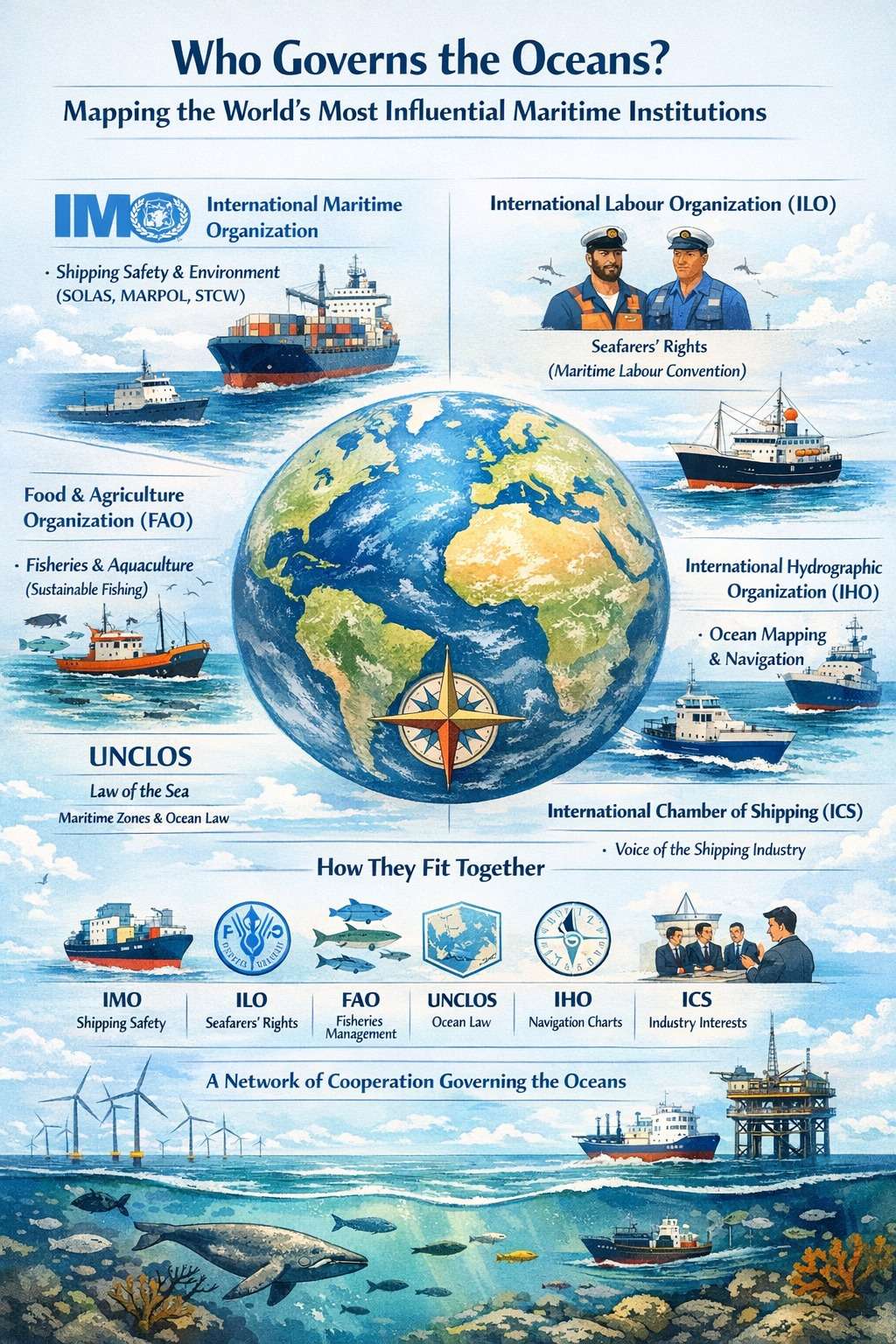
The answer is less straightforward than one might expect. There is no single “ultimate” maritime authority. Instead, global maritime governance is a carefully layered system composed of multiple international institutions—each with distinct mandates, yet deeply interconnected.
Together, they form a complex but functional architecture that keeps the world’s oceans navigable, productive, and (ideally) sustainable.
The Closest Thing to a Global Maritime Authority
At the center of this system sits the International Maritime Organization (IMO), widely regarded as the most influential maritime body in the world.
As a specialized agency of the United Nations, the IMO establishes the rules that govern international shipping. Its mandate spans three critical areas: safety at sea, environmental protection, and maritime security. Through landmark conventions such as SOLAS (Safety of Life at Sea), MARPOL (Marine Pollution), and STCW (Standards of Training, Certification, and Watchkeeping), the IMO effectively sets the global standard for how ships are built, operated, and managed.
If one were to identify a “top regulator” in maritime affairs, the IMO would undoubtedly take that position.
Protecting the People Behind the Ships
While the IMO focuses on vessels and systems, the human dimension of maritime activity is overseen by the International Labour Organization (ILO).
The ILO ensures that seafarers—the backbone of global trade—are protected through fair labor standards. Its most important instrument, the Maritime Labour Convention (MLC), is often described as the “seafarers’ bill of rights,” covering everything from wages and working hours to onboard living conditions.
In essence, if the IMO governs ships, the ILO safeguards the people who operate them.
Managing Ocean Resources
Beyond shipping, the oceans are also a vital source of food and economic activity. This domain falls under the Food and Agriculture Organization (FAO).
The FAO plays a central role in regulating global fisheries and aquaculture. It promotes sustainable fishing practices, combats illegal, unreported, and unregulated (IUU) fishing, and helps ensure that marine resources remain viable for future generations.
Mapping the Unknown
Safe navigation depends not only on rules, but also on knowledge—particularly of the ocean floor. This is where the International Hydrographic Organization (IHO) comes in.
The IHO is responsible for standardizing nautical charts and advancing hydrographic surveys worldwide. Its work ensures that ships can navigate safely, reducing the risk of accidents in increasingly crowded sea lanes.
The Legal Backbone of the Oceans
No discussion of maritime governance would be complete without the United Nations Convention on the Law of the Sea (UNCLOS).
Although not an organization, UNCLOS serves as the foundational legal framework for all maritime activities. Often referred to as the “constitution of the oceans,” it defines maritime zones such as territorial seas, exclusive economic zones (EEZs), and the high seas. It also outlines the rights and responsibilities of states in using ocean resources.
Without UNCLOS, the modern maritime order would lack coherence and legitimacy.
The Voice of the Industry
Balancing the regulatory landscape is the private sector, represented by the International Chamber of Shipping (ICS).
The ICS advocates for the interests of the global shipping industry, working closely with regulators like the IMO. While it does not create binding rules, its influence on policy discussions ensures that industry perspectives are taken into account.
A System of Interdependence
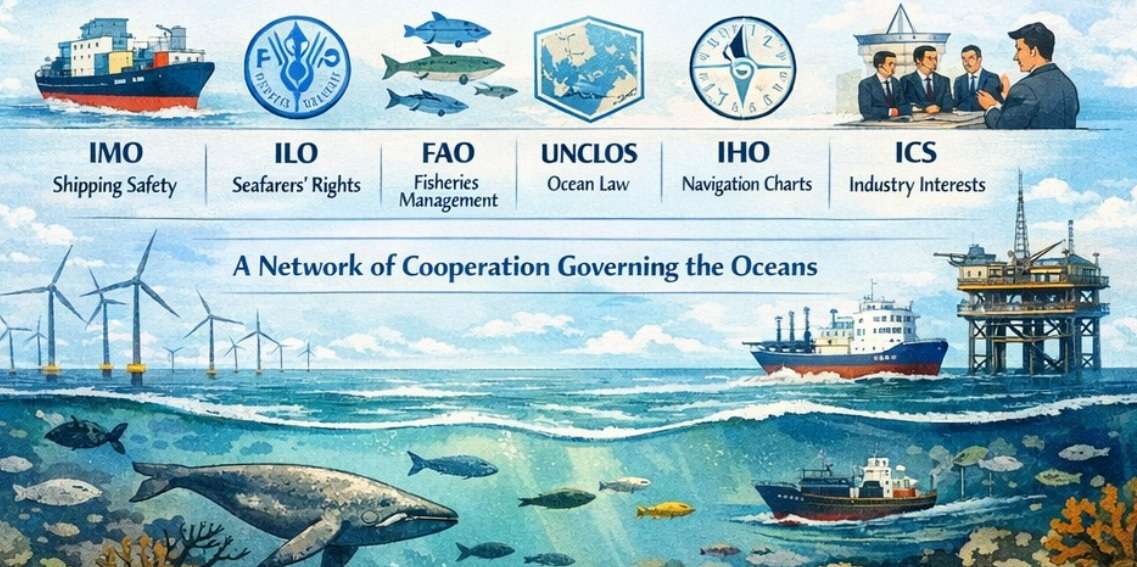
Rather than operating in isolation, these institutions form a mutually reinforcing system:
- The IMO regulates ships and maritime safety
- The ILO protects seafarers
- The FAO governs fisheries and sustainability
- UNCLOS provides the legal foundation
- The IHO supports navigation through data and mapping
- The ICS represents industry interests
This division of roles reflects the multifaceted nature of the oceans themselves—simultaneously highways of trade, sources of food, and arenas of geopolitical strategy.
Beyond a Single Authority
The absence of a single “ultimate” maritime authority is not a weakness, but a reflection of complexity. Ocean governance requires a balance between regulation, cooperation, science, and economic interests.
In this sense, the strength of the global maritime system lies not in centralization, but in coordination. And as pressures on the oceans continue to grow—from climate change to geopolitical rivalry—the effectiveness of this system will depend on how well these institutions continue to work together.