

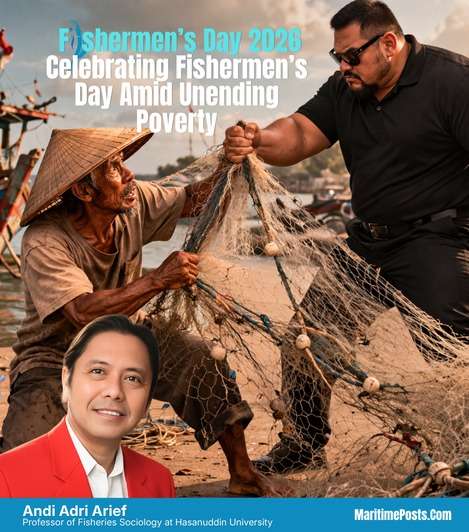
Professor of Fisheries Sociology at the Faculty of Marine Science and Fisheries, Hasanuddin University, Prof. Dr. Andi Adri Arief, shares his perspective and in-depth reflections on the realities, issues, and future of fishermen in the momentum of Fishermen’s Day. Let’s take a closer look.
MARITIMEPOSTS.COM– Every April 6, Fishermen’s Day is commemorated once again. Yet behind the ceremony lies a question that is rarely answered honestly: what are we actually celebrating—fishermen’s welfare, or our failure to break free from the same cycle of poverty?
In a country with approximately 6.4 million square kilometers of marine area, the second-longest coastline in the world, and vast Fisheries Management Areas, fishermen remain among the most vulnerable occupational groups.
Maritime narratives sound convincing, but often collapse when confronted with the socio-economic realities in coastal villages and small islands.
Rising Production, Persistent Poverty
On paper, Indonesia’s fisheries production continues to increase. However, this growth is not proportional to the welfare of fishermen. Data shows that around 16.42 million coastal residents are still classified as poor—a figure that should be a national irony, not merely a development statistic.
They are spread across 3.91 million households in more than 10,000 coastal villages, with high levels of vulnerability.
Among them are approximately 2.5 million small-scale fishermen living under layered pressures: unstable economic conditions, ongoing ecological degradation, and increasingly unpredictable climate change.
In this landscape, fishermen live in permanent uncertainty: they can only go to sea for 6–8 months a year, facing high risks and uncertain returns. When catches are abundant, prices fall; when catches are scarce, debt becomes the only support.
Official indicators reinforce this picture. The Fishermen’s Terms of Trade (NTN) stood at 101.62 in 2024 and only ranged between 103–104 in 2025. Technically, this indicates a surplus, but in reality, it reflects fragility. An NTN above 100 signifies survival, not prosperity.
When the State Is Absent Downstream
The root of the problem does not lie merely in resource availability, but in policy perspectives. So far, state intervention has been overly focused on production—through assistance such as boats and fishing gear—as if increasing output would automatically improve welfare.
In reality, the ocean is a common pool resource—shared and difficult to control—with a fugitive nature that is dynamic and uncertain. In this context, the main problem for fishermen is not only how to catch fish, but how those fish are valued.
The absence of intervention on the downstream side creates market failure, particularly in price formation and value distribution. Production surges often lead to local oversupply, which depresses prices at the fisherman level. This is where the paradox emerges: the state actively drives production but is nearly absent in managing the value chain.
Middlemen: A Symptom, Not the Cause
In this vacuum, local mechanisms take over. Relationships such as ponggawa-sawi and the presence of middlemen (pappalele) are often blamed as sources of inequality. In fact, they are not anomalies, but the most rational products of state and formal market failure.
Fishermen need fast and flexible financing, while formal banking tends to be rigid and high-risk.
As of 2024, the distribution of People’s Business Credit (KUR) to the fisheries sector was only around 2–3 percent of the national total. In this situation, middlemen and ponggawa function as providers of quick financing at the local level—a form of non-formal financial intermediation that emerges from the limitations of the formal system, while also acting as a social safety net.
Ironically, while fishermen gain access to capital, they lose bargaining power in determining prices, due to an almost unwritten principle: “where the capital comes from, that is where the catch is sold.”
As long as the state cannot provide financing schemes compatible with coastal characteristics, these relationships will persist. The problem is not the existence of middlemen, but the absence of fairer alternatives.
Blue Economy and Emerging Threats
In recent years, policy direction has shifted toward the blue economy concept and quota-based measured fishing. On paper, the goal is sustainability. However, its implementation carries serious risks.
Quota systems have the potential to trigger ocean grabbing, where access control shifts to large capital players who can afford upfront costs. In such situations, small-scale fishermen risk being displaced—from “owners of their seas” to laborers in systems they do not control.
This risk is further complicated by the implementation of Marine Spatial Utilization Suitability Approval (PKKPRL), which in principle aims to better regulate marine space use.
However, in practice, this licensing mechanism may reinforce access exclusivity, as it requires administrative compliance and capacity not always possessed by small-scale fishermen.
Without inclusive design, PKKPRL could indirectly encourage concentration of marine space among stronger capital and bureaucratic actors, while narrowing the living space of traditional fishermen.
On the other hand, ecological demands placed on fishermen are not matched with adequate economic incentives. Environmentally friendly catches remain undervalued due to weak cold chain infrastructure.
This creates ecological injustice: conservation burdens fall on small fishermen, while economic benefits are enjoyed more by large players.
Vast Seas, Limited Budget
With around 77 percent of Indonesia’s territory consisting of ocean, the 2025 budget allocation for the marine and fisheries sector—only around IDR 6 trillion—is difficult to justify. The imbalance between territorial scale, problem complexity, and fiscal capacity reflects not just numbers, but policy priorities.
The sea is expected to be an engine of economic growth, yet state investment in its primary actors remains minimal.
What Should Actually Be Done
If the problems are structural, then the solutions must go beyond adding programs—they must involve changing policy direction so that impacts are truly felt in fishermen’s daily lives.
First, quota policies must be based on transparent and participatory stock data. Without this, policies risk becoming arenas of speculation that deepen inequality.
For fishermen, transparency is crucial to ensure clarity on fishing areas, prevent displacement by larger actors, and provide certainty for planning fishing activities.
The same applies to PKKPRL implementation, which must be inclusive, simple, and pro-fishermen, so it does not become a tool that restricts small fishermen’s access to marine space.
Second, the state can no longer leave fish pricing entirely to market mechanisms. Intervention is needed through a price floor at the producer level, supported by multi-layered institutions: state-owned enterprises (BUMN) as national buffers, regional enterprises (BUMD) as connectors, and cooperatives as aggregators at the community level.
This mechanism must be integrated with cold chain infrastructure and warehouse receipt systems to improve price transmission and reduce seasonal oversupply pressures. With this system, fishermen are no longer forced to sell when prices fall, but have the option to store, process, or sell at better times.
Third, financing must adapt to the flexible, seasonal, and high-risk nature of the sea. This requires the establishment of specialized financial institutions, such as a Fisheries Bank, with adaptive schemes—ranging from seasonal financing and harvest-based repayment to income protection insurance.
Without this, cycles of debt will continue, and the state will always lag behind more adaptive informal systems.
Fourth, industrialization must be inclusive. Added value is not created at sea, but on land—through processing. As long as fishermen sell only raw fish, they will remain at the weakest point in the value chain.
Therefore, cooperatives must be strengthened as economic institutions capable of managing post-harvest and processing activities, so fishermen and their families are not merely catchers, but value creators.
This also allows fishing households—including coastal women—to participate in processing, extend product shelf life, and generate more stable income.
Conclusion
Indonesia’s fisheries sector stands at a crossroads. Today’s policy choices will determine whether fishermen remain objects or become true subjects of development.
Fishermen’s Day should not merely be a celebration, but a mirror to test where we stand. What is at stake is not only fishermen’s welfare, but the direction of development itself: whether the state will continue to accept inequality as normal, or begin to correct it in meaningful ways.
Editor: Denun