
MARITIMEPOSTS.COM – The global climate crisis is no longer a distant theoretical threat; it is an immediate logistical and economic challenge that demands a fusion of administrative authority and academic precision.
To move the needle, we must stop treating government policy and scientific research as parallel tracks and start treating them as a single, integrated engine.
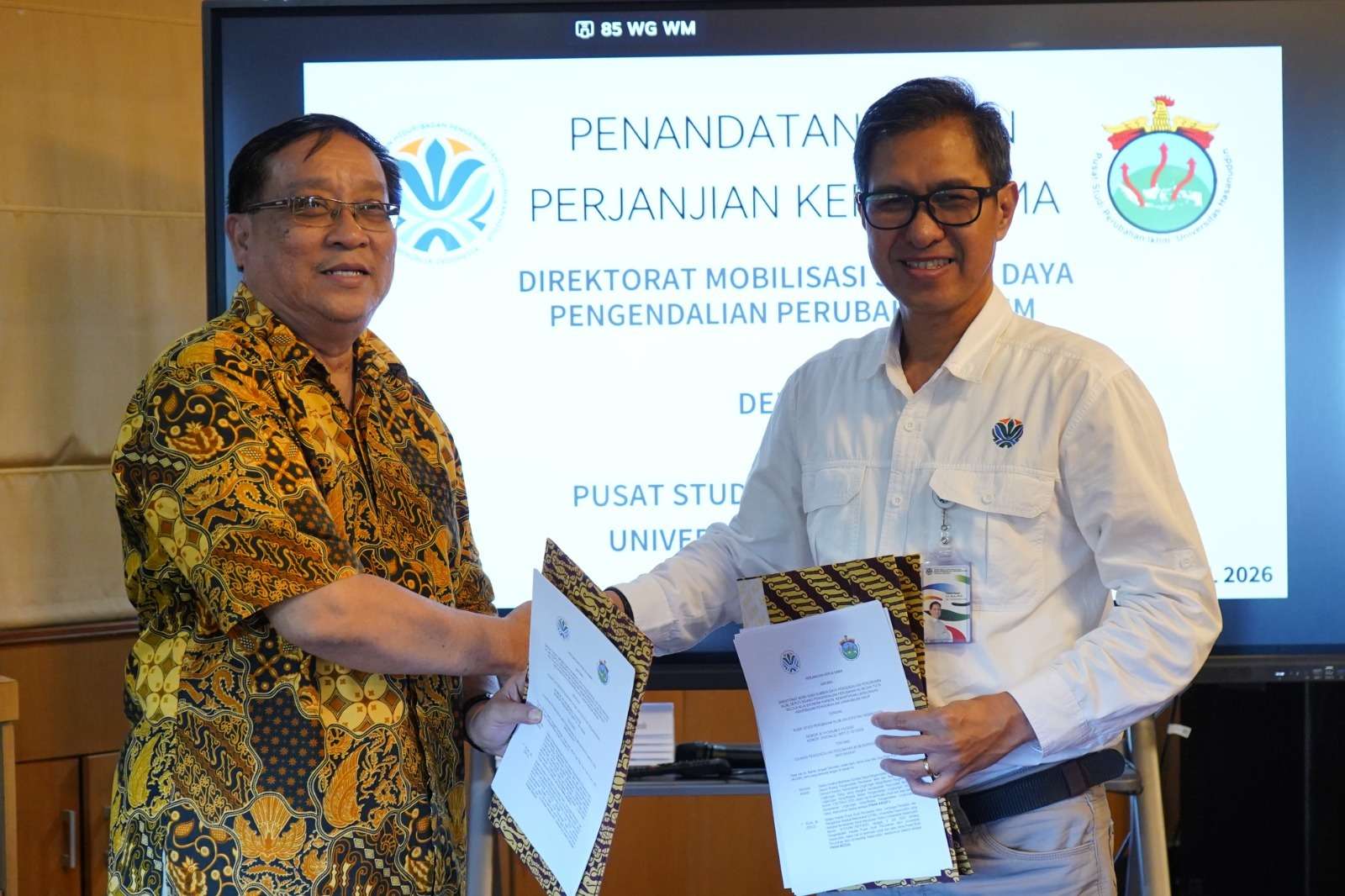
On April 9, 2026, in the 8th Floor Lounge of the Hasanuddin University Rectorate Building, a pivotal alignment occurred. The Directorate of Climate Change Control Resource Mobilization (MSDPPI-KLH)—an arm of the Deputy for Climate Change Control and Carbon Economic Value (NEK) Governance—formalized a partnership with Hasanuddin University’s Center for Climate Change Studies (PSPI-UH).
This is not just another bureaucratic signature; it is a strategic blueprint designed to operationalize climate theory into measurable, local impact.
Translating Data into Boots-on-the-Ground Action
The core of this agreement is the transition from top-down mandates to science-based, community-led participation. Traditionally, environmental policies fail when they are applied as “one-size-fits-all” directives from the capital. By anchoring climate action in scientific education, this partnership ensures that solutions are tailored to the specific ecological and social realities of the region.
Precision Over Presumption Science-based action allows for a “micro-climate” approach to policy.
When local communities understand the specific data behind the changes in their environment, participation shifts from passive compliance to active ownership. This synergy ensures that mitigation efforts are technically sound and, more importantly, socially durable.
Weaponizing Student Power: The Multiplier Effect
A standout feature of this partnership is the integration of climate programs into the university’s “KKN Tematik” (Thematic Student Study Service). This effectively mobilizes a massive, educated workforce to serve as agents of change in rural and urban areas alike.
“Perjanjian ini berfokus pada pelaksanaan edukasi dan aksi pengendalian perubahan iklim… yang mencakup integrasi program ke dalam KKN Tematik.”
Mobilizing the Next Generation This is more than a summer project; it is a multiplier effect. By deploying thousands of students, the initiative creates a decentralized network of climate ambassadors.
These students translate complex academic insights into practical local solutions, and as they return to their home provinces, they carry these values with them, creating a long-term ripple effect across Indonesia’s diverse landscapes.
The Economics of Credibility: Unlocking International Grants
In the world of high-stakes climate policy, “Carbon Economic Value” (Nilai Ekonomi Karbon) is the primary currency. A key objective of this collaboration is the joint preparation of proposals for international grants. This is where the partnership between a Ministry and a University becomes a significant economic asset.
Science as a Gatekeeper to Funding International donors, such as the Green Climate Fund or bilateral agencies, demand rigorous, independent verification before releasing capital.
PSPI-UH provides the scientific credibility and peer-reviewed legitimacy that the Ministry needs to unlock global funds. In this context, the university isn’t just a research hub; it is the “scientific proof” required to fuel large-scale environmental projects.
Waste Management as a Low-Hanging Fruit for Mitigation
The agreement identifies sustainable waste management as a primary entry point for local climate action. While “trash” might seem like a mundane starting point, it is a sophisticated tactical choice for immediate impact.
Methane and the Tangible Entry Point Waste management is one of the most effective ways to tackle methane reduction—a greenhouse gas far more potent than CO2 in the short term.
By focusing on waste, the partnership addresses a visible, local issue while simultaneously contributing to global mitigation targets. It bridges the distance between abstract atmospheric goals and the practical reality of community health and environmental hygiene.
A Four-Year Roadmap for Resilience
Real change is measured in years, not fiscal quarters. This agreement is structured with a four-year duration, ensuring that projects have the stability to mature. The finalization was spearheaded by Irawan Asaad, S.T., M.Sc., Ph.D. (Director of MSDPPI-KLH) and Ir. Rijal M. Idrus, M.Sc., Ph.D. (Head of PSPI-UH).
“The parties have agreed on all substantive aspects of the Cooperation Agreement after undergoing a comprehensive process of discussion and refinement.”
The Strength of Multi-Year Commitment Climate resilience requires a roadmap, not a sprint. This comprehensive commitment allows for the exchange of data, the refinement of research, and the implementation of adaptation strategies to be tested and adjusted over time. It represents a shift away from “project-based” thinking toward “system-based” governance.
The Road Ahead
The partnership between MSDPPI-KLH and PSPI-UH marks a significant evolution in how Indonesia approaches environmental governance. By marrying the regulatory weight of the Ministry with the localized intelligence of Hasanuddin University, the agreement creates a scalable model for climate resilience.
As we look toward the future of national policy, a fundamental question emerges: Can a national environmental strategy ever truly succeed without the specialized, local intelligence of its universities?
___
Editorial Team