
MARITIMEPOSTS.COM — Environmental management and coastal development require an approach that goes beyond compliance during operations. They must also consider the long-term economic sustainability of communities when an investment changes course or, eventually, when business activities come to an end.
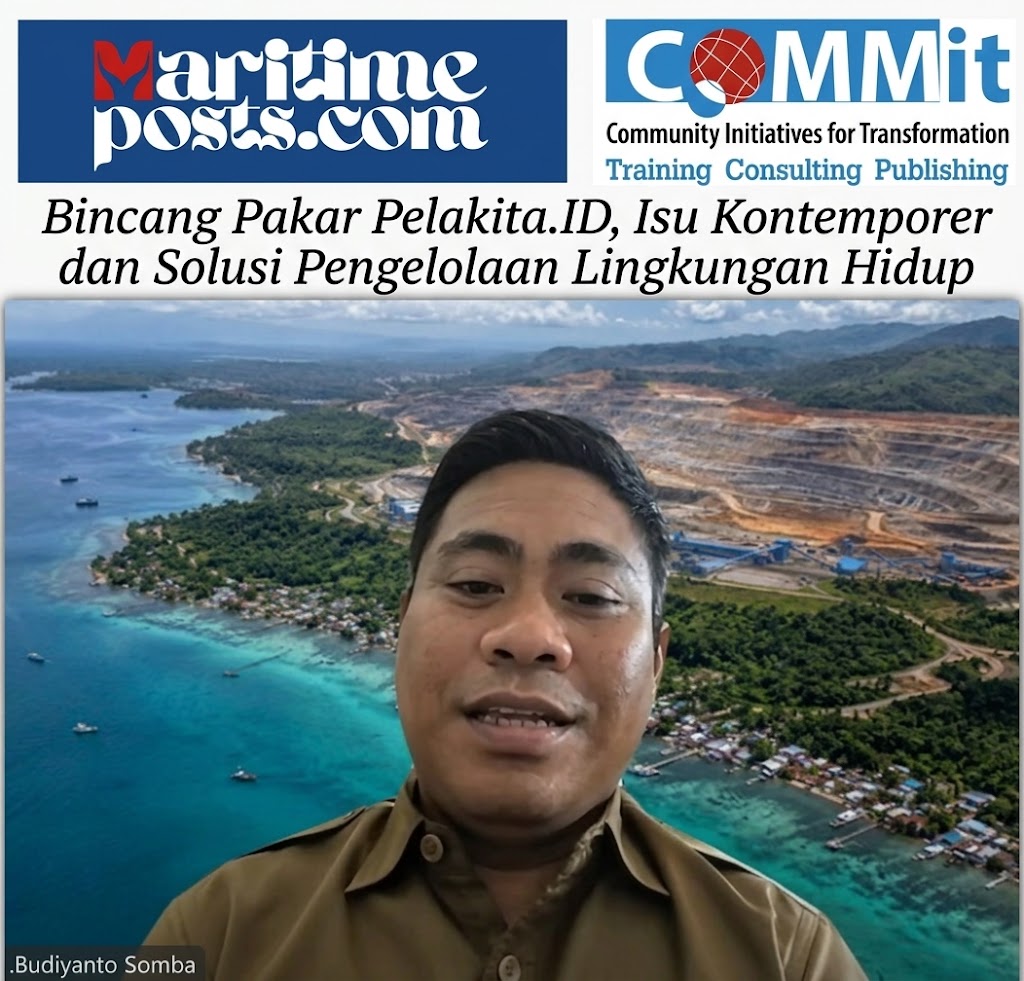
This view was expressed by Budiyanto Somba, a civil servant at the Marine and Fisheries Agency of Central Sulawesi Province, during the Expert Talk Contemporary Issues and Solutions for Environmental Management in South Sulawesi, organized by MaritimePosts.com and The COMMIT Foundation on Monday, August 24, 2026.
The discussion featured Dr. Fahrie Reska Ayyub, S.T., M.Si., and was moderated by Kamaruddin Azis, host of Pelakita.ID.
Although the discussion focused on South Sulawesi, Budiyanto offered a Central Sulawesi perspective that he considered relevant for comparison, particularly because the province is also experiencing the expansion of extractive industries and various coastal environmental challenges.
“Central Sulawesi also has a lot of mining and many environmental issues, so I want to learn more about environmental management in South Sulawesi,” said Budiyanto, a Junior Aquaculture Analyst with the Central Sulawesi Provincial Government.
North Morowali as an Important Lesson
Budiyanto then shared an experience currently unfolding in Central Sulawesi, particularly in relation to industrial activities in North Morowali Regency.
He referred to the case of PT Gunbuster Nickel Industry (GNI), which, in his view, is facing serious challenges following changes in the company’s condition and their impacts on workers and communities surrounding its operational area.
According to Budiyanto, the issue is not merely about corporate continuity, but also about the social and environmental consequences that emerge when industrial activities come under pressure.
One group he identified as being affected is seaweed farmers. North Morowali was previously one of Central Sulawesi’s important seaweed-producing areas.
However, following the arrival of national strategic projects and rapid industrialization, the space available for communities to develop aquaculture and food production activities has become increasingly limited.
Budiyanto said this change is also reflected in North Morowali’s growing dependence on supplies from outside the region, including fish, shrimp, and vegetables.
“There is no longer enough space for people to, so to speak, grow crops,” he said.
When a Company Stops, Who Is Responsible?
For Budiyanto, one important issue that needs to be considered from the outset is what happens to communities and the environment when a company ceases operations.
He recalled companies’ commitments to supporting community empowerment programs, including initiatives for farmers and seaweed cultivators. Yet when a company faces difficult circumstances, questions arise about the sustainability of those commitments.
“What form of responsibility do they have toward the community?” he asked.
According to Budiyanto, this question is important as a long-term lesson. He encouraged stakeholders to consider what might happen 10 to 20 years from now, when mineral resources begin to decline and industrial activities undergo significant changes.
For him, sustainable development is not simply about ensuring that investment operates successfully today. Planning must also consider people’s livelihoods after extractive activities come to an end.
“We must not reach a point where the nickel is gone while we are left dealing with the problems it has left behind,” he said.
Budiyanto also noted that before industrial activities expanded, several aquaculture ponds in the area had received certification under the Good Fish Farming Practices, or CBIB, system. However, following changes in land use and industrial development, some of these areas can no longer be utilized as they once were.
This situation presents a particular challenge for local governments, especially the Marine and Fisheries Agency, which must then develop recovery strategies and alternative livelihood options for affected communities.
“When something has already been damaged like this, we have to find another solution,” he said, illustrating the dilemma faced by local authorities.
In his view, the situation demonstrates the importance of cross-sectoral planning from the outset. When coastal space changes, the consequences are not solely an environmental issue; they also involve fisheries, food security, employment, local economies, and social resilience.
CSR Must Build Self-Reliance
Budiyanto also highlighted community empowerment approaches that, in his view, should focus more strongly on building capacity and self-reliance.
He observed that in certain circumstances, communities may receive direct assistance or payments from companies. While such arrangements can provide short-term economic benefits, they do not necessarily create sustainable livelihoods.
He therefore encouraged CSR and community empowerment programs to go beyond compensation and instead focus on strengthening communities’ economic capacities.
According to him, the experience of North Morowali demonstrates that when industrial activities change or a company experiences difficulties, communities need alternative livelihoods that can continue to function independently.
One response being considered by the local government is the development of more water-efficient and adaptive aquaculture technologies, including systems such as biofloc.
Budiyanto said such initiatives are part of efforts to find alternatives after changes in the space available for community aquaculture.
This approach also demonstrates the importance of innovation in responding to environmental and economic change. However, he believes innovation will be more effective when prepared from the beginning rather than introduced only after problems have emerged.
“In the past, when there were many CSR programs like that, they did not think far enough ahead to anticipate this,” he said.
Future development, therefore, needs to integrate community empowerment, technological innovation, capacity building, and environmental protection from the planning stage.
The Need for a Post-Operation Guarantee Mechanism
The discussion also raised the importance of guarantee mechanisms to ensure that environmental responsibilities continue to be fulfilled when companies cease operations.
Dr. Fahrie Reska Ayyub explained that the mining sector has instruments such as reclamation guarantees, while in the broader environmental context, comparable mechanisms are not always available with the same level of strength.
According to Fahrie, this highlights the need to strengthen monitoring instruments and mechanisms that guarantee sustainability.
“It is different from mining. Mining has a reclamation guarantee. In the broader environmental context, there is no equivalent concept of a reclamation guarantee,” explained the Hasanuddin University marine science graduate.
He said an ideal situation could actually be established through routine monitoring. When environmental impacts emerge and are not addressed promptly, accumulated problems can become far more difficult to restore.
Budiyanto then highlighted a classic challenge faced by local governments: limited budgets and resources for monitoring.
He described situations in which governments are responsible for supervision but have very limited support for mobilization, human resources, and field activities.
“It turns out that there is almost no funding for monitoring,” he said.
This creates a serious challenge because environmental monitoring requires regular field presence, data collection, evaluation, and cross-sectoral coordination.
According to Budiyanto, environmental monitoring should not depend solely on funding from the companies being monitored. Such an arrangement could raise questions about the independence and authority of the monitoring process.
He therefore proposed the importance of joint monitoring involving central and local governments and relevant sectors, with clearly defined responsibilities and authorities.
Central Sulawesi’s Experience as a Learning Resource
Budiyanto also recalled that Central Sulawesi has a long experience in managing marine space and generating regional revenue.
He noted that Central Sulawesi had previously developed a marine spatial management model that generated significant regional revenues. This experience subsequently became part of broader learning in marine spatial management at the national level.
In his view, regional experience should not disappear when authority shifts from local to central government.
Instead, the knowledge, data, and good practices developed by local governments should remain part of the national management system.
This is important to ensure that national policies do not sever the chain of experience and institutional capacity built by local governments.
For Budiyanto, the North Morowali experience should not be viewed merely as a problem involving a single company or a single region.
It can serve as a lesson for both Central and South Sulawesi in planning natural-resource-based development.
The fundamental question is how to ensure that investment generates economic added value without eliminating local communities’ sources of livelihood.
It is also necessary to consider how companies can make sustainable contributions, how the environment can be monitored regularly, and how governments can have the instruments necessary to respond when corporate conditions change.
With such an approach, industrial development would go beyond creating investment and jobs today. It would also leave economic, social, and ecological capacity for future generations.
Preparing for the Future Before the Mine Ends
Budiyanto’s central message during the discussion was the importance of thinking beyond the lifespan of a project.
Central and South Sulawesi both possess significant natural-resource potential. This potential can become a driver of development if managed with prudence, transparency, strong monitoring, and a commitment to sustaining community livelihoods.
Coastal communities therefore need to be prepared not only to live alongside industry, but also to have economic options when the economic structure of their region changes.
Local governments, companies, academics, civil society, and the central government need to build systems that allow this process to move forward collectively.
For Budiyanto, the experience of North Morowali offers an important lesson: good development is not merely about how to initiate an investment, but also about ensuring that communities and the environment continue to have a future when that investment changes.
By strengthening planning, monitoring, aquaculture innovation, community empowerment, and post-operation responsibility mechanisms, Sulawesi can develop a more resilient development model—one in which economic growth continues while coastal areas, fisheries, and communities retain the space and capacity to thrive.
___
Editor: Denun