

MARITIMEPOSTS.COM – When you enjoy a plate of grilled tuna, fried mackerel, or fresh shrimp, have you ever wondered who decides how many fish can actually be caught from Indonesia’s waters each year?
Many people assume fishing quotas are simply government restrictions or arbitrary limits that make life harder for fishermen. In reality, nothing could be further from the truth. Behind every fishing quota lies years of scientific research, biological assessments, and ecosystem monitoring designed to ensure that Indonesia’s marine resources remain productive for generations to come.
Fishing quotas are not about limiting opportunity—they are about protecting the future of one of the world’s richest marine ecosystems.
Science, Not Guesswork
Indonesia’s fisheries management is built upon scientific evidence rather than political estimates or economic speculation. Every quota established by the Ministry of Marine Affairs and Fisheries (KKP) is based on comprehensive studies of fish populations, ecosystem health, reproductive capacity, and fishing intensity across the country’s Fisheries Management Areas (WPPNRI).
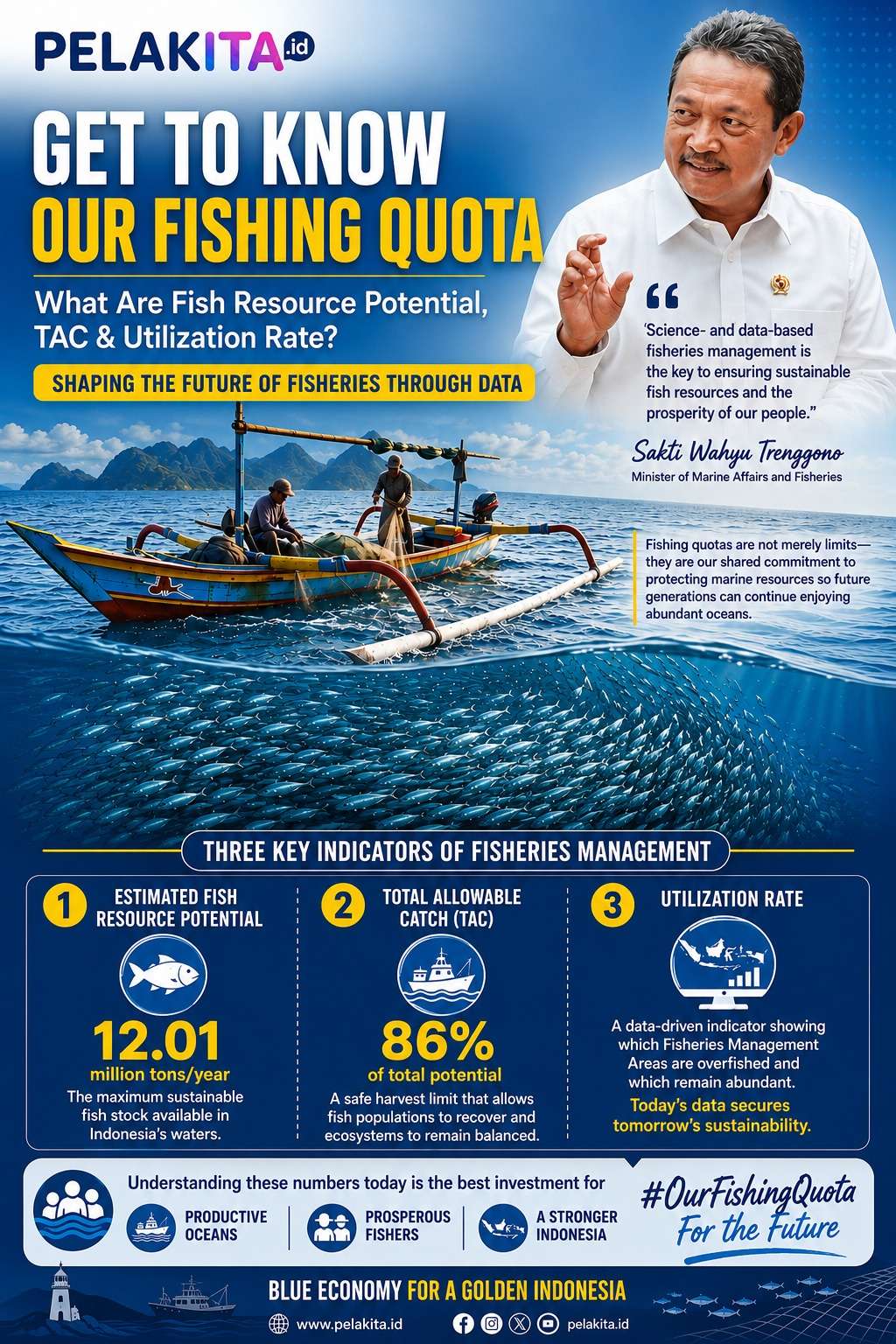
The challenge is balancing two equally important objectives: Supporting the livelihoods of millions of fishermen and coastal communities today. Ensuring fish populations remain healthy enough to sustain future generations. This balance is achieved through three key scientific indicators that guide fisheries policy.
Measuring Indonesia’s Marine Wealth
The first indicator is Estimated Fish Resource Potential (Estimasi Potensi Sumber Daya Ikan). Think of Indonesia’s oceans as a biological savings account. Scientists first estimate how much “capital” exists in the form of fish biomass. This represents the maximum sustainable biological capacity of the ecosystem.
According to the latest national assessment released in July 2026, Indonesia’s marine fish resource potential is estimated at 12.01 million metric tons annually.
This figure serves as the foundation for fisheries management. It tells policymakers the size of the country’s biological asset before determining how much can safely be harvested.
Why Indonesia Leaves Fish in the Ocean
The second indicator is the Total Allowable Catch (Jumlah Tangkapan yang Diperbolehkan—JTB). A common misconception is that if the ocean contains 12.01 million tons of fish, all of it can be harvested. Scientific fisheries management says otherwise. Indonesia deliberately limits harvests to approximately 86 percent of the estimated potential.
The remaining 14 percent is intentionally left in the ocean. This portion functions as biological capital—the breeding stock that allows fish populations to reproduce, recover naturally, and maintain ecosystem stability.
Without this biological reserve, fish stocks would gradually decline, eventually leading to overfishing, reduced catches, and long-term economic losses. In other words, sustainable fisheries are built on the principle that not every available fish should be caught.
Every Fishing Area Has Its Own Story
Indonesia does not manage all of its waters in the same way. The third scientific indicator—Utilization Level (Tingkat Pemanfaatan)—allows fisheries managers to evaluate each Fisheries Management Area (WPPNRI) individually.
Continuous monitoring helps determine whether a particular area falls into one of three categories: Abundant – Fish stocks remain healthy and can support additional harvesting. Optimal – Fishing pressure is balanced with natural replenishment. Overfished – Harvesting has exceeded sustainable limits and requires corrective measures.
This approach enables policymakers to tailor regulations to local conditions rather than imposing blanket restrictions across the entire archipelago.
If one region begins showing signs of overexploitation, quotas, fishing gear regulations, or management measures can be adjusted specifically for that area while allowing healthier regions to continue operating efficiently.
Quotas Protect Both Fish and Fishermen
Fishing quotas are often misunderstood as barriers to economic growth.
In reality, they function more like an insurance policy for Indonesia’s fisheries sector. Without scientifically determined harvest limits, excessive fishing could rapidly reduce fish populations, resulting in smaller catches, declining incomes, and increased competition among fishermen.
As Syahril A. Raup, Director of Fish Resources Management at the Directorate General of Capture Fisheries, Ministry of Marine Affairs and Fisheries, explains: “Without good management, overfishing can cause a decrease in fish stocks, reducing the catch of fishermen in the future, and even threatening national food security.”
This highlights an important principle: sustainable fisheries are not anti-business—they are essential to maintaining a healthy and profitable fishing industry. Protecting fish populations today helps secure livelihoods tomorrow.
A Data-Driven Future
Indonesia’s fisheries management increasingly relies on science, monitoring technologies, and ecosystem-based decision-making rather than intuition or short-term economic pressures.
The combination of Estimated Potential, Total Allowable Catch (JTB), and Utilization Level creates a framework that allows policymakers to make informed decisions while balancing environmental sustainability with economic development.
For consumers, these scientific calculations may seem invisible. Yet every responsibly managed fish that reaches the market reflects years of research and careful planning.
Looking Ahead
Indonesia’s oceans are among the country’s greatest natural assets, but they are not limitless.
Fishing quotas represent more than numerical limits—they embody a national commitment to ensuring that marine resources continue supporting food security, economic growth, and coastal livelihoods for decades to come.
The next time seafood appears on your dinner table, it is worth remembering that behind every catch lies an entire system of science designed to keep Indonesia’s oceans productive—not just for today, but for future generations.
___
Editor Kamaruddin Azis