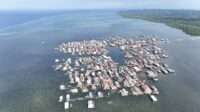

MARITIMEPOSTS.COM – Indonesia’s abundant marine resources have not always translated into prosperity for coastal communities. In Weri and Saharey Villages, Fakfak Regency, West Papua, limited access, inadequate storage facilities, and distribution challenges often force small-scale fishers to sell their catches raw, with limited economic value.
These neighboring villages are home to approximately 250 people and lie about 50 kilometers from Fakfak town. The journey takes up to four hours by road due to severely damaged infrastructure. This presents a significant challenge for communities whose livelihoods depend on fisheries resources.
Through the Unhas Patriot Expedition #9, a collaborative initiative between Indonesia’s Ministry of Transmigration and Hasanuddin University (Unhas), efforts are underway to change this situation. The initiative focuses on fisheries value addition, strengthening community business institutions, and developing market access so that local marine resources can generate greater economic value for fishing families.
Marine Potential and Limited Economic Access
Weri and Saharey have considerable fisheries potential that could be developed into higher-value processed products. However, limited cold-storage facilities and distribution access remain major obstacles to maintaining product quality and expanding market reach.
Fish catches face a familiar challenge: their quality deteriorates quickly, requiring them to be sold immediately. Under these circumstances, communities have limited bargaining power, while the distance and poor road conditions to economic centers increase distribution costs and risks.
This situation provides an important rationale for the Unhas Patriot Expedition to adopt an empowerment approach that goes beyond technical skills training. Communities need support to process their catches, establish collective businesses, package products properly, and develop marketing strategies that reach wider consumer markets.
Who Is Involved: Collaboration Between Academics and Communities
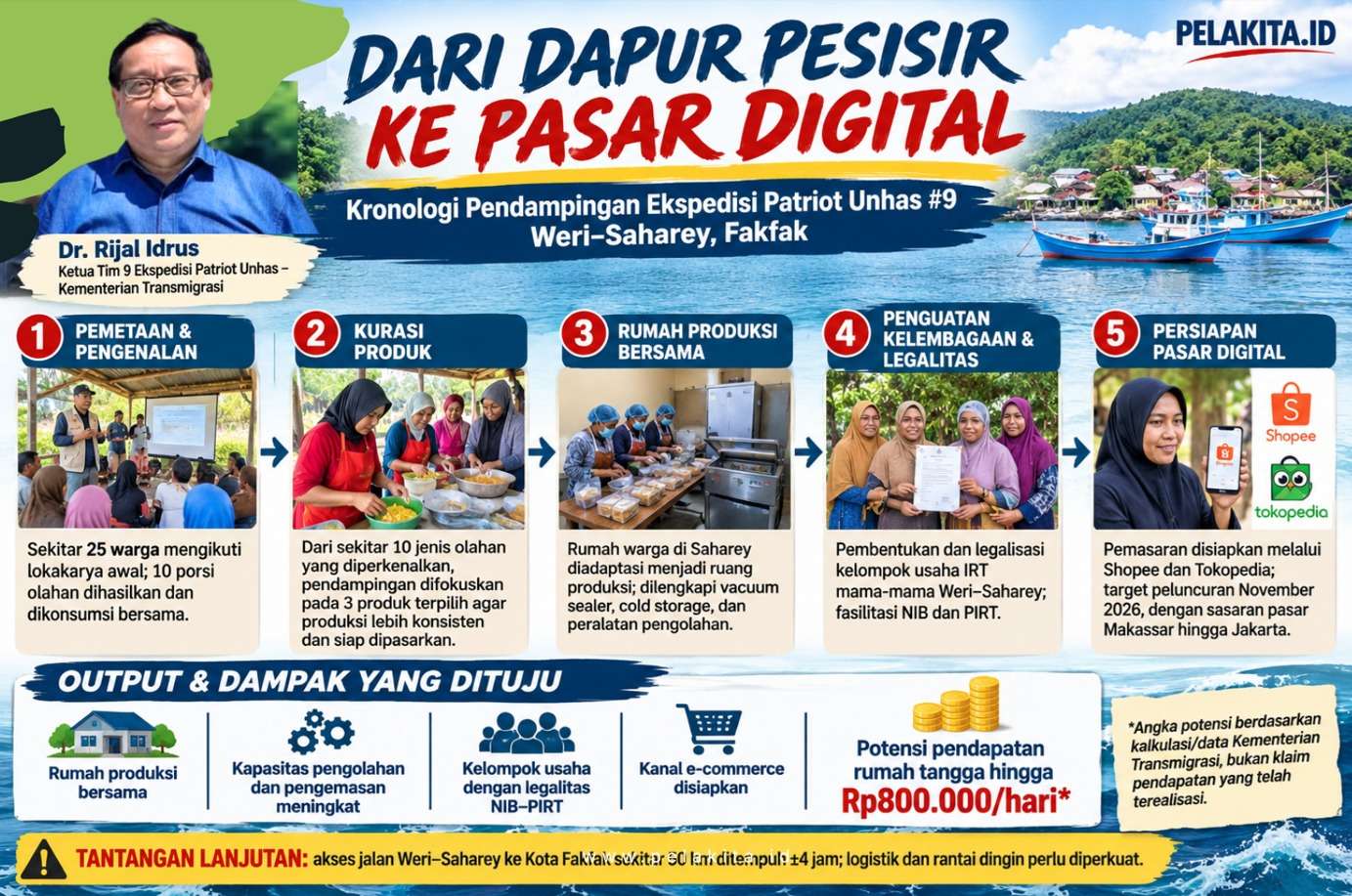
The Unhas Patriot Expedition #9 mentoring program is designed through complementary roles. Dr. Kasmiati handles the technical aspects of fisheries processing, Prof. Tamar focuses on strengthening and empowering community institutions, while Dr. Rijal Idrus and Team 9 are responsible for downstream development, product readiness, packaging, labeling, and marketing.
Dr. Rijal Idrus is the Head of Unhas Patriot Expedition Team #9, overseeing product development to prepare local products for market entry. According to him, processing training is only the initial stage of a broader process, as successful economic empowerment requires continuity between production, business management, and marketing.
The people of Weri and Saharey, particularly the coastal women’s business group, are the main actors in this initiative. They are not merely training participants but are being encouraged to become business operators who manage production and develop local products. The Ministry of Transmigration and Unhas serve as facilitators supporting the growth of community capacity.
The Purpose of the Unhas Patriot Expedition: From Skills to Business Independence
The primary objective of the Unhas Patriot Expedition is to help the people of Weri-Saharey increase the economic value of fisheries products through more structured processing and marketing. The program also seeks to shift production from household consumption toward a market-oriented business model.
Dr. Rijal Idrus emphasizes that training alone is insufficient if it only results in the ability to make products. Communities need to understand how to select promising products, produce them consistently, package them, build product identity, and manage marketing.
“If the ultimate goal is to strengthen the community’s economy, training must be followed by planned production, packaging, marketing, and the ability to manage a business,” said Dr. Rijal Idrus.
The facilitation is also intended to establish a business foundation that enables local products to reach broader markets, including through digital platforms. In this way, communities in relatively isolated coastal villages can still connect with markets beyond their immediate surroundings.
Program Inputs: Training, Production Facilities, Business Legality, and Marketing
The Unhas Patriot Expedition’s program inputs include human capacity development, the provision of processing facilities, the establishment of business institutions, and preparation for market access.
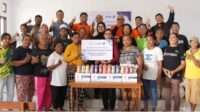
At the initial stage, approximately 25 residents participated in a fisheries-processing workshop. Of the approximately 10 product types introduced, the team subsequently conducted a selection process and identified three processed products as the main focus. This simplification was intended to help communities increase production volumes, maintain consistent taste, and prepare products for commercial packaging and marketing.
One practical step was to utilize a local resident’s house in Saharey Village as a shared production facility. This approach was chosen to enable production to begin without waiting for the construction of a new industrial facility. The shared production house was equipped with fisheries-processing equipment, a vacuum sealer, and cold-storage facilities to help maintain the quality of raw materials and finished products.
At the institutional level, the team facilitated the establishment and legal registration of the IRT business group comprising women from Weri-Saharey. The processing of Business Identification Numbers (NIB) and Home Industry Food Production Certificates (PIRT) forms part of the effort to strengthen the legal foundation of the business and ensure product eligibility for market distribution.
Marketing development is also being pursued through preparations for a digital ecosystem. Local products are targeted for sale through platforms such as Shopee and Tokopedia, with the aim of reaching consumers in Makassar and Jakarta. This strategy reflects the concept of “Marketing from the East to the West,” bringing products from Fakfak’s coastal communities to broader markets5. Results: A Business Foundation Is Taking Shape, While Logistics Challenges Remain
Several important foundations have been established through the Unhas Patriot Expedition #9. Communities have acquired fisheries-processing skills, business groups have begun receiving legal assistance, a shared production house has been prepared, and packaging and digital marketing strategies are being developed.
One significant achievement is the shift in production orientation. During the initial workshop, approximately 10 portions of processed fish products were immediately consumed by participants. This experience demonstrated that product-making skills must be accompanied by more structured production planning if the results are to be marketed.
Product selection became the next step. By focusing on three selected products, communities are expected to build consistent quality, increase production capacity, and prepare products for market entry. Meanwhile, business legality and online marketing preparations open opportunities for local products to reach consumers beyond their villages.
According to calculations and data from the Ministry of Transmigration cited in the program materials, the transition from selling raw fish to producing legally registered processed products has the potential to significantly increase fishing households’ income, reaching up to IDR 800,000 per day. This figure represents projected potential, not verified actual income.
Nevertheless, logistics remain a major challenge. Products ready for digital marketing must still travel approximately 50 kilometers over four hours by road to Fakfak town before being forwarded through courier services or air cargo. Without sustained support for road access, transportation, and cold-chain logistics, the market opportunities already being developed may not be fully realized.
Dr. Rijal Idrus notes that the team’s current assistance remains focused on strengthening community capacity at the grassroots level. Infrastructure improvements and connectivity require the involvement of government and other stakeholders at broader institutional levels.
“The logistics issue is something that this team has not yet addressed. Our work is still at the community level. There should also be interventions at a higher institutional level to improve access roads, and so on,” he said.
Looking Ahead: From Coastal Villages to Wider Markets
The Unhas Patriot Expedition #9 in Weri-Saharey demonstrates that coastal community empowerment can begin with the resources available in their immediate surroundings. Fish that were previously sold as raw commodities now have the potential to be processed, packaged, branded, and marketed as products with greater added value.
This optimism must be accompanied by sustained support. Communities need business mentoring, legal certainty, market access, and distribution infrastructure that enables their products to reach consumers while maintaining quality.
If collaboration between communities, universities, the Ministry of Transmigration, local governments, and logistics providers can continue to strengthen, Weri-Saharey may not only become a fish-producing village but also develop into a community-based fisheries-processing business hub.
From coastal kitchens in Fakfak, a pathway toward economic independence is being established. The journey may not be easy, but the potential of marine resources, community skills, and the collaboration already in place provide strong grounds for believing that products from eastern Indonesia can reach wider markets while bringing more tangible prosperity to fishing families.