
How the U.S.–Iran Conflict Is Reshaping Global Travel Mobility
MARITIMEPOSTS.COM – War is usually measured through missiles, military operations, casualties and economic losses. Yet another consequence often receives less attention: the movement of people.
Tourism is particularly sensitive to geopolitical instability because travel depends on something that cannot easily be quantified—people’s perception of safety. When a destination, airport, air corridor or transit hub is perceived as dangerous, travelers can cancel their journeys, postpone them, choose another destination or simply find another route.
The 2026 U.S.–Iran conflict provides a powerful illustration of this phenomenon. Its consequences have extended well beyond Iran and the immediate battlefield because the Middle East is also one of the world’s most important aviation and transit regions.
Available evidence suggests that the conflict has not simply stopped tourism. Instead, it has disrupted, redirected and redistributed tourism mobility across regions.
The Numbers Behind the Shock
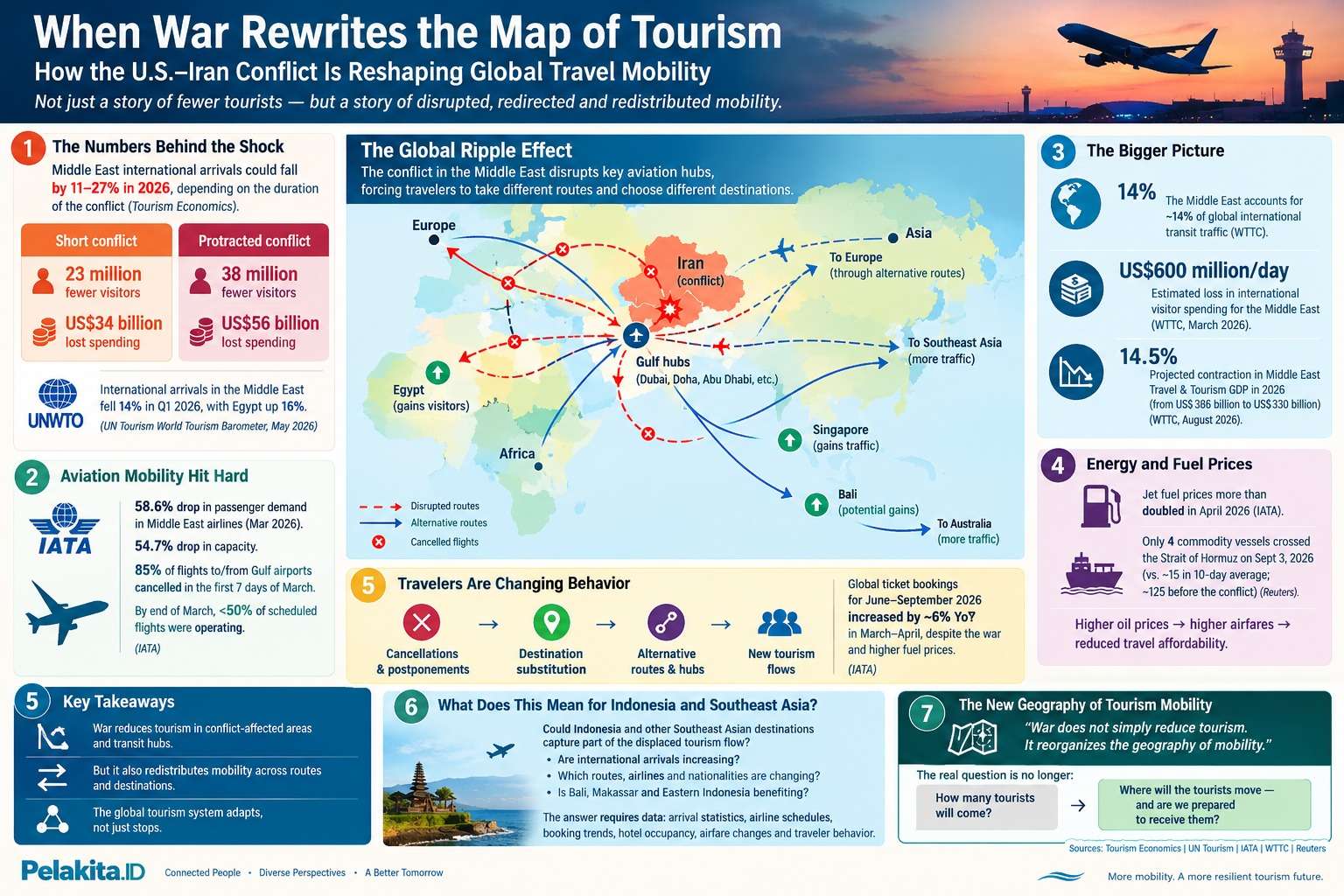
Tourism Economics estimates that international arrivals to the Middle East could decline by 11–27 percent in 2026, depending on how long the conflict lasts. Under its short-conflict scenario, the region could lose approximately 23 million visitors, equivalent to about US$34 billion in tourism spending. Under a prolonged-conflict scenario, the estimated loss rises to 38 million visitors and US$56 billion in tourism spending. These are scenario estimates rather than final losses, but they illustrate the potential scale of the disruption.
The first observed data already indicate a significant decline. According to the UN Tourism World Tourism Barometer, international tourist arrivals in the Middle East fell 14 percent during the first quarter of 2026. Yet the regional picture was far from uniform. While several Gulf destinations experienced substantial declines, Egypt recorded 16 percent growth, suggesting that tourists do not necessarily abandon travel altogether when conflict occurs—they may choose alternative destinations.
This unevenness is important. It tells us that tourism mobility is not simply a story of expansion or contraction. It is also a story of geographical substitution.
Airports Become the First Casualty
Perhaps the clearest evidence comes from aviation.
The International Air Transport Association (IATA) reported that Middle Eastern airlines experienced a 58.6 percent year-on-year decline in passenger demand in March 2026, while capacity fell 54.7 percent. The scale of the disruption was extraordinary: approximately 85 percent of flights arriving at or departing from Gulf airports were cancelled during the first seven days of March. By the end of the month, fewer than half of originally scheduled flights from those airports were operating.
The consequences went beyond passengers who wanted to visit the Middle East.
Dubai, Doha, Abu Dhabi and other Gulf aviation hubs function as bridges connecting Europe, Asia, Africa and other parts of the world. WTTC estimates that the Middle East represents approximately 14 percent of global international transit traffic. When these hubs are disrupted, the effect reaches travelers who may never have intended to visit the conflict zone itself.
A tourist traveling from Europe to Southeast Asia, for example, may previously have transited through a Gulf hub. When that corridor becomes uncertain, the journey can be reorganized through another hub or another flight path.
The traveler may still travel. The geography of travel changes.
War Does Not Always Stop Mobility
This may be the most interesting lesson emerging from the current crisis.
IATA found that direct Europe–Asia air traffic increased by 15.3 percent in April, partly reflecting a shift away from Middle Eastern transit hubs. In other words, disruption in one corridor created additional demand in another.
The implication is profound. Conflict can produce a chain of reactions: geopolitical conflict → perceived risk → cancelled or postponed journeys → route substitution → destination substitution → redistribution of tourism flows.
This means that the impact of war on tourism should not be measured only by asking how many tourists disappeared.
We should also ask: Where did they go instead?
Travelers Are Choosing Again
Booking data reinforce this interpretation.
IATA reported that global ticket bookings for travel during June–September 2026 were around 6 percent higher year-on-year during March and April, despite the conflict and the surge in aviation fuel prices. At the same time, travelers were increasingly selecting destinations outside the Middle East.
This creates what economists might call a substitution effect.
A traveler who cancels Dubai may choose Singapore. Someone who postpones a Gulf holiday might select Bangkok, Kuala Lumpur, Bali or another destination. A passenger who previously connected through Doha might instead travel through another Asian or European hub.
Not every displaced tourist necessarily disappears from the global tourism system.
Some simply move elsewhere.
The Price of Flying Also Changes
There is another layer to the story: energy.
The conflict has affected energy markets and shipping through the Strait of Hormuz, a critical corridor for global oil supplies. Reuters reported in early September that shipping activity through the strait remained substantially below normal levels, with only four commodity vessels crossing on September 3 compared with a 10-day average of around 15 observed vessels. Before the conflict, roughly 125 commercial vessels passed through the strait each day.
For tourism, the connection may not be immediately obvious.
Oil prices influence jet-fuel prices. Jet fuel influences airline costs. Airline costs influence ticket prices. Higher ticket prices can influence travelers’ decisions.
The chain therefore becomes: war → energy disruption → fuel prices → airfares → travel affordability → tourism demand. IATA reported that jet-fuel prices more than doubled during April’s disruption, adding pressure to airlines and travelers.
A US$600 Million-a-Day Tourism Problem
The economic implications are substantial.
WTTC estimated in March that the conflict was costing the Middle East Travel & Tourism sector at least US$600 million per day in international visitor spending. The estimate was based on its pre-conflict projection of approximately US$207 billion in international visitor spending in the region during 2026.
By August, WTTC’s updated outlook projected that Middle East Travel & Tourism GDP could contract by 14.5 percent in 2026, declining from approximately US$386 billion in 2025 to US$330 billion.
For destinations heavily dependent on international visitors, this is not simply a tourism statistic.
It affects hotels, restaurants, airlines, airports, tour operators, guides, retailers, transport providers and millions of people whose livelihoods are connected directly or indirectly to tourism.
But Somebody Else May Benefit
The paradox is that geopolitical disruption can create both losers and beneficiaries. A Gulf destination can lose visitors while another destination gains them. An airline can cancel flights while a competing airline adds capacity. One transit hub can become quiet while another becomes busier.
This is why tourism mobility should be understood as a network rather than a collection of individual destinations. When one node becomes inaccessible, travelers and airlines search for alternatives. The resulting map of tourism may therefore look different from the map that existed before the conflict.
What Does This Mean for Southeast Asia?
This raises an important question for countries such as Indonesia.
If Middle Eastern aviation hubs become less attractive or less reliable, could Southeast Asian destinations capture part of the displaced tourism flow?
Singapore, Bangkok, Kuala Lumpur, Bali and Jakarta are already connected to major international aviation networks. The question is whether they can capture additional traffic generated by route substitution.
The answer cannot simply be assumed.
Researchers would need to examine international arrival statistics, airline schedules, booking data, airport passenger movements, hotel occupancy, airfare changes and traveler nationality before and after the conflict.
Indonesia could particularly examine whether travelers who would traditionally have connected through Gulf hubs have shifted toward Southeast Asian gateways.
For Bali, for example, the relevant question is not simply whether foreign arrivals increased.
It is whether the origin, route, airline and travel behavior of those visitors changed because of geopolitical instability elsewhere.
From War to a New Geography of Mobility
The 2026 U.S.–Iran conflict therefore offers an unusual laboratory for understanding contemporary tourism. The conventional assumption is straightforward: War reduces tourism.
The emerging evidence suggests a more complicated reality: War disrupts tourism mobility, but disruption can also redistribute mobility. Some destinations experience cancellations and falling arrivals. Some transit hubs lose their strategic position. Other airports gain passengers. Alternative routes emerge. Travelers substitute destinations. Airlines redesign networks.
The global tourism system does not simply stop.
It adapts.
This may be the most important lesson for tourism policymakers. Destination resilience should not be measured only by the ability to attract tourists during peaceful periods. It should also be measured by the ability to understand and respond to sudden changes in geopolitical risk, aviation networks, energy prices and traveler perceptions.
For Indonesia and Southeast Asia, the lesson is particularly relevant. The question is no longer simply how many tourists will come? The more strategic question may be:
When the world’s mobility map is disrupted, where will the tourists move—and are we prepared to receive them?