

- The consultation also highlighted the importance of collaboration between BPRL Makassar and higher education institutions.
- The forum recommended reviewing and updating cooperation agreements with universities according to the institution’s needs, creating opportunities for academic expertise to support marine spatial planning, technical assessment and service improvement.
- Participants included representatives from the South Sulawesi and West Sulawesi Marine and Fisheries Offices, the Bali Marine Management Office, BPPHMKP Makassar, universities and private-sector companies.
MARITIMEPOSTS.COM – MAKASSAR, Indonesia — August 11, 2026 — Indonesia’s marine spatial management authority in eastern Indonesia is seeking to make marine-use licensing more transparent, accessible and responsive through a public consultation on Kesesuaian Kegiatan Pemanfaatan Ruang Laut (KKPRL), or conformity of marine spatial utilization activities.
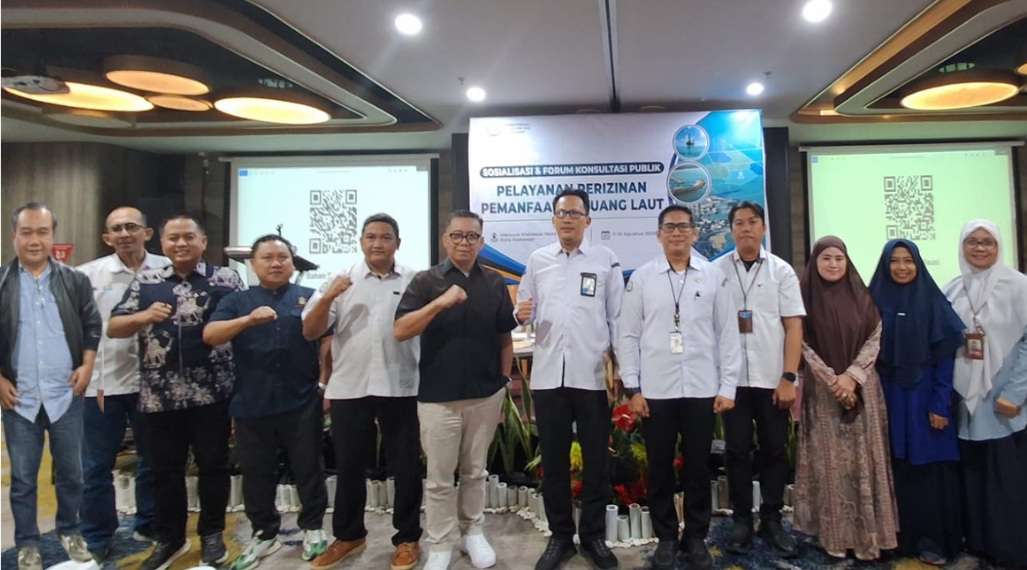
The Makassar Marine Spatial Planning Office (Balai Penataan Ruang Laut/BPRL Makassar), under the Directorate General of Marine Spatial Planning of Indonesia’s Ministry of Marine Affairs and Fisheries (KKP), held a Socialization and Public Consultation Forum (Forum Konsultasi Publik/FKP) on the service standards for assistance in KKPRL applications on Tuesday, August 11.
The forum brought together government agencies, universities, businesses and other stakeholders using or involved in marine space across BPRL Makassar’s working area.
The initiative is designed not merely to explain KKPRL procedures, but also to identify problems experienced by applicants and develop concrete recommendations for improving public services.
From information-sharing to service reform
The consultation identified several challenges faced by marine-space users.
Among them are limited understanding of KKPRL procedures, difficulties in preparing applications, challenges in identifying the reasons behind technical assessment rejections, and limited awareness of KKPRL requirements among users at the village and sub-district levels.
The forum therefore recommended stronger publication of service standards, broader socialization, and more intensive assistance for KKPRL applicants.
BPRL Makassar also plans to expand information and outreach activities to villages and sub-districts, particularly because many marine-space users remain unfamiliar with the requirement to obtain KKPRL conformity.
The approach reflects a shift from a purely administrative licensing model toward a more service-oriented and participatory system.
Universities and businesses join the dialogue
The consultation also highlighted the importance of collaboration between BPRL Makassar and higher education institutions.
The forum recommended reviewing and updating cooperation agreements with universities according to the institution’s needs, creating opportunities for academic expertise to support marine spatial planning, technical assessment and service improvement.
Participants included representatives from the South Sulawesi and West Sulawesi Marine and Fisheries Offices, the Bali Marine Management Office, BPPHMKP Makassar, universities and private-sector companies.
Among the participants recorded in the forum documents were representatives of Hasanuddin University’s Faculty of Engineering, ITBM Balikdiwa, PT Rekind Daya Mamuju, PT Triple Eight Energy and PT MAA Ataita Indah.
Their participation is significant because marine space is shared by multiple interests, including fisheries, infrastructure, energy, tourism, transportation, conservation and coastal communities.
Effective spatial governance therefore requires coordination beyond a single government institution.
KKPRL as more than a licensing requirement
KKPRL is increasingly important as Indonesia expands economic activities in its marine and coastal areas.
For businesses, spatial conformity can provide greater certainty regarding where activities may be developed. For local governments, it can help prevent development from conflicting with marine spatial plans. For communities, it can provide greater assurance that economic activities will not simply displace existing uses and livelihoods.
In this context, KKPRL should not be viewed merely as another administrative requirement.
Instead, it can function as a spatial governance instrument that connects investment certainty, environmental protection, community interests and sustainable marine development.
BPRL Makassar has previously emphasized that problems in KKPRL applications often involve regulatory misunderstandings, spatial coordinates and data, incompatibility with designated zones, and incomplete technical or administrative documentation.
Early consultation and clearer access to spatial information can therefore help reduce repeated submissions, transaction costs and potential conflicts.
Building a more accessible marine spatial service
Another important outcome of the forum is the commitment to improve access to BPRL Makassar’s service points.
The consultation recommended greater public information about the Gerai Pelayanan, or service counter, enabling users to access assistance either at the BPRL Makassar office or through designated service units according to their respective working areas.
The forum’s recommendations are accompanied by target completion periods, including actions scheduled for the third and fourth quarters of 2026.
This is important because public consultation can only have value if stakeholder input is translated into measurable institutional action.
The forum’s official minutes state that the head of the service unit is prepared to receive the identified problems, proposed recommendations and agreed implementation timelines, while stakeholders will monitor progress on the agreed improvements.
Makassar as a gateway for eastern Indonesia’s marine governance
BPRL Makassar’s role extends beyond Makassar itself.
Under the current organizational arrangement, its working area covers a broad part of eastern Indonesia, including South Sulawesi, West Sulawesi, Central Sulawesi, Southeast Sulawesi, North Sulawesi, Gorontalo, Bali, West Nusa Tenggara and East Nusa Tenggara.
This gives the institution an important role in connecting national marine spatial policy with implementation at the regional and local levels.
Its challenge is therefore substantial: the region combines rapidly growing economic activity with highly sensitive coastal and marine ecosystems.
Marine spatial planning has to accommodate investment and infrastructure while also protecting fisheries, conservation areas, coastal livelihoods and ecological functions.
A stronger role for public participation
The August 11 consultation suggests that BPRL Makassar is positioning public participation as part of the improvement cycle rather than as a one-off event.
The mechanism is relatively straightforward: identify problems, receive recommendations, agree on a timeline, implement improvements and monitor the results.
Such a mechanism can strengthen public trust because applicants and stakeholders are given a formal space to explain where the existing service system creates difficulties.
It also gives the government an opportunity to identify problems that may not be visible from within the bureaucracy itself.
Ultimately, better KKPRL services are not simply about processing applications faster.
They are about ensuring that marine-space users understand the rules, have access to reliable information, receive adequate assistance and can identify where problems occur when an application encounters technical or administrative obstacles.
Toward more accountable marine spatial governance
The BPRL Makassar initiative comes at a time when Indonesia’s marine space is becoming increasingly important to the country’s economic future.
Ports, fisheries, tourism, offshore infrastructure, energy, cables, conservation and other marine activities will increasingly compete for limited and ecologically sensitive space.
That makes transparent spatial governance essential.
The public consultation in Makassar offers a practical example of how marine spatial governance can move beyond maps, permits and administrative procedures toward a system that combines regulatory certainty, stakeholder participation, technical assistance and accountability.
For Indonesia’s eastern marine region, that may ultimately be just as important as the spatial plans themselves.
The future of the ocean economy will depend not only on how much marine space Indonesia can utilize, but on how intelligently, transparently and sustainably that space is governed.
By K. Azis