


The RPP for WPPNRI 712 is intended not only for the Ministry of Marine Affairs and Fisheries, but also for local governments, relevant agencies, and various other stakeholders.
MARITIMEPOSTS.COM — The issuance of Minister of Marine Affairs and Fisheries Decree No. 62 of 2026, signed on August 20, 2026, concerning the Fisheries Management Plan (RPP) for Fisheries Management Area of the Republic of Indonesia (WPPNRI) 712, marks an important development in strengthening national capture fisheries governance.
The decree does more than simply update the fisheries management planning document.
More broadly, the issuance of Ministerial Decree No. 62/2026 demonstrates significant progress toward developing fisheries governance based on area-specific management, data, sustainability, and policy integration.
For the Directorate General of Capture Fisheries of the Ministry of Marine Affairs and Fisheries, including the Directorate of Fish Resources Management (SDI), the updating of the RPP for WPPNRI 712 represents an important part of efforts to ensure that fishery resources are utilized optimally while remaining within the principles of sustainability and safeguarding the interests of future generations.
WPPNRI 712 holds a strategic position because it encompasses the waters of the Java Sea, one of Indonesia’s most intensively fished marine areas.
The area is also part of the Measured Fishing Zone, or Zone 06, as stipulated in Government Regulation No. 11 of 2023 on Measured Fishing.
Given these characteristics, the need for an up-to-date management plan has become increasingly important.
Pressure on fish resources, changes in administrative boundaries, developments in fishing fleets and fishing activities, evolving policies, and the need to maintain ecosystem sustainability all require a continuously updated management approach.
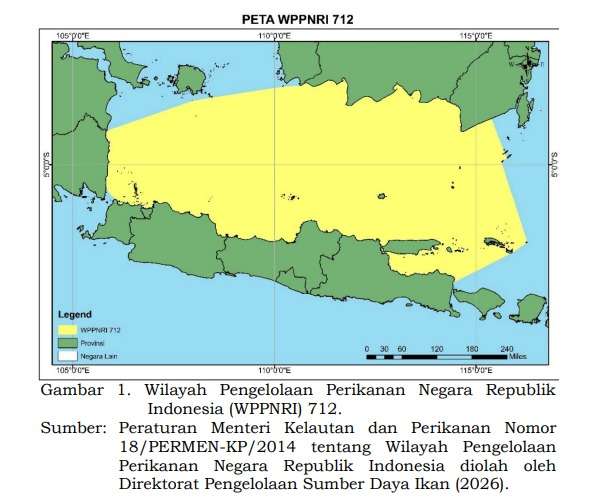
From the 2016 RPP to the 2026 RPP
The RPP for WPPNRI 712 is not actually a new document. The government previously established an RPP for this area through Minister of Marine Affairs and Fisheries Decree No. 79/KEPMEN-KP/2016.
However, nearly a decade after the document was established, fisheries conditions and the national policy framework have undergone significant changes.
Therefore, evaluating the previous RPP became essential. The evaluation considered, among other factors, production trends, the utilization status of fish resources, changes in administrative boundaries, regulatory developments, and recommended fishing efforts.
The evaluation concluded that updates were needed to the status of fish resources, fisheries management policies, current management issues, and the fisheries management action plan for WPPNRI 712.
This is where the significance of Ministerial Decree No. 62/2026 becomes evident. The document serves as an instrument to bring the management of WPPNRI 712 into a new phase that is more responsive to the current requirements of fisheries governance.
Potential Exceeding One Million Tons per Year
From a resource perspective, WPPNRI 712 holds strategic importance for Indonesia’s fisheries sector.
Based on Minister of Marine Affairs and Fisheries Decree No. 19 of 2022 concerning Estimated Potential, Allowable Catch, and Utilization Levels of Fish Resources in WPPNRI, the estimated fishery resource potential in WPPNRI 712 reaches 1,034,485 tons per year.
This figure demonstrates the enormous economic opportunity contained in the Java Sea. At the same time, however, it also carries significant governance implications.
A large resource potential does not automatically mean that resources can be exploited without limits. On the contrary, the greater the fisheries potential, the more important it becomes to ensure effective control of fishing effort, monitoring of resource utilization, resource protection, and equitable distribution of benefits.
The RPP therefore serves as an important instrument for balancing two interests at once: positioning fisheries as a source of economic growth while ensuring that fish resources remain available over the long term.
The preparation of the RPP for WPPNRI 712 also does not stand apart from developments in international fisheries governance.
The document refers to the principles of the Code of Conduct for Responsible Fisheries (CCRF) of the FAO 1995, particularly the principle that the right to fish must be accompanied by the obligation to conduct fishing activities responsibly.
This principle emphasizes that fisheries management must ensure the quality, diversity, and availability of fish resources for both present and future generations.
Fisheries management must also be placed within the broader context of food security, poverty reduction, and sustainable development.
Thus, the updating of the RPP for WPPNRI 712 demonstrates Indonesia’s increasingly strong shift in fisheries governance—from simply pursuing production toward more responsible resource management.
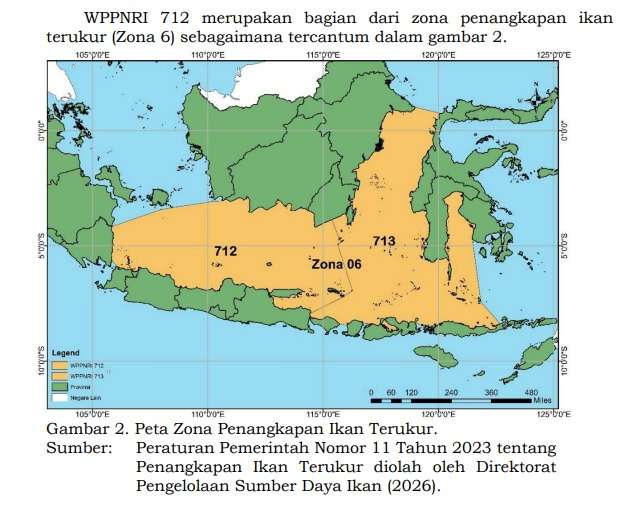
The RPP as a Multi-Stakeholder Governance Instrument
Another important aspect of Ministerial Decree No. 62/2026 is the role of the RPP as a shared management framework.
The RPP for WPPNRI 712 is intended not only for the Ministry of Marine Affairs and Fisheries, but also for local governments, relevant agencies, and various other stakeholders.
This means that fisheries management is not regarded as the responsibility of a single directorate or ministry. The complexity of marine areas requires the involvement of multiple institutions and stakeholders.
In this context, the RPP can serve as a common framework for aligning the interests of conservation, production, economic development, enforcement, fishing communities, local governments, and national development priorities.
This becomes increasingly relevant to the implementation of the Measured Fishing policy, which positions WPPNRI as a key spatial basis for managing fishing activities.
Three Foundations of Fisheries Management
The RPP for WPPNRI 712 has a clearly defined scope: the status of fisheries, the strategic fisheries management plan, and the management and evaluation period.
This structure demonstrates that management does not stop at identifying problems.
The fisheries status provides the basis for understanding the current condition of fish resources and their utilization. The strategic plan then translates these conditions into management policies and actions. Meanwhile, the management and evaluation period provides an opportunity to review and improve policies in response to the latest developments.
Such an approach is important because fisheries management is fundamentally an adaptive process. Fish resources, climate conditions, fishing technology, markets, fleets, policies, and the socioeconomic conditions of fishing communities are constantly changing.
Therefore, a good RPP should not be merely an administrative document. It must function as a living policy instrument that is continuously evaluated and improved.
The issuance of Ministerial Decree No. 62 of 2026 should be viewed as an important step forward by the Directorate General of Capture Fisheries in strengthening the foundation of WPPNRI-based fisheries governance.
For WPPNRI 712 in particular, this update is strategically significant because the Java Sea is one of Indonesia’s most important fishing areas while simultaneously facing complex pressures from resource utilization.
The challenge now is to ensure that the RPP does not remain merely a policy document.
Its implementation must be translated into measurable management, effective monitoring and enforcement, science-based resource utilization, control of fishing effort, ecosystem protection, and improved fisher welfare.
Ultimately, the success of Ministerial Decree No. 62/2026 should not be measured merely by the issuance of a ministerial decree, but by the extent to which the document is able to transform fisheries management practices on the ground.
From this perspective, the updating of the RPP for WPPNRI 712 represents an important step forward: from planning toward governance, from exploitation toward measured utilization, and from a production-oriented approach toward fisheries that are both productive and sustainable.
Editor K. Azis