
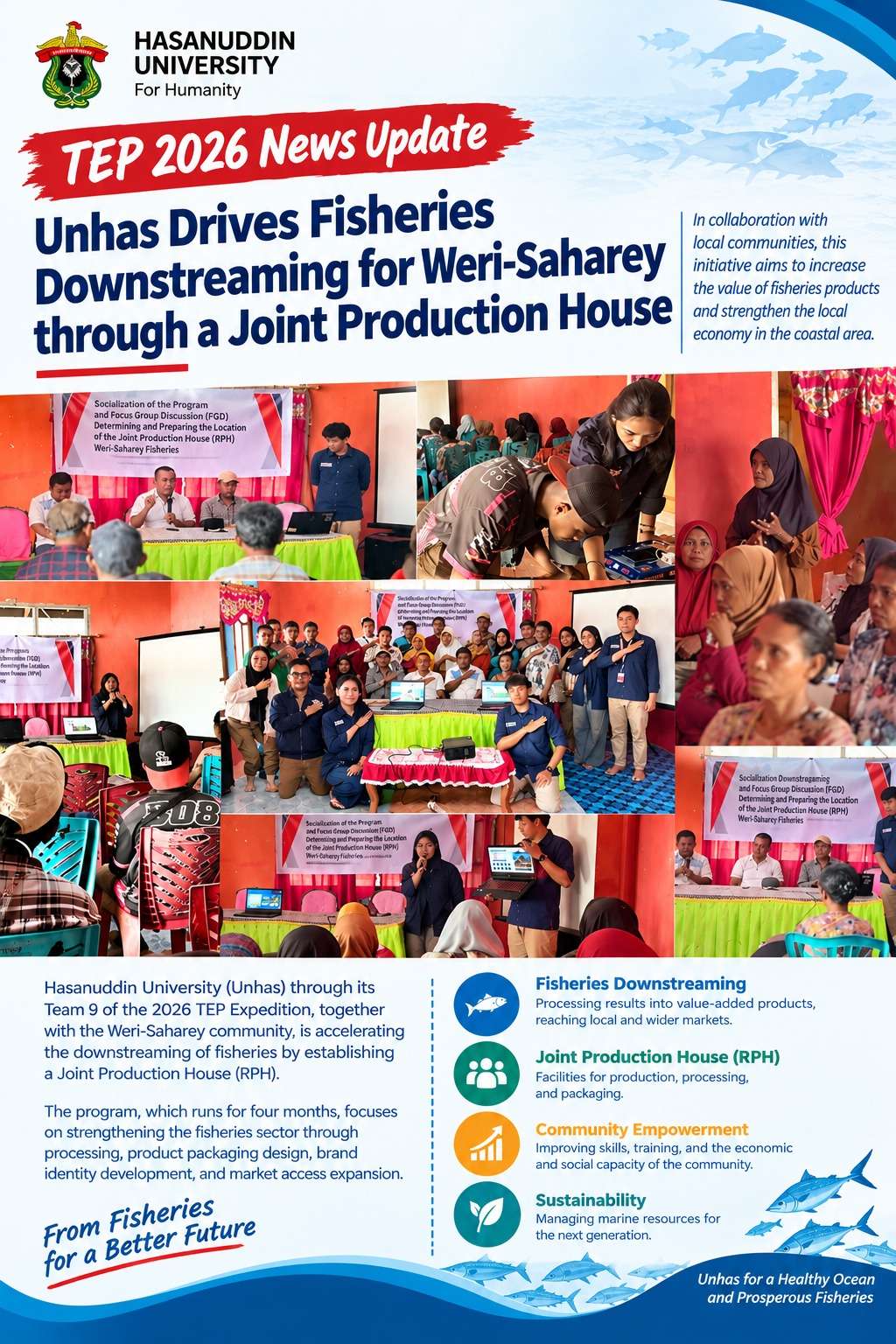
The four-month program is designed to increase the economic value of local fisheries products through processed-product development, packaging design, brand identity development, and expanded market access.
The initial phase was marked by the Program Socialization and Focus Group Discussion (FGD) on the Determination and Preparation of a Joint Production House (RPB) Site, held at the Saharey Village Hall on Friday, September 4, 2026, at 1:30 p.m. local time.
MARITIMEPOSTS.COM— Team 9 of the 2026 Patriot Expedition (TEP) of Hasanuddin University (UNHAS) has begun implementing a fisheries downstreaming program in the Weri-Saharey Transmigration Area, East Fakfak District, Fakfak Regency, Southwest Papua.
The four-month program is designed to increase the economic value of local fisheries products through processed-product development, packaging design, brand identity development, and expanded market access.
The initial phase was marked by the Program Socialization and Focus Group Discussion (FGD) on the Determination and Preparation of a Joint Production House (RPB) Site, held at the Saharey Village Hall on Friday, September 4, 2026, at 1:30 p.m. local time.
The meeting was the first activity under the research program led by Ir. Rijal M. Idrus, M.Sc., Ph.D., entitled “Downstreaming and Diversification of Fisheries Products Based on a Joint Production House in the Weri-Saharey Transmigration Area,” implemented within the framework of the Indonesian Ministry of Transmigration program.
The meeting was attended by 30 participants representing government institutions and local communities, including the Head of East Fakfak District, the Heads of Saharey and Weri Villages, representatives of Baperkam Weri and Baperkam Saharey, BUMKam Saharey, young people from Weri-Saharey, and women from fishing families.
During the meeting, Team 9 TEP Unhas presented the intervention stages to be implemented throughout the assignment, ranging from the preparation of production facilities through the Joint Production House, packaging skills development, brand identity creation, digital marketing, and business matching with prospective business partners.
The FGD also discussed the readiness of the proposed site for the Weri-Saharey Fisheries Joint Production House.
One of the key decisions reached during the meeting was the agreement on the final location of the Weri-Saharey Fisheries Joint Production House.
The location was determined through discussions involving the participants as well as officials from the district and villages.
The agreement provides the foundation for the next stage, including preparation of the production space, organization of work zones, and installation of packaging equipment that will eventually be used by the community.
This approach is consistent with the TEP Unhas program’s Participatory Action Research (PAR) design, which places local communities as the primary subjects and partners in the change process—from determining the RPB location and developing packaging and branding to opening access to markets.
Why Fisheries?
The decision to focus on fisheries is not without reason. The Weri-Saharey Transmigration Area is located in the coastal zone of East Fakfak District, an area with fisheries potential and community activities closely connected to marine resources. However, the challenges faced by local communities are not limited to fishing activities themselves, but also concern what happens after the catch is landed.
Limited access to organized processing facilities means that communities still lack sufficient capacity to transform raw fisheries commodities into value-added, market-ready products.
Home-based processed products also face challenges related to packaging, product information, brand identity, and limited marketing networks. These conditions make it difficult for local products to reach broader markets, including consumers in Fakfak City.
This situation has encouraged Team 9 TEP Unhas 2026 to look beyond production capacity and develop the value chain that follows production.
The program is designed around three major components: the Joint Production House as a processing and packaging facility; capacity building in packaging and branding; and expanded market access and partnerships with business actors in Fakfak City.
These three components will be connected with other fisheries cluster programs being implemented in parallel in the area, with the expectation of creating a fisheries value chain stretching from upstream production to downstream markets.
The primary objective is therefore to increase the economic value of community-caught fisheries products by strengthening local capacity in processing, packaging, branding, and community-based marketing.
More specifically, the program aims to operationalize the RPB, improve the packaging skills of women’s and youth groups, develop the identity of Weri-Saharey fisheries products through a participatory process, and establish marketing networks and partnerships with business actors in Fakfak City.
Bridging the Gap Between Fishers’ Catches and the Market
The Joint Production House being prepared under the program will utilize an existing building in the area. The facility will be reorganized into a more structured and hygienic production space and equipped with packaging-support equipment, including a vacuum sealer, digital scales, production tables, and other necessary tools.
The RPB will serve as a community asset that can be used sustainably by local residents for production and packaging activities.
However, establishing an RPB is not simply a matter of providing a building and equipment.
The team is also preparing mentoring activities to ensure that the community can operate the facility independently.
Women’s groups will play an important role in the operational management of the RPB, particularly in production and packaging activities. Youth groups, meanwhile, will be strengthened in digital marketing, social media management, online stores, and product distribution to business partners.
Fishing communities themselves will remain a critical part of the supply chain because their catches will serve as the primary raw materials processed through the RPB.
This approach means that the program will not stop at the distribution of equipment or the delivery of training.
From the outset, Team 9 TEP Unhas 2026 has sought to connect raw materials, processing, packaging, product identity, and markets into an integrated chain of mutually reinforcing activities.
Training and Business Matching for the Community
Following the preparation of the RPB, the program will move into a series of training sessions and business-matching activities.
The first training session will focus on Basic Packaging, covering the selection of packaging types and materials according to product characteristics, hygiene and sanitation principles, sealing techniques, and methods for maintaining product quality during storage.
The training will include hands-on practice using sample products and equipment available at the RPB, including vacuum sealers and digital scales.
The next session will be Product Labeling and Market Standards Training, which will introduce participants to the preparation of more complete product information, including product names, ingredients, net weight, production and expiration dates, and producer identity.
Participants will also be introduced to packaging standards required for products to become more market-ready for distribution through shops and minimarkets.
Meanwhile, Real Product Packaging Training will provide participants with a more practical, hands-on experience. The entire training sequence will also be evaluated through pre-tests and post-tests to measure improvements in participants’ understanding.
Thus, the success of the program will not be measured solely by the number of people attending the training, but also by their ability to independently carry out packaging processes.
In addition to packaging, the community will participate in determining product identity through branding training and FGDs. Discussions will cover the values and local stories of Weri-Saharey, brand-name selection, as well as logo, color, and packaging design.
The process will be conducted collaboratively with the community so that the resulting product identity genuinely reflects Weri-Saharey.
Once the products are ready, activities will continue with digital marketing and business matching in Fakfak City. The team and community representatives will introduce the products to prospective partners, including souvenir shops, local minimarkets, seafood restaurants, and other business actors.
Aligned with National and Regional Development Agendas
The fisheries downstreaming program developed by TEP Unhas in Weri-Saharey does not stand alone.
The program has been designed within a framework aligned with national and regional development agendas, ranging from the Asta Cita agenda and policies of the Ministry of Transmigration to the development directions of Southwest Papua Province and Fakfak Regency.
At the national level, the program is most directly connected to the fifth Asta Cita priority, which calls for continued downstreaming and industrialization to increase domestic value addition. This principle is translated at the community level through efforts to transform fishers’ catches from raw commodities into processed products with proper packaging, branding, and market access.
The program is also aligned with the fourth Asta Cita priority through the strengthening of women’s and youth capacities, as well as the sixth Asta Cita priority through a development approach rooted in villages and local communities.
At the Ministry of Transmigration level, the program directly supports the 2026 TEP priority theme of Downstreaming and Industrialization, which also emphasizes strengthening economic institutions, human-resource capacity, productive economic activities, digitalization, and appropriate technology and innovation.
In Southwest Papua, the program is relevant to the province’s 2025–2029 development vision, “A Safe, Prosperous, Dignified and Independent Southwest Papua,” particularly its agenda of improving inclusive economic competitiveness and strengthening local flagship products.
The Southwest Papua 2027 Regional Government Work Plan (RKPD) also explicitly places local economic downstreaming and the empowerment of Indigenous communities among its development priorities.
At the Fakfak Regency level, the approach is likewise consistent with a development direction emphasizing inclusive planning, sustainable development, cross-sectoral synergy, and alignment between regency-level development and provincial and national priorities.
Strengthening leading commodities, increasing community capacity, and expanding market access are also part of the discussion surrounding Fakfak’s regional economic development.
Thus, the Weri-Saharey Fisheries RPB is not merely being designed as a production facility, but as a small-scale village-level instrument for translating the economic downstreaming agenda into actions that can directly benefit local communities.
East Fakfak District Head Welcomes the Research Program
The Head of East Fakfak District, Gani Samai, S.E., welcomed the implementation of Team 9 TEP Unhas 2026’s program in Weri-Saharey.
“A program that promotes fisheries processing all the way to marketing creates an opportunity for communities to gain greater economic benefits from the potential they already possess,” he said.
He expressed his gratitude that Weri-Saharey had received assistance that went beyond production and also addressed the processes that take place after products are produced.
“We are grateful for activities like this in Weri-Saharey. The community’s fisheries potential is very significant, and we hope this downstreaming program will help people move beyond selling their catches as raw materials and instead process them into products with added value,” he explained.
According to him, the program also creates broader opportunities for empowerment, particularly for young people and women’s groups.
“We hope that the youth and people of Weri-Saharey can be further empowered and develop skills that can become new sources of income. This program is interesting because it does not stop at production or processing, but also extends to marketing,” he said.
He also considered the planned business-matching activity important because it would give communities a more direct opportunity to understand the market.
“Business matching is very beneficial because the community will be introduced directly to prospective buyers and business actors. This is important for the sustainability of the program, so that the products produced will actually have a market and contribute to improving the community’s economy,” he explained.
Over the four-month implementation period, Team 9 TEP Unhas aims to establish a fisheries downstreaming ecosystem that can continue operating after the expedition ends.
The success of the program will not be determined merely by whether an RPB has been established, but by whether the community can use the facility, manage products, reach markets, and sustain these economic activities independently.
The aspiration is simple yet significant: fish that previously left Weri-Saharey as raw commodities can, in the future, leave the area as local products with an identity, a story, a market, and—most importantly—greater economic value for the people who produce them.
The downstreaming initiative forms part of TEP Unhas 2026’s broader effort to build a more integrated Weri-Saharey fisheries value chain, connecting production, processing, packaging, branding, and marketing.
Editor: Denun