
MARITIMEPOSTS.COM – The long-term economic sustainability of rural coastal communities depends fundamentally on their structural transition from low-margin, raw commodity extraction to high-margin, value-added downstream processing.
Baseline Reality and Strategic Context
The long-term economic sustainability of rural coastal communities depends fundamentally on their structural transition from low-margin, raw commodity extraction to high-margin, value-added downstream processing.
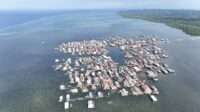
In the coastal transmigration area of Weri-Saharey, situated within the Fakfak Timur District of Fakfak Regency, West Papua (Papua Barat), local livelihoods have historically been tethered to primary marine capture fisheries. However, relying exclusively on the sale of unprocessed, highly perishable catches exposes coastal households to extreme seasonal price volatility, post-harvest biomass losses, and severe profit margin compression.
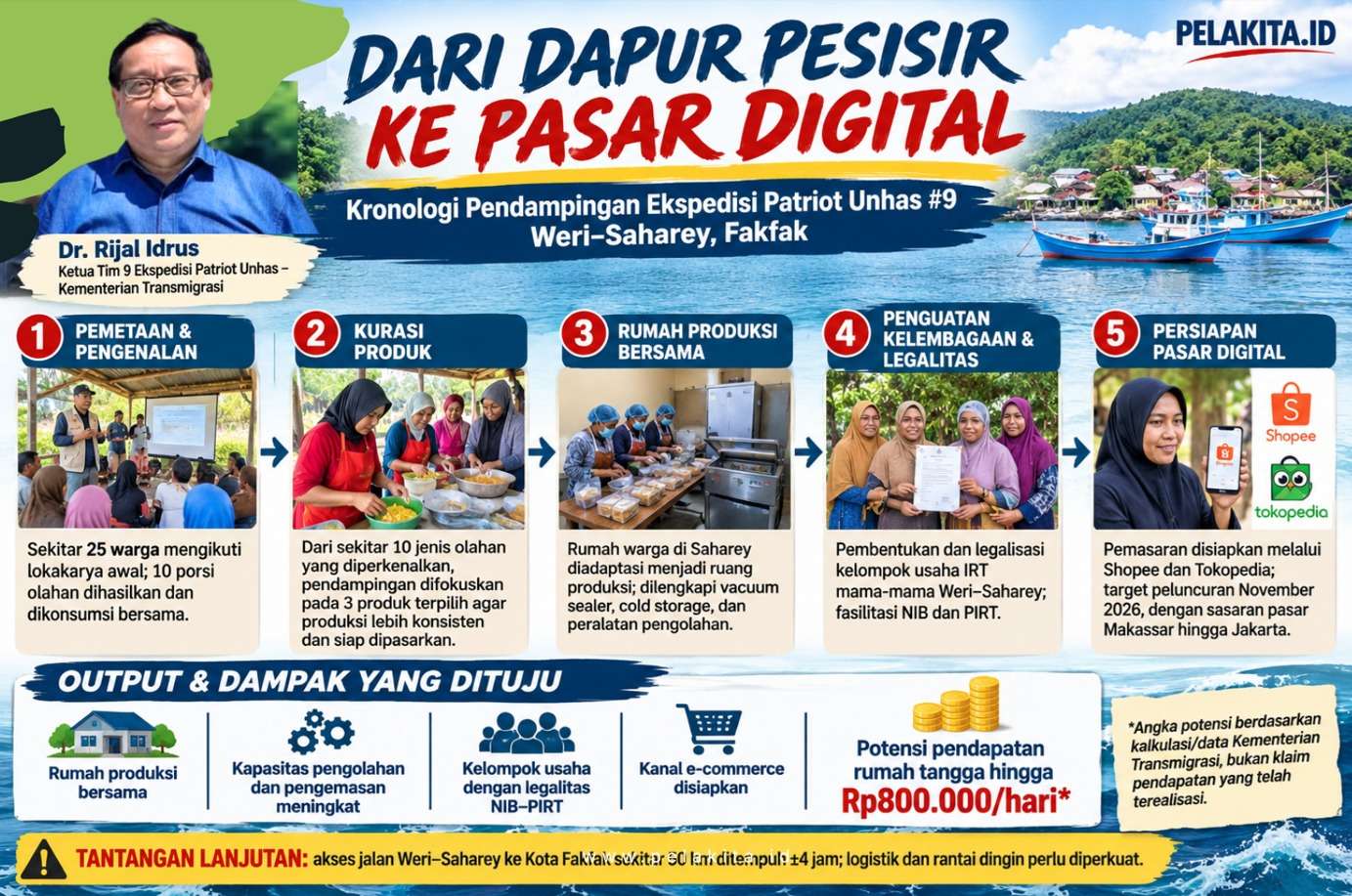
To break this cycle of economic vulnerability, Team 9 of the Hasanuddin University Patriot Expedition (Tim Ekspedisi Patriot / TEP 2026 UNHAS) initiated a comprehensive four-month value-chain intervention.
Formalized under the official research title “Hilirisasi dan Diversifikasi Olahan Perikanan Berbasis Rumah Produksi Bersama di Kawasan Transmigrasi Weri-Saharey” within the operational framework of the Ministry of Transmigration of the Republic of Indonesia, this program establishes an integrated downstream ecosystem.
Led by Team Leader Ir. Rijal M. Idrus, M.Sc., Ph.D., the initiative converts primary marine resources into shelf-stable, packaged, branded, and regulatory-compliant food products, retaining economic value directly within the community.
Pre-Intervention Reality and Structural Bottlenecks
Prior to intervention, the coastal communities of Weri and Saharey operated under severe structural bottlenecks that constrained economic mobility and capitalized value capture. Although the coastal waters of Fakfak Timur yield abundant capture fishery resources, the local economy suffered from a total absence of organized post-harvest processing infrastructure.
The economic friction points defining the pre-intervention baseline included:
- Raw Catch Volatility vs. Margin Instability: Fresh fish sales were dictated by daily buyer demand and immediate spoilage constraints. During peak harvest seasons, localized oversupply forced fishers to accept depressed raw commodity prices, whereas shelf-stable processed goods (abon, sambal, and keripik) maintain stable, elevated price points regardless of seasonal catch fluctuations.
- Infrastructure Deficits: Complete absence of dedicated, hygienic, and zone-structured processing facilities, forcing sporadic home production under unstandardized sanitary conditions.
- Packaging and Preservation Deficiencies: Home-produced goods relied on rudimentary, unsealed plastic wrapping, exposing products to rapid oxidation, moisture intake, microbial contamination, and premature degradation.
- Absence of Brand Identity and Information: Products lacked visual branding, nutritional information, standardized net weight metrics, and localized narrative identity, preventing consumer trust build-up.
- Complete Market Exclusion: Deprived of food safety compliance, professional packaging, and regulatory preparation, locally processed goods were systematically excluded from high-value commercial avenues, failing to access even regional urban centers such as Fakfak City.
Strategic Alignment with Policy Frameworks
The structural architecture of the Weri-Saharey downstreaming initiative was designed to achieve multi-level policy synchronization across national, ministerial, provincial, and regency governance tiers:
- National Level:
- Asta Cita Agenda #5: Direct operationalization of national mandates to advance downstreaming and industrialization, capturing maximum domestic added value at the village level.
- Asta Cita Agenda #4: Targeted human capital development through structured capacity building for female fishers (mama-mama) and local youth (pemuda-pemudi).
- Asta Cita Agenda #6: Institutionalization of economic development originating from rural, transmigration, and village-level foundations.
- Ministry Level:
- Ministry of Transmigration Priority Themes: Execution of TEP 2026 core mandates, explicitly integrating Joint Production House (Rumah Produksi Bersama – RPB) infrastructure, rural economic institutional strengthening, productive human resource enhancement, and appropriate technology deployment.
- Provincial Level:
- Papua Barat Vision 2025–2029 (“Safe, Prosperous, Dignified, and Independent”): Cohesion with provincial master plans to elevate inclusive regional economic competitiveness and optimize native flagship commodities.
- Papua Barat RKPD 2027: Direct alignment with regional work plans prioritizing local commodity downstreaming and the economic empowerment of indigenous coastal communities (masyarakat adat).
- Regency Level:
- Fakfak Regency Inclusive Regional Planning: Synchronization with municipal policies focused on sustainable cross-sectoral synergies, marine resource optimization, and expanding local trade connectivity between rural transmigration zones and urban municipal markets.
By harmonizing macroeconomic policy mandates with micro-level execution on the ground, the initiative constructed a legitimate governance framework capable of translating high-level downstreaming policy into a functional, community-owned enterprise. This alignment established the operational foundation for deploying participatory field methodologies to structure the local value chain.
The Implementation Process and Participatory Methodology
The operational architecture executed by UNHAS Team 9 across the four-month intervention was anchored in community co-ownership. Sustainable infrastructure deployment dictates that processing facilities must not be imposed as passive external donations; rather, they must be embedded as locally governed assets. To prevent facility abandonment post-expedition, the program deployed a methodology that positioned local stakeholders as primary decision-makers across physical setup, operational protocols, and commercial distribution.
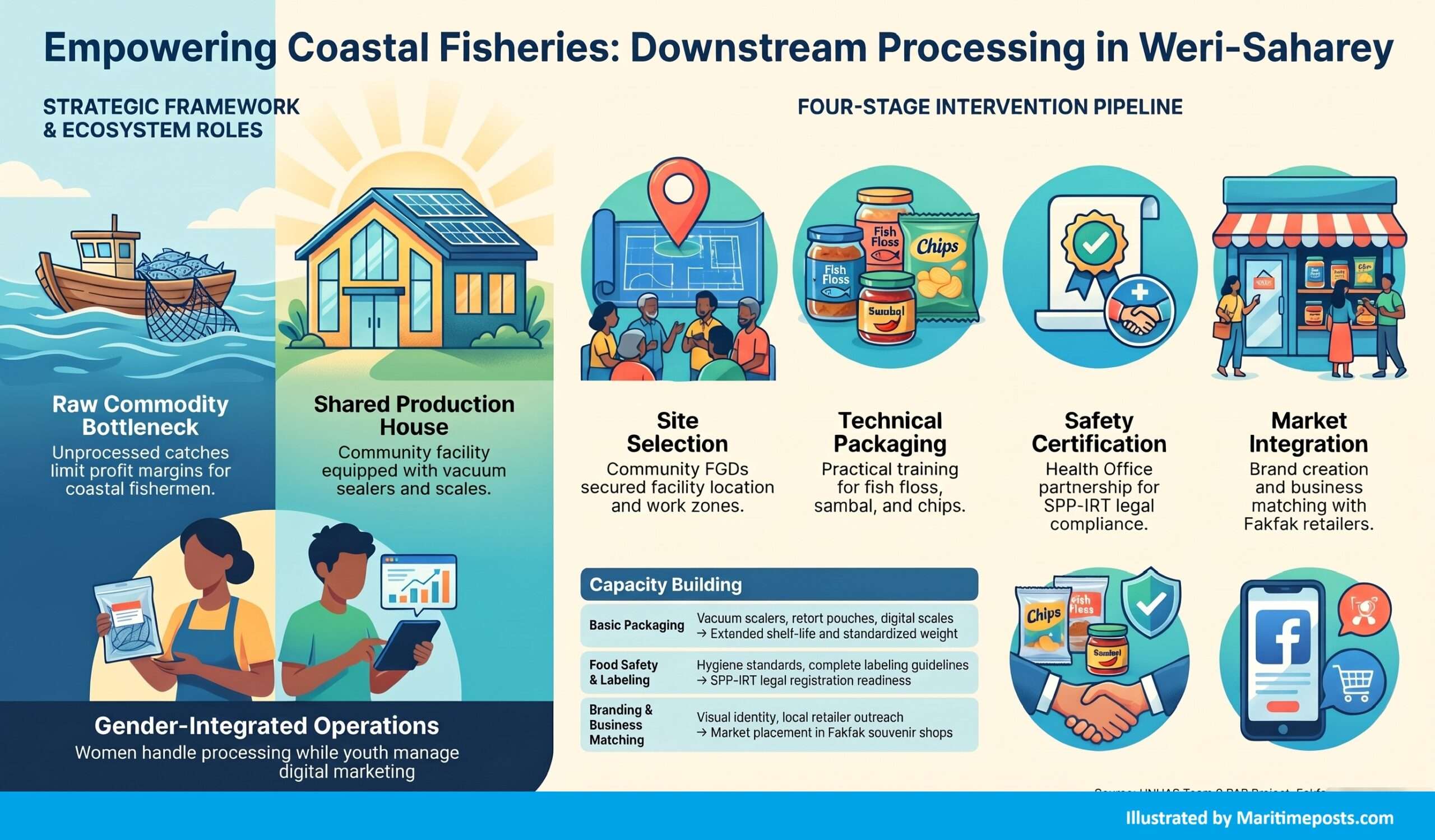
Participatory Action Research (PAR) Framework
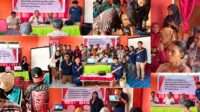
The intervention utilized a Participatory Action Research (PAR) framework, establishing community members as active co-designers of their regional economic ecosystem. The methodology was formally launched during a combined program socialization and Focus Group Discussion (FGD) held at Balai Kampung Saharey on Friday, September 4, 2026, at 13:30 WIT.
The session convened 30 core participants representing the complete governance and socio-demographic spectrum of the transmigration zone:
- Head of Fakfak Timur District (Gani Samai, S.E.)
- Village Head of Saharey (Kepala Kampung Saharey)
- Village Head of Weri (Kepala Kampung Weri)
- Village Consultative Bodies (Baperkam Weri and Baperkam Saharey)
- Village-Owned Enterprise Leadership (BUMKam Saharey)
- Weri-Saharey Youth Representative Groups (pemuda-pemudi)
- Female Fisher Groups (ibu-ibu nelayan / mama-mama)
By engaging this multi-stakeholder assembly from inception, decisions regarding facility allocation, production zoning, and commercial workflows were established through community consensus, ensuring structural alignment between municipal governance and grassroots execution.
Establishing the Joint Production House (Rumah Produksi Bersama – RPB)
A critical outcome of the initial FGD was the selection and repurposing of an existing community structure within the transmigration area to serve as the Weri-Saharey Joint Production House (RPB). Repurposing existing infrastructure reduced capital expenditure while instantly integrating the facility into the community’s physical footprint.
The interior space was re-engineered into a hygienic processing facility structured into distinct functional zones to eliminate cross-contamination. The technical baseline integrated into the RPB included:
- Industrial stainless-steel production tables for hygienic raw material handling and standardized preparation.
- High-precision digital scales to enforce strict net-weight portioning and formula consistency.
- Vacuum sealers to extract atmospheric oxygen, suppressing aerobic microbial growth and oxidative rancidity.
- Impulse hand sealers with calibrated thermal controls to execute airtight film seals across variable pouch gauge thicknesses.
End-to-End Value Chain Integration (Hulu-to-Hilir)
The physical RPB serves as the operational node bridging the gap between upstream capture (hulu) and downstream urban commercial retail (hilir). Upstream raw material procurement supplied directly by local fishers feeds into midstream hygienic processing, thermal preservation, and standardized packaging within the RPB. From there, co-created visual branding and legal label compliance prepare the finished goods for downstream commercial distribution via structured business matching networks in Fakfak City.
Crucially, the RPB framework was synchronized with parallel fishery cluster programs operating concurrently within the region (program kluster perikanan lain yang berjalan secara paralel di kawasan tersebut). Integrating these parallel initiatives optimized raw material procurement logistics, stabilized supply inputs during fluctuating catch seasons, prevented localized resource competition, and created a closed-loop marine economy across Fakfak Timur District.
With the physical, zone-structured facility operationalized and integrated into the broader regional supply chain, the program shifted its focus toward building human capital through targeted technical training execution.
Capability Building and Input Training Execution
To ensure the RPB facility operates at industrial standards, UNHAS Team 9 implemented a modular capability-building curriculum. The pedagogical strategy prioritized applied learning, pairing structural theory with practical execution using technical hardware and local raw materials.
Technical Module 1: Advanced Packaging & Shelf-Life Extension
On Monday, September 28, 2026, the team conducted the Pelatihan Dasar Pengemasan Produk Olahan Perikanan (Basic Packaging Training for Processed Fishery Products), led by technical expert Dessy Eka Kuliahsari, S.TP., M.TP. Attended by 30 key community participants—concentrated heavily among the local women (mama-mama) of Weri and Saharey—the session delivered practical training across three flagship product lines:
- Fish Abon (Abon Ikan): Low-moisture, shredded seasoned fish catch requiring protective moisture barriers.
- Fish Sambal (Sambal Ikan): Oil-based savory chili paste infused with processed fish, requiring thermal microbial control.
- Fish Chips (Keripik Ikan): Crisp, deep-fried seafood snacks sensitive to atmospheric humidity and physical crushing.
Participants engaged in hands-on calibration of digital scales for exact mass portioning, pouch filling execution, vacuum extraction using vacuum sealers, and thermal impulse sealer heat regulation matched to standing pouch and retort plastic film gauges.
A central breakthrough of this module was the practical execution of thermal retort sterilization for packaged fish sambal. By subjecting sealed retort packaging to elevated heat sterilization, microbial pathogens and spoilage organisms are neutralized, achieving natural shelf-life extension without reliance on chemical preservatives or artificial food colorings.
Emphasizing the long-term socioeconomic value of this technical capacity, Dessy Eka Kuliahsari, S.TP., M.TP., noted:
“Semoga kegiatan ini dapat terus berlanjut dan memberikan manfaat dalam meningkatkan kualitas hidup masyarakat Weri dan Saharey, terutama mama-mama yang mengembangkan produk olahan perikanan.” (“May this activity continue seamlessly and provide tangible benefits in elevating the quality of life for the communities of Weri and Saharey, particularly the mama-mama who are developing processed fishery products.”)
Technical Module 2: Food Safety, Hygiene, and Regulatory Compliance
On Tuesday, September 29, 2026, the second operational phase delivered the Pelatihan Keamanan Pangan, Higiene Sanitasi, Pelabelan, dan Persyaratan Dasar Produk Pangan Olahan Perikanan untuk Pemasaran (Training on Food Safety, Sanitation Hygiene, Labeling, and Basic Requirements for Processed Fishery Products for Marketing).
The curriculum synthesized two critical compliance pillars:
- Sanitation & Hygiene Foundations: Delivered by Andi Nur, S.Farm., focusing on personal hygiene protocols, workspace sterilization, hygienic raw material handling, and contamination prevention within the RPB workspace.
- Regulatory Compliance & Standardized Labeling: Led by the Head of the Fakfak Health Office (Dinas Kesehatan Kabupaten Fakfak), dr. Maulana Karjadi Patiran, M.Kes., alongside Armita Abdullah, S.Si., Apt., serving in her official capacity as Penanggung Jawab Urusan Kefarmasian Dinas Kesehatan Kabupaten Fakfak (Pharmaceutical Affairs Lead at the Fakfak Health Office).
Participants were instructed on mandatory statutory label elements required for commercial market entry, including Product Name (Nama Produk), Ingredient Composition (Komposisi), Net Weight (Berat Bersih), Production and Expiry Dates (Tanggal Produksi & Kedaluwarsa), and Producer Identity/Origin (Identitas Produsen).
During the session, dr. Maulana Karjadi Patiran established the formal roadmap for securing the Household Industry Food Production Commitment Certificate (Sertifikat Pemenuhan Komitmen Produksi Pangan Olahan Industri Rumah Tangga – SPP-IRT / PIRT), pledging institutional health office backing to audit and certify the facility.
Highlighting the necessity of strict food safety compliance for market adoption, dr. Maulana Karjadi Patiran, M.Kes., stated:
“Harapannya, produk yang dihasilkan dari Rumah Produksi Bersama ini nantinya dapat terjual dan menjangkau berbagai wilayah. Kami dari Dinas Kesehatan juga berharap masyarakat dapat terus memperhatikan keamanan dan kualitas produk serta memenuhi persyaratan yang diperlukan, sehingga produk yang dihasilkan tidak hanya memiliki nilai ekonomi, tetapi juga aman dan dapat diterima oleh konsumen.” (“The expectation is that products generated from this Joint Production House will successfully enter commercial trade and reach broad geographic regions. We from the Health Office also emphasize that the community must continuously maintain product safety and quality standards while fulfilling all regulatory requirements, ensuring that the finished goods possess not only economic value, but are safe and fully accepted by consumers.”)
Technical Module 3: Branding Guidelines & Identity Co-Creation
To elevate product presentation above generic market offerings, UNHAS Team 9 executed a participatory Branding FGD. This process engaged community members in mapping local cultural heritage, geographic identity, and transmigration narratives into distinct visual packaging assets.
Rather than imposing external visual templates, local youth and processing groups co-designed brand names, visual logos, typography, color schemes, and packaging graphics. This co-creation framework embedded an authentic local narrative into the physical packaging, establishing a unique brand identity designed to capture consumer interest in competitive retail environments.
Mastery of these technical modules established the practical foundation required to structure an organized, demographic division of labor across the village ecosystem.
Demographic Division of Labor and Capability Comparison
Sustaining industrial production post-expedition requires matching operational responsibilities with demographic strengths.
Distributing workload across fishermen, female processing groups (mama-mama), and local youth (pemuda-pemudi) establishes a specialized operational workflow that prevents post-project decay.
Institutionalizing this ecosystem relies on BUMKam Saharey (the Village-Owned Enterprise) acting as the operational anchor.
BUMKam Saharey assumes formal oversight of the RPB facility, manages physical asset maintenance, enforces raw material procurement contracts between local fishers and processing groups, and manages revenue distribution to continuously recapitalize village equity funds.
Stakeholder Capacity Allocation Matrix
| Demographic Group | Assigned Ecosystem Role | Key Operational Responsibilities |
| Fishermen (Nelayan) | Upstream Raw Material Supply Chain | • Procurement and primary sorting of fresh, high-grade raw fish catch. • Scheduled delivery of raw marine biomass directly to the RPB facility. • Sustaining stable, contractually agreed raw material supply lines to buffer against market volatility. |
| Women (Mama-Mama) | Midstream RPB Facility & Processing Management | • Daily operational management, sanitation, and hygiene maintenance of the RPB. • Recipe execution for fish abon, fish sambal, and fish chips. • Precision mass weighing, vacuum oxygen extraction, calibrated thermal impulse sealing, and retort heat sterilization. |
| Youth (Pemuda-Pemudi) | Downstream Digital Marketing & Urban Distribution | • Management of digital brand assets, visual content, and social media channels. • Administration of online storefronts (toko daring) and e-commerce platforms. • Logistics execution, inventory tracking, and commercial distribution to urban retail partners in Fakfak City. |
Methodological Evaluation of Training Efficacy
To evaluate capability building beyond attendance records, UNHAS Team 9 deployed pre-test and post-test metrics across the 30 core participants.
Assessments evaluated theoretical understanding and practical execution in thermal sealing calibration, vacuum pressure verification, sanitation protocol execution, and packaging label compliance.
The empirical metrics confirmed a structural shift: participants transitioned from unstandardized baseline practices to technical competency in hygienic production, thermal preservation, and regulatory compliance.
This skill acquisition established operational autonomy within the community, providing the necessary foundation for the facility to apply for formal SPP-IRT (PIRT) health commitment licensing from the municipal government.
Comparative Analysis: Pre-Intervention vs. Post-Intervention State
| Dimension | Pre-Intervention Baseline (Before) | Post-Intervention Ecosystem (After) |
| Product Form | Unprocessed raw fish sales subject to immediate spoilage; sporadic, unstandardized home preparation. | Standardized, hygienic processing of three shelf-stable product lines: fish abon (abon ikan), fish sambal (sambal ikan), and fish chips (keripik ikan). |
| Packaging Standards | Rudimentary manual plastic wrapping; zero structural protection, oxygen barrier, or moisture control. | High-barrier standing pouches and retort plastics sealed via vacuum extraction and heat-calibrated impulse sealers. |
| Preservation Technique | Immediate raw sales required; rapid post-harvest degradation; zero preservation infrastructure. | Natural shelf-life extension achieved via thermal retort packaging sterilization, eliminating artificial preservatives and synthetic colorings. |
| Regulatory Status | Unregistered home production; absence of standardized labeling, net weights, or health permits. | Fully compliant product labeling standards; active structural roadmap toward formal SPP-IRT (PIRT) health commitment certification. |
| Market Reach | Restricted strictly to localized village barter or low-margin fresh sales; excluded from municipal retail. | Market-ready commercial integration targeting urban retail ecosystems in Fakfak City, including gift shops, minimarkets, and restaurants. |
Bridging these operational capabilities with external commercial markets required structured execution to integrate products into municipal trade networks.
Outputs, Commercial Integration, and Future Action Plan
Transitioning localized production into long-term economic autonomy requires concrete operational outputs linked to commercial distribution networks in municipal centers.
Operational Outputs and Commercial Market Matching
The four-month intervention delivered four core operational outputs:
- Operational RPB Facility: A repurposed, zone-structured, hygienic processing unit equipped with industrial production tables, digital scales, vacuum sealers, and impulse sealers.
- Trained Workforce: A skilled cohort of 30 community members (mama-mama and pemuda) capable of executing hygienic food processing, vacuum packaging, retort thermal sterilization, and visual brand application.
- Market-Ready Product Lines: Three distinct, shelf-stable, naturally preserved product lines (fish abon, fish sambal, and fish chips).
- Regulatory Roadmap: A formalized pathway toward SPP-IRT health commitment certification, backed directly by the Fakfak Health Office.
To convert operational capability into village revenue, UNHAS Team 9, alongside local community representatives and District Head Gani Samai, S.E., initiated a targeted “Business Matching” campaign in Fakfak City. Commercial samples were presented directly to urban retail buyers, securing initial distribution channels across three high-value commercial categories:
- Local Souvenir & Gift Shops (Toko Oleh-Oleh)
- Independent Urban Minimarkets
- Seafood Restaurants and Hospitality Establishments
Reflecting on the program’s structural impact, the Head of Fakfak Timur District, Gani Samai, S.E., articulated the regional importance of the initiative across three key dimensions:
On post-harvest value addition:
“Kami bersyukur dengan adanya kegiatan seperti ini di Weri-Saharey. Potensi perikanan yang dimiliki masyarakat sangat besar, sehingga kami berharap program hilirisasi ini dapat membantu masyarakat tidak hanya menjual hasil tangkapan dalam bentuk bahan mentah, tetapi mengolahnya menjadi produk yang memiliki nilai tambah.” (“We are profoundly grateful for the implementation of this initiative in Weri-Saharey. The capture fishery potential owned by our community is vast; thus, we anticipate this downstreaming program will empower our people to move beyond selling raw catches, transforming marine resources into high-value processed commodities.”)
On demographic empowerment and economic expansion:
“Kami berharap pemuda-pemudi dan masyarakat Weri-Saharey dapat semakin diberdayakan dan memiliki keterampilan yang bisa menjadi sumber ekonomi baru. Program ini menarik karena tidak berhenti pada produksi atau pengolahan, tetapi juga sampai pada pemasaran.” (“We expect the youth and community of Weri-Saharey to become increasingly empowered, mastering specialized technical skills that serve as new engines of economic growth. This program is exceptionally structured because it does not terminate at raw processing, but extends directly into downstream market insertion.”)
On commercial viability through business matching:
“Business matching sangat bermanfaat karena masyarakat akan diperkenalkan langsung dengan calon pembeli atau pelaku usaha. Ini penting untuk keberlanjutan program, sehingga produk yang dihasilkan nantinya benar-benar memiliki pasar dan dapat membantu meningkatkan perekonomian masyarakat.” (“Business matching is extraordinarily beneficial because it directly connects our community producers with commercial buyers and business operators. This step is vital for long-term sustainability, ensuring that manufactured goods secure reliable market demand to elevate community prosperity.”)
Strategic Roadmap for Future Actions & Self-Reliance
To ensure operational continuity and economic independence after the conclusion of the four-month UNHAS expedition, a three-phase chronological action plan was established:
Phase 1: Immediate Execution (Final Month of Expedition)
- Finalize visual branding guidelines, brand asset vectors, and standardized packaging label prints based on FGD co-creation outcomes.
- Execute initial business matching delivery runs and commercial sample placements across verified retail outlets, minimarkets, and gift shops in Fakfak City.
Phase 2: Intermediate Consolidation (Post-Expedition Transition)
- Complete formal facility health audits in coordination with the Fakfak Health Office (Dinas Kesehatan) to issue official SPP-IRT (PIRT) commitment registration numbers for all packaging labels.
- Formalize internal raw material supply agreements between local fishermen’s capture groups and the mama-mama RPB processing management, managed under BUMKam oversight to lock in stable input pricing.
Phase 3: Long-Term Autonomy (Sustained Local Governance)
- Complete the transfer of facility management, equipment maintenance, and financial administration to BUMKam Saharey as the institutional anchor for village capital accumulation.
- Expand youth-led digital marketing infrastructure, linking social media promotion and online storefronts (toko daring) with physical retail re-orders across Fakfak Regency and West Papua.
Ultimate Vision
The structural objective of the Weri-Saharey Joint Production House program is to transform the macroeconomic profile of the coastal transmigration zone. By integrating modern processing infrastructure, thermal preservation technology, standardized regulatory compliance, local brand narratives, and direct municipal market matching, the program fundamentally alters how marine resources exit the village.
Rather than exporting low-margin raw fish catch subject to rapid spoilage and price degradation, Weri-Saharey is equipped to export finished, shelf-stable, branded food products.
Possessing an authentic regional narrative and meeting stringent health and safety standards, these downstreamed commodities capture elevated profit margins—retaining economic wealth locally and securing long-term self-reliance for the Weri-Saharey community.
Editor K. Azis