
The Kampung Nelayan Merah Putih (KNMP) program marks a shift in Indonesia’s approach to coastal development, moving beyond the distribution of fishing equipment toward building integrated economic ecosystems designed to improve fishermen’s welfare, strengthen food security, and increase national fisheries competitiveness.
MARITIMEPOSTS.COM – For decades, government assistance to traditional fishing communities often focused on providing boats, engines, nets, and other fishing equipment. While such assistance could help fishermen improve their operations, it did not always address the broader challenges that shaped their livelihoods.
A boat, for example, offers limited economic benefits if fishermen cannot obtain affordable fuel, access ice to preserve their catch, repair damaged engines, or find reliable buyers for their fish. Without these supporting services, operational costs remain high, fish quality deteriorates quickly, and fishermen may struggle to secure fair prices.
Indonesia’s Kampung Nelayan Merah Putih (KNMP) program seeks to address these interconnected challenges by establishing an integrated fisheries business ecosystem at the village level.
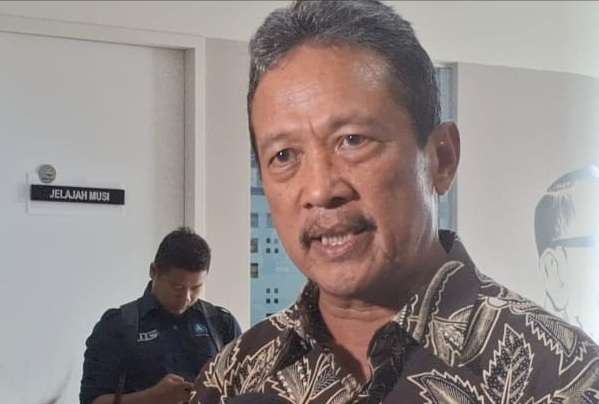
Minister of Marine Affairs and Fisheries Sakti Wahyu Trenggono has emphasized the importance of connecting fishing activities with the infrastructure and services required to make them economically viable. Under this approach, the objective is not simply to provide equipment, but to create an environment in which fishermen can operate more efficiently, preserve the value of their catch, and improve their household incomes.
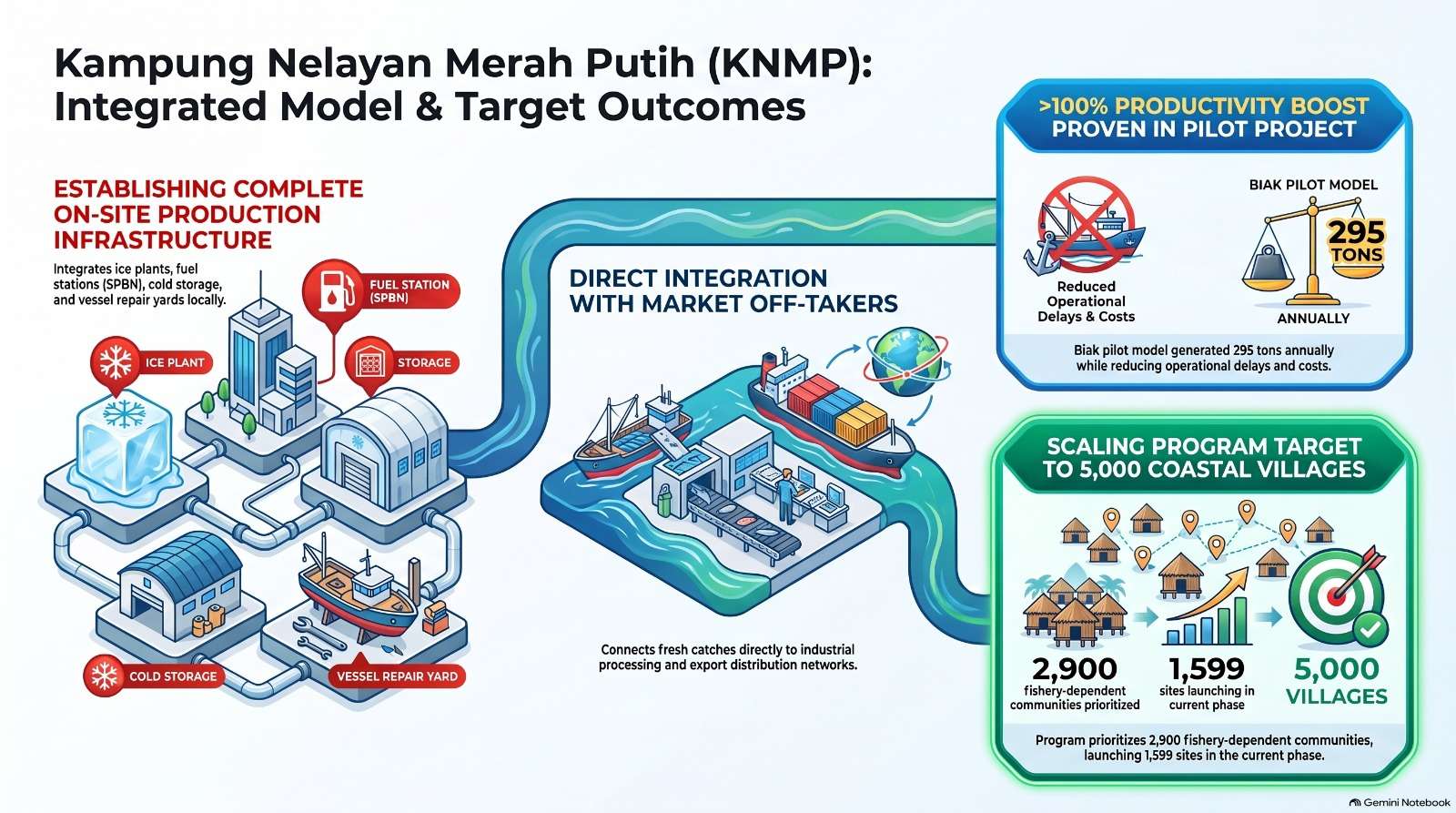
The KNMP model brings together several essential components of the fisheries value chain.
First, fishermen need reliable access to production supplies, including fishing gear and equipment. Second, fuel facilities and logistics services help reduce the time and costs associated with preparing for fishing trips. Dedicated fisherman fuel stations, known as Stasiun Pengisian Bahan Bakar Nelayan (SPBN), can play an important role in supporting daily operations.
Third, ice plants and cold storage facilities help maintain fish freshness and reduce post-harvest losses. Local boat and engine repair workshops can minimize downtime when vessels require maintenance. Community spaces and culinary facilities can also create opportunities for supporting businesses and diversifying local economic activity.
Finally, reliable market connections are essential. Partnerships with buyers, or off-takers, can help fishermen sell their catches more consistently and connect village-level production with larger domestic and export markets.
The strength of this model lies in the integration of these services. Rather than treating fishing assistance as a collection of separate projects, KNMP seeks to connect production, preservation, logistics, maintenance, and marketing within a single coastal economic ecosystem.
Coastal Development and the Challenge of Food Security
The transformation of fishing villages also has implications beyond local economic development. It is closely connected to Indonesia’s ambition to strengthen food security and make better use of its marine resources.
As the global population grows and geopolitical tensions expose vulnerabilities in international supply chains, countries face increasing pressure to secure reliable sources of food. The disruptions experienced during the COVID-19 pandemic reinforced the importance of resilient domestic production and distribution systems.
For Indonesia, fisheries represent a significant source of animal protein and an important foundation for the livelihoods of coastal communities. The country’s marine resources offer considerable potential, but realizing that potential requires more than increasing the volume of fish caught.
Fish must be harvested responsibly, handled properly, distributed efficiently, and sold through markets capable of supporting sustainable production. Improvements at each stage can help increase the economic value generated by the fisheries sector.
KNMP therefore represents an effort to connect fishermen’s welfare with a broader national objective: developing a stronger, more productive, and more resilient fisheries economy while maintaining the long-term health of marine ecosystems.
Closing the Productivity Gap: Learning from Global Fisheries Leaders
Indonesia’s extensive coastline and marine biodiversity provide a strong foundation for fisheries development. However, abundant natural resources do not automatically translate into high productivity, industrial competitiveness, or greater value added.
Comparisons with other countries illustrate the scale of the opportunity. Figures cited in the program’s policy discussion place China’s annual fish production at approximately 83 million tonnes and Vietnam’s at around 25 million tonnes. These figures underscore the importance of aquaculture, production technology, research, and well-developed industry networks in expanding fisheries output.
Indonesia’s challenge is to develop its own strengths rather than rely exclusively on wild-capture fisheries. This requires sustained investment in aquaculture, scientific research, technology, financing, and market development.
A central concept in this strategy is core competence: the development of specialized capabilities that allow a country to establish a durable competitive advantage in particular products or industries.
Norway offers an example through its salmon industry. Long-term investment in research, breeding technology, production systems, and financing has helped establish salmon as a globally competitive export commodity.
Indonesia could pursue a comparable strategy by identifying species suited to its tropical waters and developing the scientific and industrial capabilities needed to produce them competitively. Tropical fish and mud crab, known locally as kepiting bakau, are among the potential areas of focus.
The objective is not simply to produce more fish, but to build expertise around selected species, improve productivity and quality, develop reliable supply chains, and attract investment.
Consistent research and development can help reduce production risks and improve commercial performance. When these capabilities are supported by suitable financing, processing infrastructure, and access to markets, fisheries businesses may become more attractive to private investors and banks.
KNMP can complement this wider strategy by strengthening the village-level infrastructure needed to connect fishermen and aquaculture producers with a more sophisticated fisheries industry.
Balancing Productivity with Marine Conservation
Higher fisheries productivity must not come at the expense of the marine environment. Expanding production without effective management can lead to overfishing, depleted fish stocks, and long-term economic losses for the very communities that depend on the sea.
Indonesia’s approach therefore needs to balance economic development with resource management, technological monitoring, and conservation.
One important instrument is Penangkapan Ikan Terukur, or Measured Fish Capture. This approach is intended to manage fishing activities according to established limits and regional considerations. Effective implementation can help prevent excessive exploitation while supporting a more orderly distribution of fisheries benefits.
Vessel Monitoring Systems (VMS) provide another important tool. By tracking participating fishing vessels through monitoring technology, authorities can improve oversight of fishing locations and activities, support compliance with regulations, and help identify potential violations. Monitoring can also contribute to safer and more accountable fishing operations.
Marine conservation areas are equally important. These areas help protect habitats, sustain biodiversity, and support ecological processes that underpin fisheries productivity. Healthy marine ecosystems are essential to maintaining fish populations and preserving the livelihoods of future generations.
The broader principle is that fisheries development must be guided by reliable data, effective enforcement, and a clear understanding of ecological limits. Economic growth and conservation should reinforce one another rather than operate as competing objectives.
The Biak Blueprint: Testing an Integrated Fisheries Model
The KNMP concept has been associated with a pilot initiative in Biak, Papua, which illustrates how integrated infrastructure can address the everyday constraints faced by fishing communities.
According to figures presented in the policy discussion, the Biak pilot involved approximately 89 fishermen whose livelihoods supported around 445 family members.
Before the intervention, fishermen faced several practical difficulties. The absence of nearby ice-making facilities made it harder to preserve their catch. Accessing fuel could require trips to more distant urban areas, while engine or vessel damage could interrupt fishing activities and reduce household income.
These challenges demonstrate how the absence of basic services can undermine the value of fishing equipment and the productivity of fishermen’s work.
The pilot sought to address these problems by bringing essential facilities and services closer to the community. Its infrastructure included an ice plant, cold storage, an SPBN fuel station, boat repair services, culinary facilities, and connections with buyers.
Together, these facilities were intended to reduce operating costs, preserve fish quality, shorten repair delays, and improve market access.
The reported results were encouraging. After approximately two years of evaluation, the pilot was said to have achieved a productivity increase of more than 100 percent, with annual fish production reaching approximately 295 tonnes.
The site also developed connections with buyers who purchased fish directly and transported the catch to markets in Java and, according to the account presented, export destinations.
These figures suggest the potential benefits of an integrated approach: when fishermen can obtain essential supplies locally, preserve their catch more effectively, and access dependable buyers, more of the value generated by fishing can remain within the local economy.
Nevertheless, the reported outcomes should be assessed alongside information about the measurement period, baseline production, operating costs, household incomes, and the sustainability of the buyer relationships. These indicators are important for determining whether the improvements can be maintained and replicated in other locations.
Biak’s significance, therefore, lies not only in its reported production figures but also in its potential to demonstrate how coordinated infrastructure and market access can address multiple barriers simultaneously.
Scaling KNMP Across the Indonesian Archipelago
The next challenge is to translate the integrated village model into a broader national development strategy.
Figures cited in the policy discussion place the number of Indonesia’s coastal villages at approximately 12,000, of which around 2,900 are heavily dependent on capture fisheries. The scale of this coastal landscape presents both an opportunity and a substantial implementation challenge.
President Prabowo Subianto has set a target of transforming 5,000 fishing villages, while 1,599 locations were identified for development in the program phase described in the discussion.
Achieving these ambitions will require more than constructing facilities. Each village has different fishing grounds, species, production volumes, infrastructure needs, market connections, and institutional capacities. A successful model must therefore be adapted to local conditions rather than implemented as an identical package everywhere.
The long-term performance of KNMP will depend on whether facilities remain operational, fishermen can afford and access the services provided, maintenance is properly financed, and buyers continue purchasing local production. Local participation and effective management will also be essential to ensuring that infrastructure serves the needs of fishing households.
Energy costs represent another significant challenge. The policy discussion cited approximately Rp15.5 trillion in fuel subsidies, highlighting the importance of examining how energy support can be delivered efficiently.
The ministry has also explored hybrid propulsion technologies as a potential way to reduce fuel consumption while maintaining the operational needs of fishing vessels. Any transition, however, will need to consider vessel safety, affordability, maintenance requirements, and the suitability of new technology for different fishing operations.
A national rollout will ultimately require coordination between infrastructure development, fisheries management, financing, technology, and local economic institutions.
From Fishing Villages to Engines of Economic Growth
The Kampung Nelayan Merah Putih program reflects a fundamental change in how coastal development can be approached. Instead of viewing fishermen primarily as recipients of government assistance, it seeks to position fishing communities within a connected economic system.
The distinction is important. Equipment may help fishermen go to sea, but it cannot independently resolve problems involving fuel access, post-harvest losses, repairs, market uncertainty, or weak bargaining power. Those challenges require coordinated solutions across the fisheries value chain.
At the same time, village-level improvements must be connected to a broader industrial strategy. Research, aquaculture development, specialized production capabilities, and access to investment can help Indonesia move toward higher productivity and greater competitiveness in domestic and international markets.
These efforts must remain consistent with responsible fisheries management and marine conservation. Without healthy ecosystems and effective oversight, higher production may be difficult to sustain.
The Biak pilot offers a starting point for examining the potential of integrated infrastructure and market connections. The larger test will be whether the approach can deliver durable improvements in income, productivity, employment, and the quality of life of fishing households across diverse coastal regions.
Ultimately, the success of KNMP should not be measured solely by the number of villages receiving new facilities. It should be measured by whether fishermen earn better and more stable incomes, local businesses become more viable, fish losses decline, market access improves, and marine resources remain productive for future generations.
If these outcomes can be achieved together, Indonesia’s fishing villages could become more than places where fish are landed. They could become resilient centers of coastal enterprise, contributing to national food security, industrial development, and long-term marine sovereignty.