

- The future of Indonesia’s marine tourism will depend on how well we protect the seas that give travelers a reason to visit. When the ocean deteriorates, destinations lose their appeal. When the ocean remains healthy, tourism has a future.
- World Tourism Day 2026 should be a moment to ensure that artificial intelligence helps us build tourism that is smarter—but also bluer, fairer, and more sustainable.
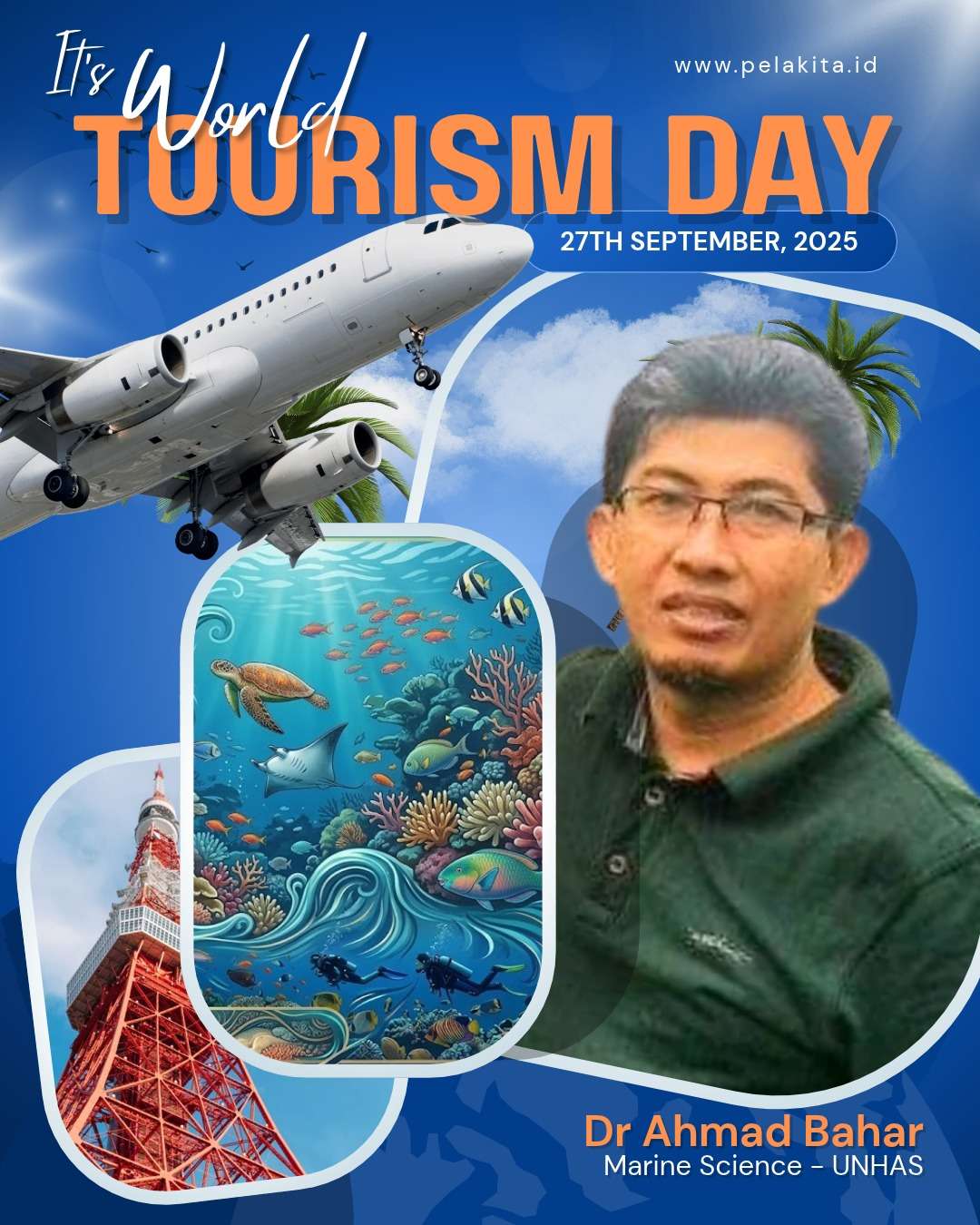
By Ahmad Bahar, Lecturer in Marine Science at Hasanuddin University and Marine Tourism Specialist
MARITIMEPOSTS.COM — Indonesia does not lack oceans to offer as tourism destinations and attractions. What we lack is the courage to change the way we manage these resources so they can generate greater value for communities, the nation, and the country.
With more than 17,000 islands, approximately 108,000 kilometers of coastline, extraordinary marine biodiversity, and a strategic position at the heart of the Coral Triangle, Indonesia possesses natural assets that few countries can match.
These assets are also a responsibility. The ocean is not merely the backdrop for tourism photographs; it is an ecological and economic foundation that will determine the future of marine tourism.
Today, September 27, 2026, marks World Tourism Day, with the theme “Digital Agenda and Artificial Intelligence to Redesign Tourism.”
The theme is particularly relevant to Indonesia. The question is not simply how artificial intelligence (AI) can promote destinations, but how technology can help us determine when a destination has become overcrowded, when coral reefs are beginning to experience stress, how ocean currents transport marine debris, and how tourism benefits can be distributed more fairly among coastal communities.
A Paradigm That Must Change
The idea of Blue Tourism 2045 calls for a paradigm shift in marine tourism: from mass tourism toward nature tourism, ecotourism, conservation tourism, and scientific tourism.
This shift is not merely a response to changing tourist preferences. It is a consequence of mounting pressure on destinations. Overtourism, ecosystem degradation, marine litter, competing claims over coastal space, and declining environmental quality demonstrate that the assumption that “more tourists are always better” is no longer sufficient.
A current example can be seen in Komodo National Park, where the government has imposed visitor restrictions of up to 1,000 people per day at several major destinations, including Padar, Rinca, Komodo, and diving sites.
The policy reflects concerns over carrying capacity and ecosystem sustainability.
An Ocean Under Increasing Pressure
Marine debris presents another challenge. On Derawan Island, one of Indonesia’s iconic diving destinations, waste has become a serious concern. Debris originates from local communities and tourism activities, while ocean currents also transport waste from other areas.
Recent research in Sabang similarly indicates that managing plastic waste on small islands requires community-based and multi-stakeholder approaches.
Threats to coral reefs are not always immediately visible. Research involving hundreds of divers in Indonesia and the Philippines found that divers came into contact with coral reefs approximately once every four minutes on average. More than 40 percent of the observed contacts resulted in visible damage.
At the same time, climate change is intensifying these pressures. Recent research indicates that Indonesian coral reefs possess a certain degree of resilience to rising sea temperatures, but that resilience has limits.
Marine tourism, therefore, cannot simply claim to be “environmentally friendly.” It must be grounded in measurable ecological capacity.
Oceanography Must Be at the Core
This is where oceanography must be placed at the heart of marine tourism planning. Waves, currents, tides, temperature, depth, water clarity, water quality, and biological dynamics are not merely academic data. They determine site suitability, visitor safety, comfort, carrying capacity, and even the types of tourism activities that can be developed.
The Blue Tourism 2045 framework places oceanography among its key foundations because marine tourism attractions are shaped by ocean dynamics, while those same dynamics influence visitor safety and comfort.
AI to Manage, Not Accelerate, Overtourism
The theme of World Tourism Day 2026 provides a new opportunity. Indonesia can harness AI to develop smart marine tourism: forecasting waves and weather, monitoring water quality, mapping biodiversity, measuring visitor density, and detecting ecological pressures.
Beyond this, the concept of a digital twin destination could be developed to create virtual models of tourism destinations by integrating oceanographic, environmental, visitor, infrastructure, and economic activity data.
AI should not become merely a promotional engine that directs millions of tourists toward the same destinations.
Algorithms should instead be used to distribute visitor flows, provide warnings when carrying capacity is reached, and direct tourists toward alternative destinations that are ecologically and socially better prepared.
In this way, technology would not accelerate overtourism but help prevent it.
Toward Blue Tourism 2045
Indonesia needs a new paradigm that integrates marine conservation, community well-being, the blue economy, oceanography, technology, and collaborative governance.
Government cannot work alone. Businesses need to redefine success beyond visitor numbers and investment, placing greater emphasis on the quality of visitor experiences and ecosystem sustainability.
Coastal communities should be positioned as beneficiaries and stewards, rather than merely as a source of labor. Academics should produce knowledge that can be translated into practical decision-making.
The indicators of successful marine tourism must also be broadened. Coral reef health, water quality, reductions in marine debris, compliance with carrying capacity, local community income, visitor safety, and ecosystem recovery should all become part of destination performance indicators.
The Blue Tourism 2030–2045 Roadmap should move Indonesia beyond being merely a marine tourism destination toward becoming one of the global leaders in sustainable marine tourism.
The future is not about extracting more from the ocean for tourism, but about generating greater benefits from the ocean while reducing ecological pressure.
The future of Indonesia’s marine tourism will depend on how well we protect the seas that give travelers a reason to visit. When the ocean deteriorates, destinations lose their appeal. When the ocean remains healthy, tourism has a future.
World Tourism Day 2026 should be a moment to ensure that artificial intelligence helps us build tourism that is smarter—but also bluer, fairer, and more sustainable.
Editor: Denun