
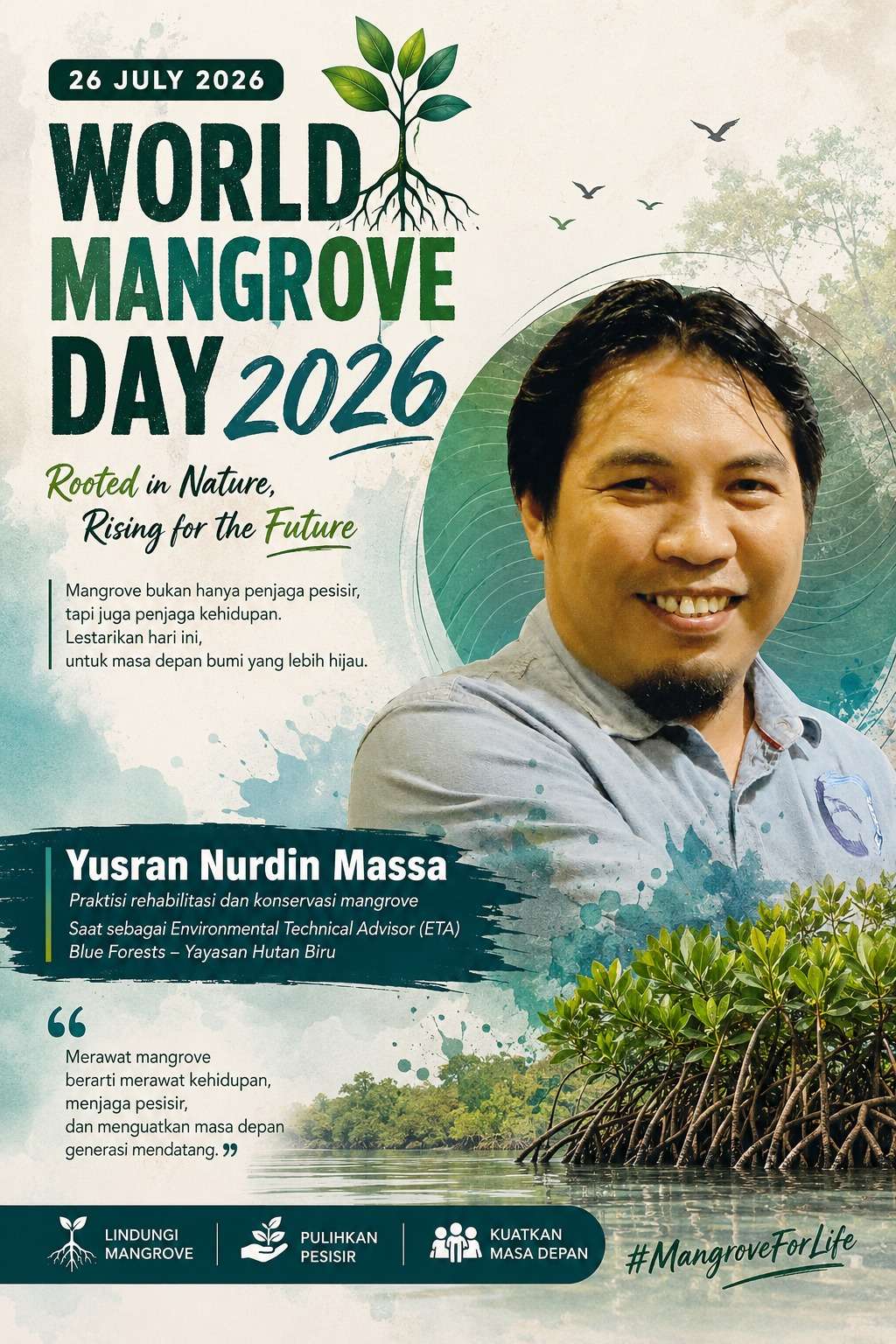
By Yusran Nurdin Massa
Mangrove Rehabilitation and Conservation Practitioner
Environmental Technical Advisor (ETA), Blue Forests – Yayasan Hutan Biru
Every World Mangrove Day, we almost always witness the same activities. Seedlings are prepared, participants gather along the coast, banners are displayed, and hundreds or even thousands of mangrove seedlings are planted within a matter of hours.
MARITIMEPOSTS.COM – Such events certainly play an important role in raising public awareness. However, after more than two decades working in mangrove rehabilitation, I have come to realize that the greatest challenge facing mangroves today is not simply the lack of planting initiatives.
The more fundamental question is this:
Do mangroves still have space to live?
This question becomes increasingly critical in urban coastal areas. In cities like Makassar, the coastline has long served as both a place where communities live and a hub for economic activities, trade, housing, ports, warehouses, industries, tourism, and infrastructure development. All these interests compete for the same limited coastal space, while the coastline itself does not expand.
As a result, coastal areas have become contested landscapes.
In this situation, mangroves are often the weakest stakeholder. Mangrove forests are still frequently perceived as vacant land, unproductive swamps, or reserve areas for future development.
Compared with warehouses, residential areas, commercial districts, roads, or ports, the financial value of mangroves often appears insignificant.
Yet the true economic value of mangroves is far greater than these alternative land uses. Blue Forests conducted a Total Economic Valuation (TEV) study in Mimika and Asmat, revealing a striking contrast.
The total economic value of mangroves reached approximately IDR 339 million per hectare per year, while the directly quantifiable financial value was only around IDR 1.8 million per hectare annually. This enormous gap reflects the difference between the full range of ecosystem services mangroves provide and the limited financial benefits that are immediately visible. When direct, indirect, option, and intrinsic values are fully considered, the economic contribution of mangroves becomes extraordinary.
Mangroves provide habitat for fish, crabs, shellfish, birds, and countless other coastal species. They also protect the communities living behind them. Their root systems trap sediment, dissipate wave energy, and maintain the connection between land and coastal waters. When mangroves disappear, cities lose far more than vegetation—they lose part of their natural coastal defense system.
In my previous article discussing the contestation of coastal space in Makassar, I highlighted how the interests of communities, government, businesses, and environmental conservation compete in allocating coastal land.
Government data at the time showed that Makassar’s mangrove area had declined dramatically—from approximately 411.7 hectares in 2001 to only around 100.07 hectares by 2016.
Those figures certainly need updating, but the overall trend remains the same: mangrove habitats continue to face mounting pressure while urban development continues to expand.
What often goes unnoticed is that once a mangrove area has been converted to another use, not only are the trees lost—the opportunity to restore the ecosystem is also greatly diminished.
Former mangrove areas may become aquaculture ponds, settlements, industrial estates, roads, or privately claimed land. Ecologically, some of these areas may still be recoverable. Socially and legally, however, restoration becomes far more complicated.
We must deal with land ownership, business permits, land values, development plans, and the interests of those already occupying the area. From my experience in mangrove rehabilitation, these issues are often far more difficult to resolve than the technical aspects of restoration itself.
Because suitable former mangrove sites are increasingly difficult to find, rehabilitation efforts are often shifted toward coastal mudflats. These areas usually have fewer ownership claims and are therefore easier to access for planting activities.
However, ease of access does not necessarily mean ecological suitability.
Not every mudflat is naturally intended to support mangroves. Many are valuable open ecosystems that provide feeding grounds for shorebirds, habitat for benthic organisms, and important functions within coastal sediment dynamics.
When mangroves are planted in such unsuitable mudflats, the seedlings may appear healthy during the first few months.
Rows of seedlings stand neatly, stakes remain upright, photographs look impressive, and planting targets are considered achieved. Yet after exposure to waves, shifting currents, sediment movement, and prolonged inundation, the seedlings begin to die. A year later, all that often remains are weathered wooden stakes.
I have witnessed this pattern repeatedly in many locations. The problem is not always poor seedling quality or incorrect planting techniques. From the outset, these sites were simply not suitable habitats for mangroves.
This is the fundamental difference between planting mangroves and restoring mangrove ecosystems.
Planting is highly visible and easily reported. Ecological restoration is a much longer process that does not always produce attractive photographs during its early stages.
Before deciding to plant, we must first understand why mangroves disappeared or failed to regenerate naturally. Has tidal flow been blocked? Is there an embankment preventing seawater from entering? Is the ground elevation too high or too low? Are wave conditions too harsh? Are natural seed sources still available? Was the site historically a mangrove habitat?
In many situations, planting is not the most important intervention. What is truly needed is restoring tidal channels, reconnecting hydrological flows, reducing disturbances, resolving land tenure conflicts, or protecting naturally regenerating mangroves.
If hydrological conditions are restored and natural seed sources remain available, nature itself can accomplish much of the recovery. Our responsibility is to remove the barriers preventing natural regeneration.
This perspective is particularly important in urban mangrove rehabilitation. Coastal land is already extremely limited. Therefore, every rehabilitation site must be carefully evaluated for ecological suitability.
We should never choose a location simply because it is available, free of ownership claims, or convenient for planting. Rehabilitation should focus on areas that historically supported mangroves or still possess environmental conditions capable of sustaining them.
Since the real challenge is space, mangrove conservation cannot stop with planting projects. It must become an integral part of spatial planning.
Remaining mangrove forests should be formally designated as protected areas. Former mangrove sites that still retain restoration potential should be identified, mapped, and allocated specifically for rehabilitation.
Without secure spatial planning, rehabilitation areas will always remain vulnerable. Mangroves may be planted today, only to be converted for development a few years later because their land status was never clearly protected.
Defending mangrove space within urban planning is undoubtedly difficult. Rehabilitation efforts inevitably compete with land reclamation, industrial expansion, ports, stadiums, housing developments, infrastructure projects, and increasing land values.
However, reducing coastal risks is also a development priority. Protecting communities from erosion, coastal flooding, declining fisheries, and climate change impacts should not be viewed merely as environmental concerns.
Mangroves should instead be recognized as essential components of a city’s green and blue infrastructure. While they cannot replace engineered infrastructure entirely, they are a vital part of adaptive coastal protection systems that work alongside natural processes.
In Makassar, areas such as Lantebung and Untia have become increasingly important because they represent some of the city’s remaining mangrove landscapes. These places are not valuable only for mangrove vegetation. They are also living spaces for communities, fisheries habitats, educational sites, public spaces, and crucial ecological buffers.
Therefore, the question is not whether we should choose between development and mangroves.
The real question is: What kind of development do we want? Where should development occur? Which areas should never be sacrificed? And who will bear the consequences when coastal ecological functions disappear?
We must stop using rehabilitation as a justification for creating new environmental damage. Healthy mangrove forests should never be converted on the promise that they can simply be replaced by planting elsewhere.
Experience has repeatedly shown that mature mangrove ecosystems developed over decades cannot easily be recreated.
Avoiding damage must always be our first priority. Where impacts cannot be entirely avoided, they must be minimized. Rehabilitation should focus on restoring already degraded areas—not on legitimizing the destruction of healthy mangrove forests.
World Mangrove Day should encourage us to redefine how we measure success.
Success is not merely counting how many seedlings have been planted. It is determining how much mangrove habitat has actually been conserved. It is not simply reporting activities, but asking whether hydrological systems have been restored, whether natural regeneration has resumed, and whether local communities possess the security and capacity to protect these ecosystems.
We should also revisit these sites one year, five years, or even ten years after planting. Have the mangroves matured into functioning ecosystems, or have they become nothing more than abandoned project signs and decaying stakes?
For me, protecting mangroves ultimately means protecting the ecological space they need to survive.
The remaining mangrove areas must be safeguarded from further conversion. At the same time, degraded areas that still possess restoration potential should be given the opportunity to recover.
This process requires effective spatial planning, secure land tenure, sound hydrological understanding, long-term management, and meaningful community participation.
The goal is not to dedicate every coastline to mangroves. Rather, we must ensure that coastal areas which are naturally suitable for mangrove ecosystems are no longer continuously reduced or destroyed, while degraded habitats are given the opportunity to recover.
That is why celebrating World Mangrove Day is not enough if all we do is encourage people to plant trees.
We must also have the courage to protect and secure the spaces where mangroves can truly live.
____
Editor Kamaruddin Azis