

Trenggono offers a different perspective. In his view, marine resources have ecological boundaries that must be respected. Once environmental carrying capacity is exceeded, what follows is not economic growth but a gradual process of ecosystem degradation and the loss of livelihoods for coastal communities.
MARITIMEPOSTS.COM — During a discussion with the authors and editors of a book on Measured Fishing (Penangkapan Ikan Terukur/PIT), Indonesia’s Minister of Marine Affairs and Fisheries, Sakti Wahyu Trenggono, was not merely talking about catch quotas, fishing vessels, or monitoring systems.
What he was really putting forward was a far more fundamental idea: changing the way this nation views the ocean.
From Exploitation to Sustainability
For decades, Indonesia’s marine and fisheries development has been driven by a production-oriented mindset. Success has been measured by the volume of fish landed, export growth, and rising investment. The ocean has often been treated as an inexhaustible resource, available for extraction without limits.
Trenggono offers a different perspective.
In his view, marine resources have ecological boundaries that must be respected.
Once environmental carrying capacity is exceeded, what follows is not economic growth but a gradual process of ecosystem degradation and the loss of livelihoods for coastal communities.
At first glance, this may sound like a simple statement. In reality, it is deeply political. Within the tradition of modern development, economic considerations are almost always placed above ecological concerns. Trenggono reverses this hierarchy by making ecosystem sustainability the foundation of public policy.
In the field of political ecology, environmental degradation is never merely a technical issue. It is always linked to political choices about who benefits, who bears the risks, and how the state manages natural resources for the public good.
PIT as an Instrument of Political Ecology
Having read the works of political ecology scholars ranging from Peet to Escobar, I find that PIT can indeed be understood through this lens.
The policy seeks to limit exploitation in order to maintain sustainable fish stocks, even if such measures are not always popular among business actors or certain fishing communities.
What Trenggono is proposing is, in essence, a critique of a development paradigm that has long placed economic growth as its primary objective. Under this paradigm, nature is frequently reduced to a mere supplier of raw materials for production.
What is particularly interesting is that Trenggono does not see conservation as a burden on development. Instead, he views conservation areas as ecological investments that ensure the future productivity of marine ecosystems.
This idea differs significantly from conventional perspectives that often frame conservation and community welfare as competing interests.
Within the framework of sustainable development, economic growth and environmental protection should not be viewed as opposing forces. They must advance together. Conservation is not the enemy of development; it is a prerequisite for development that can endure over time.
This is why Trenggono’s concept of the blue economy deserves close attention. He is not advocating an end to economic activity. Rather, he is asking how economic activity can continue without destroying the ecological foundations that sustain it.
The Ocean as a System of Life
His perspective reflects an understanding that the ocean is not merely an economic space. It is a living system connecting plankton, fish, mangroves, seagrass meadows, coral reefs, and human beings within a single interconnected ecological network.
Damage to one part of this system creates cascading effects across the entire ecosystem. Excessive exploitation ultimately threatens not only fish populations but also the people whose lives and livelihoods depend on them.
In Trenggono’s vision, PIT is not the final destination. It is the first step toward a broader transformation of coastal economies. Regulating fishing activities must be accompanied by the expansion of marine aquaculture, downstream value-added industries, and improved welfare for coastal communities.
His ideas on mariculture and Modern Fishing Villages demonstrate that the government’s ambition extends beyond regulating fishing practices. It also seeks to transform the economic structure of coastal communities so that they are no longer entirely dependent on the extraction of wild natural resources.
From the perspective of environmental politics, the state carries a responsibility to safeguard the public interest across generations. Government must not merely serve short-term economic interests; it must also ensure that natural resources remain available for future generations.
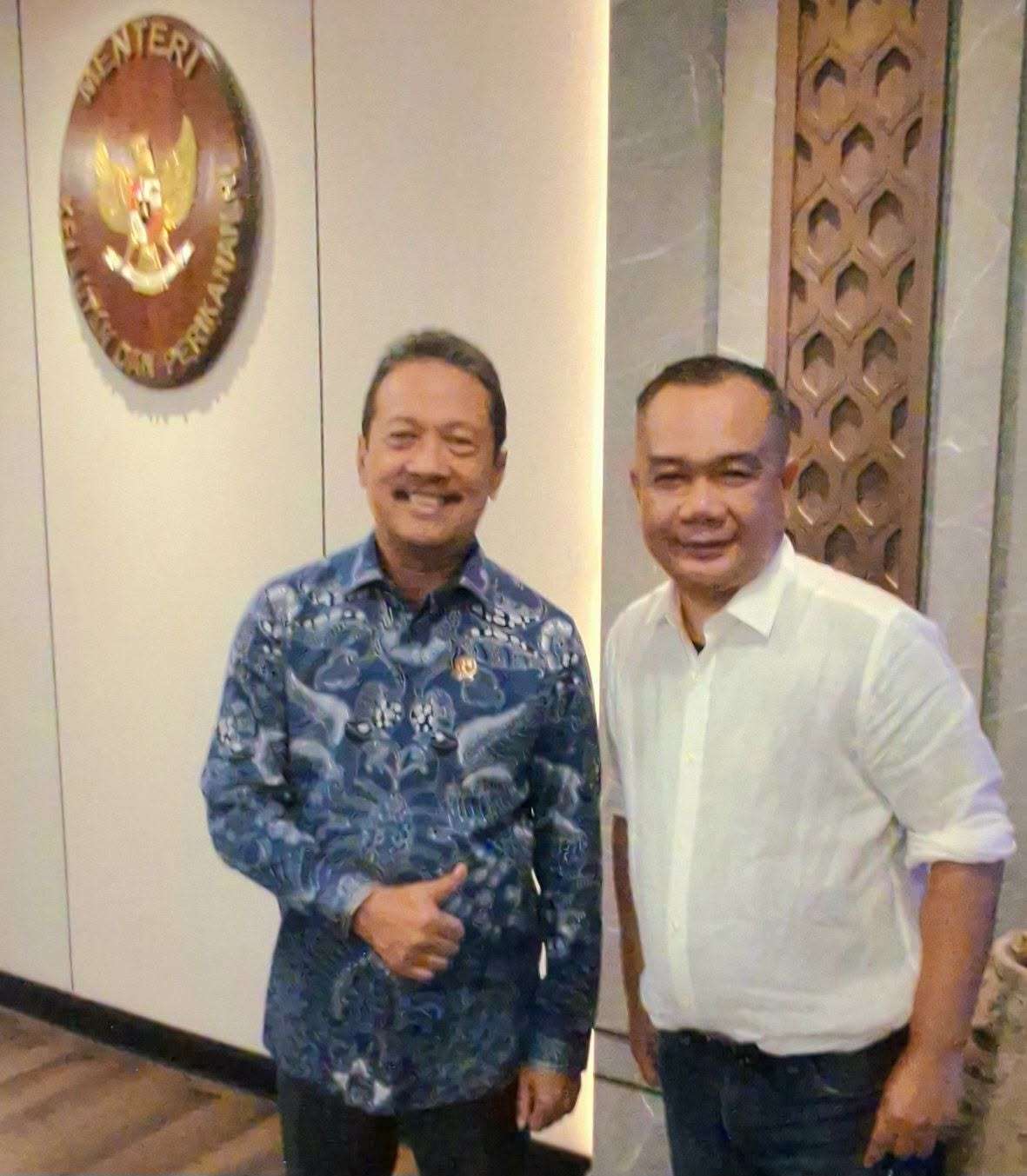
Dear readers, today I had the privilege of listening to and engaging directly with Minister Trenggono. For years, I had only heard him speak in formal public settings. This time, however, he dedicated nearly two hours to a conversation with academics, donor representatives, marine and fisheries development organizations, and members of the media.
In an era dominated by investment-driven development and resource extraction, perspectives such as those expressed by Trenggono are relatively rare among government elites. Sustainability is frequently invoked in speeches, but it does not always become the foundation of policymaking.
For that reason, Trenggono’s ideas are significant not only within the fisheries sector but also within the broader debate about Indonesia’s development future. He invites us to reconsider whether economic growth alone should remain the primary measure of development success.
Ultimately, the true measure of a nation’s success is not how much natural wealth it can extract today. More important is whether it can pass on healthy and productive ecosystems to future generations.
It is within this context that PIT and the blue economy acquire a deeper meaning. They are not merely marine-sector policies; they are part of a larger effort to build a civilization in which human beings and nature exist in a more balanced, equitable, and sustainable relationship.
Finally, if one truly wishes to understand the trajectory of PIT, the more interesting question is not how quotas are allocated or how regulations are enforced.
Rather, it is whether a lasting sustainability ethic can become institutionalized—one that stakeholders willingly embrace, not because they are compelled by sanctions or the threat of punishment, but because they share a political, ecological, and economic awareness of its necessity.
Menteng, 13 August 2026
Kamaruddin Azis
Founder the MaritimePosts.com