

Kompas published an insightful article on August 1, 2026, titled “Is Social Science Still Useful?” The thought-provoking piece was written by Ija Suntana, a lecturer in Constitutional Law at UIN Sunan Gunung Jati Bandung.
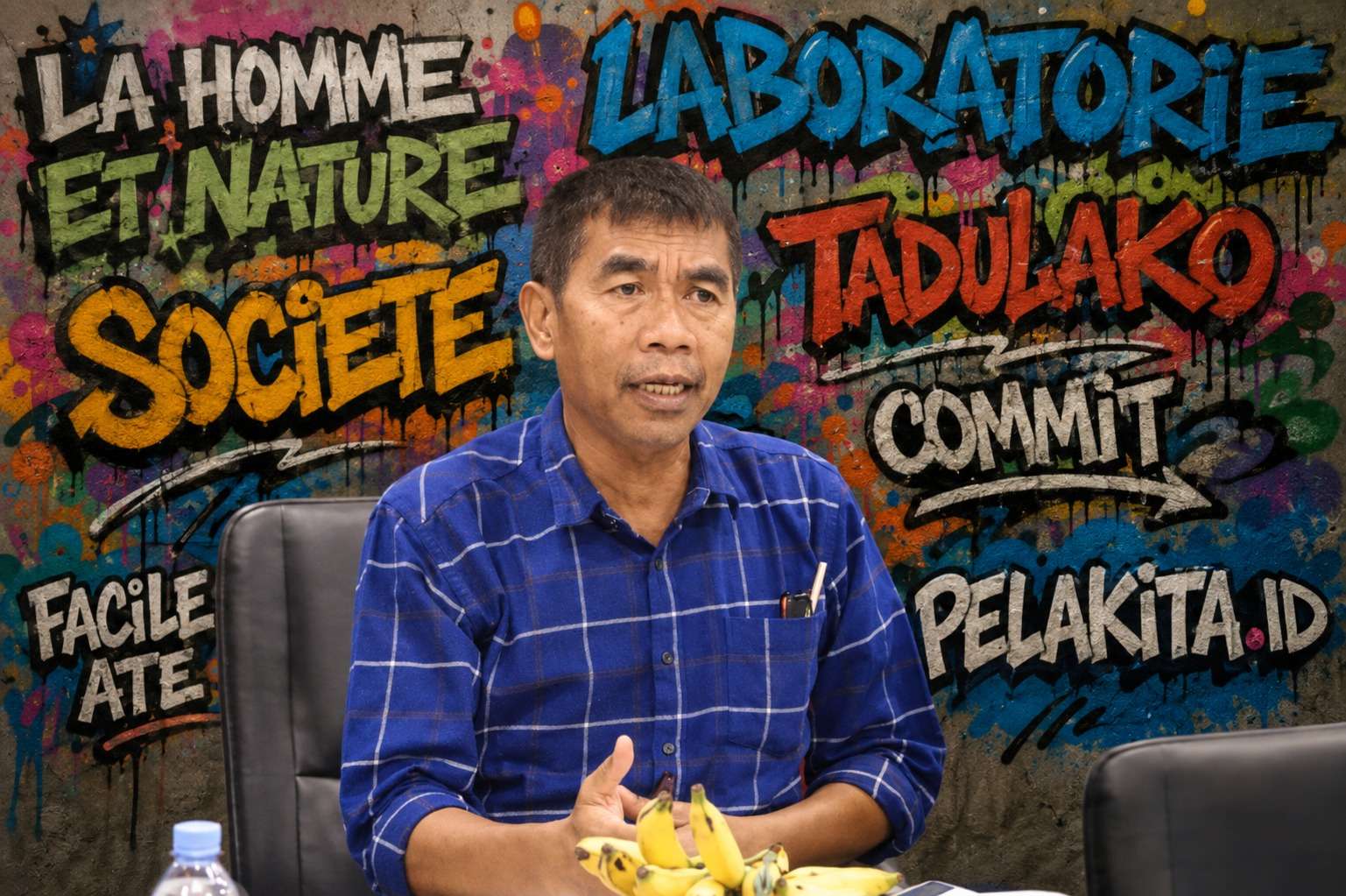
By: Muhd Nur Sangadji, Professor of Agriculture, Tadulako University
MARITIMEPOSTS.COM— Among his arguments, the author suggests the need for social laboratories in the form of formal and physical laboratories. We are generally familiar with physics laboratories. But why should there not be laboratories for social engineering that actually conduct social experiments?
This immediately reminded me of two things. First, in 1981, Professor Mattulada, then Rector of Tadulako University, established the Uvemanje Social Laboratory in the Palu Valley, Central Sulawesi.
Second, in 1994, when I was first interviewed at several universities in France as part of the admission process, I was surprised to discover that almost every field of science had what they called a laboratoire—a laboratory. Medicine had laboratories, the natural sciences had laboratories, and the social sciences had laboratories as well. Almost all PhD students in these fields generally conducted their work in laboratories.
The field I studied was called “L’homme et Nature” (Man and Nature), more commonly known as Human Ecology. In 1995, however, the field was transformed into DEA “Société et Nature” (Society and Nature).
The change from L’homme to Société—from the individual human being to society as a social group—carried an important message: the relationship between humans and nature is influenced more strongly by social groups than by individual actions. In this context, social science becomes extremely important in understanding its relationship with ecology.
At national and international seminars in various places, I have often criticized scholars from both fields—social sciences and the natural sciences alike.
I have argued that we often do nothing more than take pictures and complain, moving from one seminar to another. We compete to demonstrate the sophistication of our theories and, above all, the complexity of our research methodologies and analytical tools. Yet conditions in the field continue to deteriorate.
In other words, we move only from the realm of ontology to epistemology, and then stop there. Effective formulations rarely emerge from the dimension of axiology—the dimension of values, action, and practical consequences.
Let me give an example.
“At the previous seminar, we showed that the remaining land cover amounted to a certain number of hectares. At this seminar, using satellite imagery and a spatial approach, we present a map showing that degradation has expanded even further. We present the findings while lamenting the situation. And then we repeat the same process at the next seminar.”
After that, we formulate recommendations. But environmental destruction cannot be addressed simply by taking pictures. Nor is protection and repair enough. What is needed first is the earliest, most urgent, and most courageous action: stop it. That is where action and advocacy come into play. And in my view, this is precisely where social science has an essential and decisive role.
More than fifteen years ago, I asked the Rector of Tadulako University to take concrete action to save Palu Bay from mercury pollution caused by gold mining.
The problem had actually been revealed through research led by the Rector himself. The data came from the Soil Laboratory at Tadulako University. Yet the response was remarkably simple: “We are scientists. Our job is simply to document the situation.”
Taking further action, he suggested, was not our responsibility. Perhaps this is what Ija Suntana identifies as one of the greatest challenges facing social science. The problem is not a lack of theories. Rather, it is the absence of mechanisms for transforming theory into social engineering.
Therefore, as he argues, social science must move from explanatory science toward design science. It can no longer stop at diagnosis. It must proceed toward designing solutions. It is not enough merely to interpret reality. We must also intervene.
Wallahu a’lam bi al-shawab.
Happy 45th Anniversary to Tadulako University.