
MARITIMEPOSTS.COM – Aquatic food self-reliance is not merely an issue of increasing production; it is fundamentally about transforming the relationship between communities, institutions, natural resources, and markets.
The experience of the seaweed farming community in Laikang Village, Takalar Regency, South Sulawesi, demonstrates that sustainable transformation emerges when community knowledge, facilitation, and government policies converge toward shared objectives. Such transformation requires understanding not only what a community is (ontology), but also how knowledge is created and shared (epistemology), and why development should be pursued (axiology).
Ontology: Understanding the Community as a Living Social System
From an ontological perspective, the seaweed farming community is more than a collection of individual producers. It represents a dynamic socio-ecological system whose livelihood depends on the interaction between coastal ecosystems, local institutions, family labor, traditional knowledge, and market networks.
Following Elinor Ostrom’s theory of common-pool resources, coastal communities develop collective norms that regulate resource use and reduce conflicts through cooperation.
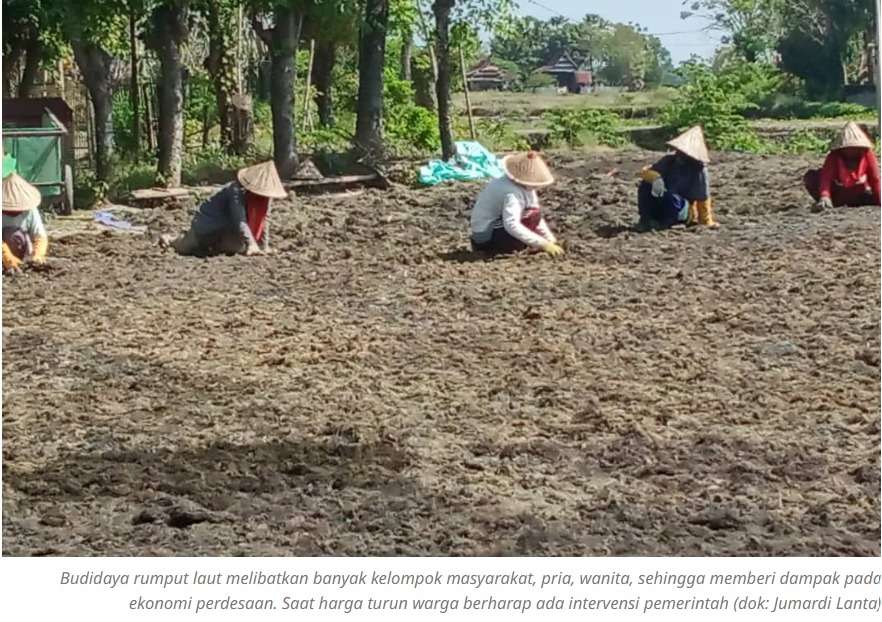
Seaweed farming in Laikang illustrates this interconnectedness. Farmers depend not only on marine resources but also on trust among neighbors, access to buyers, extension services, village leadership, and environmental stability. Therefore, community transformation cannot be reduced to technological intervention alone.
It must recognize that social capital, ecological resilience, and institutional arrangements are inseparable components of development.
Epistemology: Co-producing Knowledge through Facilitation and Government
Transformation begins when knowledge is no longer transferred in a top-down manner but co-produced through collaboration. Paulo Freire argued that communities should not be treated as passive recipients of development but as subjects capable of critical reflection and collective action. Similarly, Etienne Wenger’s Communities of Practice emphasizes that learning occurs through participation, dialogue, and shared experiences.
In Laikang, community facilitators become knowledge brokers rather than instructors. They bridge scientific knowledge with indigenous experience, helping farmers understand climate variability, cultivation techniques, financial literacy, digital marketing, and cooperative management. Government agencies complement this role by providing regulatory support, infrastructure, extension services, and policy coherence.
This epistemological approach creates reciprocal learning. Farmers contribute contextual knowledge regarding tides, seasonal changes, and local ecology, while facilitators and government introduce innovations in production, quality control, entrepreneurship, and sustainability standards. Such collaborative learning strengthens adaptive capacity and increases resilience against environmental and market uncertainties.
Axiology: Development as Human Well-being and Ecological Sustainability
The ultimate value (axiology) of aquatic food self-reliance extends beyond economic growth. It encompasses dignity, justice, environmental stewardship, and intergenerational sustainability. This perspective aligns with Amartya Sen’s Capability Approach, which defines development as expanding people’s freedoms and capabilities rather than merely increasing income.
For the Laikang community, successful transformation means enabling seaweed farmers to make informed decisions, diversify livelihoods, improve household welfare, participate in local governance, and conserve coastal ecosystems simultaneously. Development therefore becomes an ethical process that balances productivity with environmental integrity and social inclusion.
This value orientation also resonates with the Sustainable Development Goals, particularly SDGs 1 (No Poverty), 2 (Zero Hunger), 8 (Decent Work and Economic Growth), 14 (Life Below Water), and 17 (Partnerships for the Goals).
Why Community Transformation Matters
Transformation is necessary because coastal communities increasingly face multiple challenges: climate change, fluctuating commodity prices, declining environmental quality, fragmented value chains, and unequal bargaining positions. Conventional development programs often focus on distributing inputs while neglecting institutional strengthening and community empowerment.
Without transformation, seaweed farmers remain vulnerable to external shocks and trapped in low-value production systems. Sustainable self-reliance therefore requires moving beyond production-oriented interventions toward systemic capacity building.
Transformation is not about changing people; it is about expanding their opportunities, strengthening collective agency, and enabling communities to become active drivers of their own development.
How Transformation Can Be Achieved
A transformative model for Laikang should integrate five mutually reinforcing strategies.
First, strengthen social capital by fostering trust, farmer organizations, women’s participation, youth engagement, and collaborative leadership. Robert Putnam demonstrates that communities with stronger bonding, bridging, and linking social capital achieve better development outcomes.
Second, institutionalize participatory facilitation through continuous mentoring rather than short-term projects. Facilitators should function as connectors linking communities with universities, government agencies, private companies, and financial institutions.
Third, develop inclusive value chains that enable farmers to move beyond raw material production into processing, branding, certification, and digital marketing. Michael Porter’s Shared Value framework suggests that business competitiveness and community prosperity can be mutually reinforcing.
Fourth, promote adaptive governance, where village governments, district authorities, cooperatives, universities, and private sectors jointly design development agendas through evidence-based planning and collaborative decision-making. Emerson and Nabatchi’s Collaborative Governance theory highlights the importance of shared motivation, institutional capacity, and principled engagement.
Finally, embed social learning and innovation into community development. Continuous experimentation, reflection, and knowledge exchange enable farmers to respond effectively to changing ecological and economic conditions.
Conclusion
The experience of seaweed farmers in Laikang demonstrates that aquatic food self-reliance is fundamentally a process of social transformation rather than merely agricultural modernization.
Ontologically, communities are complex socio-ecological systems. Epistemologically, transformation emerges through collaborative learning among communities, facilitators, and government. Axiologically, development should expand human capabilities while sustaining coastal ecosystems.
When these three philosophical dimensions are integrated within collaborative governance, social capital, participatory facilitation, and shared value creation, aquatic food self-reliance becomes more than a policy objective. It becomes a pathway toward resilient communities, sustainable livelihoods, and inclusive coastal development capable of meeting both present and future generations’ needs.
___
Author: Kamaruddin Azis, The COMMIT Foundation