

This article is a synthesis of the presentation delivered by Hasnawir, Ph.D., Head of the South Sulawesi Natural Resources Conservation Agency (BKSDA South Sulawesi) during the Focus Group Discussion and General Assembly of the South Sulawesi Indonesian Marine and Fisheries Scholars Association (MKTI), Makassar, June 27, 2026.
MARITIMEPOSTS.COM — If we were to draw an imaginary line between the islands of Borneo and Sulawesi, we would not merely be dividing Indonesia’s geographical map—we would be crossing one of the world’s most fundamental biological boundaries.
Welcome to Wallacea, a transitional region where the rules of nature appear to have been rewritten.
At the heart of this extraordinary region lies Sulawesi, an island so uniquely positioned that many of its inhabitants seem like products of evolutionary experiments found nowhere else on Earth.
Standing at the forefront of protecting this remarkable heritage is the South Sulawesi Natural Resources Conservation Agency (BKSDA South Sulawesi), entrusted with safeguarding one of humanity’s most valuable natural laboratories.
The Miracle of Wallacea: The Only Place in Asia Where Primates and Marsupials Coexist
Sulawesi represents an evolutionary crossroads that defies conventional patterns of global wildlife distribution. Under normal circumstances, Asian fauna—such as monkeys and apes—and Australian fauna—such as cuscuses and other marsupials—are separated by distinct biogeographical boundaries.
Yet Sulawesi breaks this rule by serving as an improbable biological melting pot.
It is the only place in Asia where primates and marsupials naturally coexist within the same landscape.
According to technical data, Sulawesi is home to at least seven species of macaques (Macaca) and ten species of tarsiers, the world’s smallest primates.
Remarkably, the island also supports two species of cuscus, marsupials that are evolutionarily more closely related to Australia’s native wildlife.
The coexistence of these two distinct evolutionary lineages in a single region is a scientific phenomenon that elevates Sulawesi to one of the world’s highest conservation priorities.
“Sulawesi is the largest island in Wallacea, with an exceptionally high level of endemism.”
Astonishing Numbers: 98% of Its Mammals Exist Nowhere Else
Sulawesi’s biodiversity is remarkable not merely because of its richness, but because of its extraordinary exclusivity.
Current biodiversity data reveal astonishing levels of endemism:
- Birds: 36% (84 out of 233 species) are endemic.
- Reptiles: 29% (29 out of 104 species) occur nowhere else.
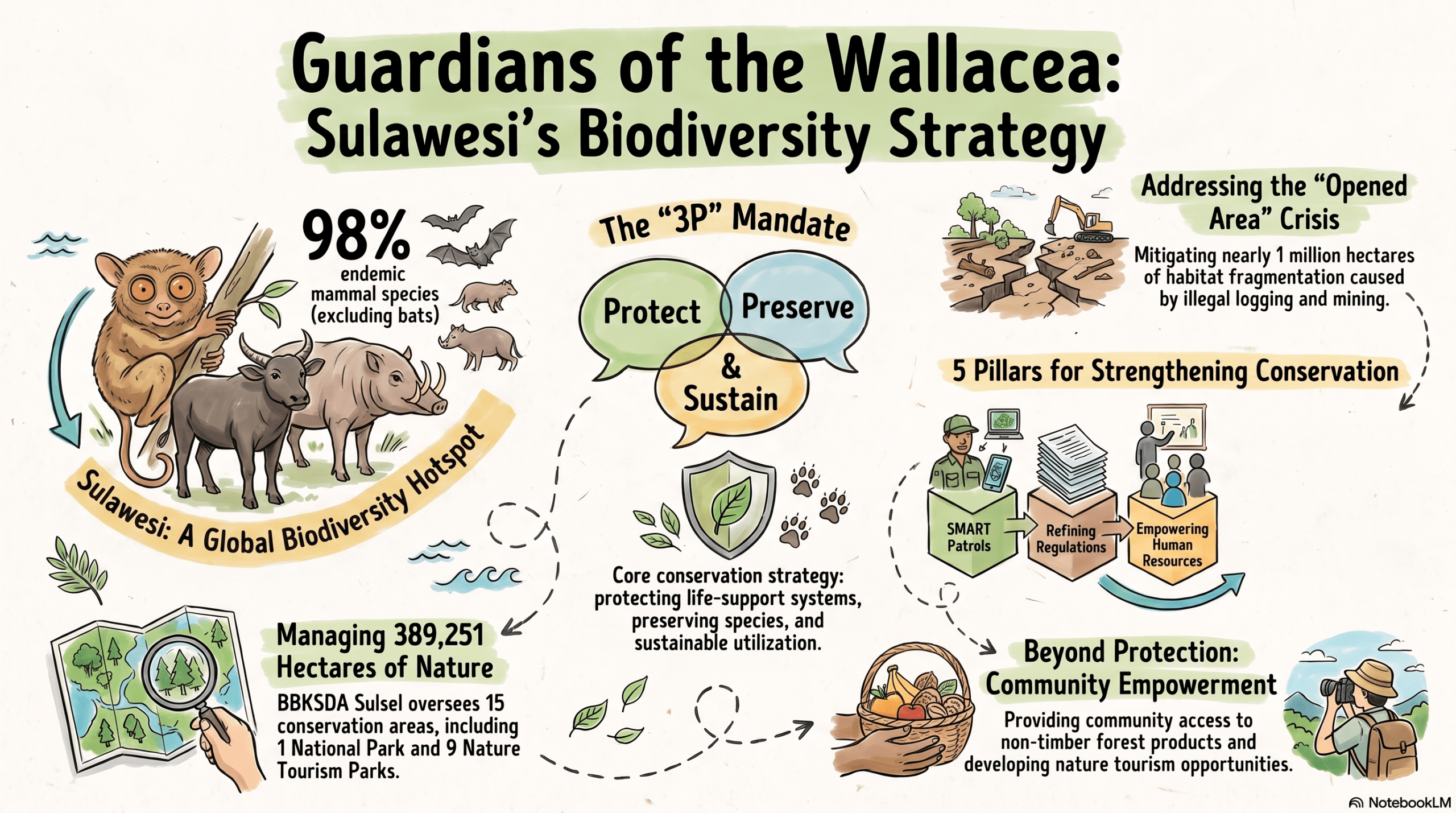
- Mammals: Overall, about 60% of Sulawesi’s mammals are endemic. However, when bats are excluded from the calculation, the figure becomes even more extraordinary—98% of the island’s mammal species are found nowhere else on Earth.
These statistics come to life through iconic species that appear almost mythical.
There are the Lowland Anoa (Bubalus depressicornis) and the Mountain Anoa (Bubalus quarlesi), the world’s smallest wild buffaloes, known for their elusive nature.
There is also the Babirusa (Babyrousa babyrussa), famous for its extraordinary tusks that curve upward through the skin of its snout; the endemic Macaca maura; and the Maleo (Macrocephalon maleo), a bird unlike any other, which does not incubate its eggs but buries them in warm volcanic sand or geothermal soils.
Losing even a single species on this island would mean far more than a decline in biodiversity statistics—it would erase an entire chapter from Earth’s evolutionary history.
A New Conservation Paradigm: Beyond Protection Toward Prosperity
In managing this irreplaceable natural wealth, BKSDA South Sulawesi embraces a dynamic conservation philosophy rooted in Article 33, Paragraph (3) of Indonesia’s 1945 Constitution, which mandates that natural resources be managed for the greatest benefit of the people.
This constitutional principle is reinforced through Law No. 5 of 1990, as amended by Law No. 32 of 2024, which establishes the Three Pillars (3P) of Conservation:
- Protecting life-support systems;
- Preserving biodiversity and ecosystems;
- Ensuring sustainable utilization.
Modern conservation no longer means sealing forests behind barbed wire.
Instead, it promotes sustainable environmental services that transform conservation areas into engines of the green economy.
Protected forests are increasingly recognized for their potential to generate forest carbon credits for climate mitigation, support renewable energy development through water and biomass resources, and foster premium nature-based tourism.
The objective is clear: achieving a balance where ecological integrity and community prosperity reinforce one another.
The Harsh Reality Behind 27 Million Hectares
Yet conservation advocates must also confront difficult realities.
Indonesia currently manages 27.02 million hectares of conservation areas spread across 579 protected sites.
Behind these impressive figures lies a systemic challenge: approximately 998,826 hectares of opened or degraded land within conservation areas.
These are not merely vacant lands—they are visible evidence of mounting human pressure on the country’s last strongholds of biodiversity.
Available data indicate that degradation is driven by:
- Oil palm expansion covering 147,143 hectares;
- Community agricultural activities occupying 697,483 hectares;
- Encroachment, illegal logging, illegal mining, and forest fires.
The result is severe habitat fragmentation, where forest ecosystems become isolated into disconnected patches.
Such fragmentation significantly reduces wildlife populations while intensifying human-wildlife conflicts, as native Wallacean species lose the habitats they depend upon for survival.
The Road Ahead: SMART Patrols and Resort-Based Management
To address increasingly complex conservation challenges, BKSDA South Sulawesi is strengthening its management through technology and community participation.
Its strategic initiatives include:
SMART Patrols, utilizing data-driven monitoring systems to make forest patrols more accurate, measurable, and transparent in detecting threats.
Resort-Based Management, strengthening government presence at the smallest operational units within protected areas to enable rapid responses to ecological disturbances.
Community Empowerment, regarded as the cornerstone of long-term conservation success. Through the establishment of Conservation Villages and community access to Non-Timber Forest Products (NTFPs), local residents are transformed from potential forest encroachers into active conservation partners.
When healthy forests are directly linked to water security and sustainable economic opportunities—such as ecotourism—local communities naturally become the first line of defense for Sulawesi’s extraordinary natural heritage.
Today, BKSDA South Sulawesi is responsible for managing 15 conservation areas covering 389,251 hectares. This conservation mosaic consists of:
- 1 National Park;
- 3 Nature Reserves;
- 1 Wildlife Sanctuary;
- 1 Hunting Park;
- 9 Nature Tourism Parks.
These figures are far more than administrative statistics—they represent the boundary between survival and extinction.
We must ask ourselves: if 98% of Sulawesi’s mammals exist nowhere else on Earth, can we truly imagine a world that loses them simply because we failed to share space with them?
Protecting Sulawesi is not merely a technical responsibility of government institutions. It is a global commitment to preserving one of the most extraordinary natural laboratories ever bestowed upon our planet.