


The Free Nutritious Meal (MBG) program is implemented under Indonesia’s national development priorities and operationalized through the National Nutrition Agency, or Badan Gizi Nasional (BGN). The agency was established under Presidential Regulation (Perpres) No. 83 of 2024 and is positioned directly under presidential authority.
MARITIMEPOSTS.COM – The Free Nutritious Meal program (MBG) has been framed as one of Indonesia’s most ambitious human capital investments—an intervention designed to reduce stunting, improve cognitive development, and strengthen long-term national competitiveness.
On paper, it represents a decisive state commitment to children’s welfare and equality of opportunity.
Yet, in practice, the implementation narrative has raised serious concerns among policy analysts, civil society observers, and governance experts.
Rather than functioning as a tightly regulated welfare instrument, MBG increasingly appears to expose structural weaknesses in public financial management, accountability systems, and institutional design.
What was intended as a transformative nutrition policy is now widely debated as a cautionary case of how large-scale social programs can drift into governance risk when oversight mechanisms lag behind fiscal expansion.
Defining MBG and the Regulatory Framework
The Free Nutritious Meal (MBG) program is implemented under Indonesia’s national development priorities and operationalized through the National Nutrition Agency, or Badan Gizi Nasional (BGN).
The agency was established under Presidential Regulation (Perpres) No. 83 of 2024 and is positioned directly under presidential authority.
This institutional design gives BGN significant administrative autonomy, particularly in budget execution and program deployment.
While such centralization is often justified by the need for speed and coordination in national programs, it also introduces a critical governance tension: the weakening of layered oversight mechanisms that typically accompany large public spending initiatives.
In effect, the regulatory architecture places substantial fiscal responsibility in a single agency without fully mature, independent, or multi-layered accountability safeguards. This creates what many governance scholars describe as a “high-trust, high-risk” institutional environment.
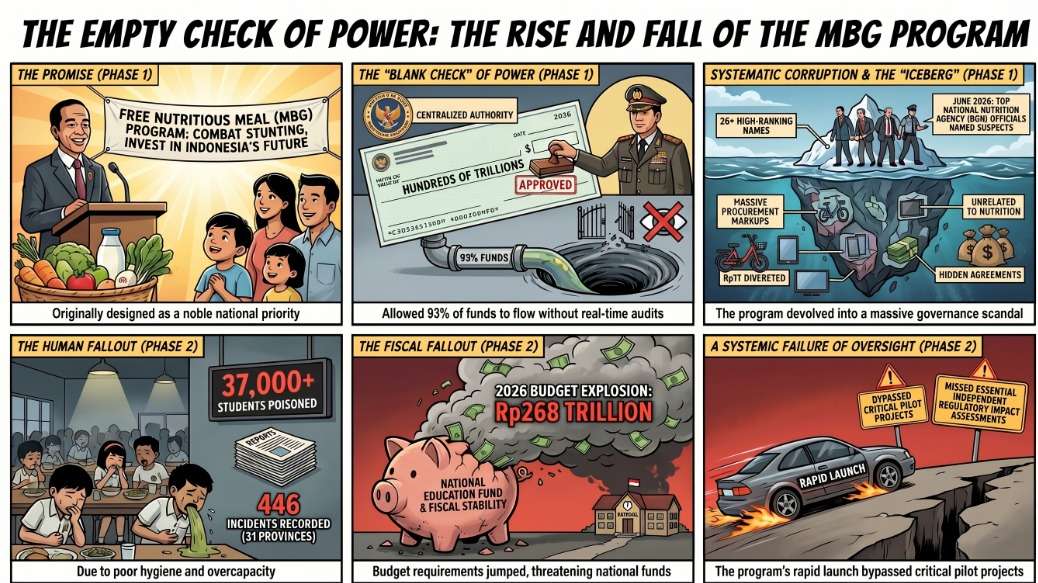
The “Iceberg” of Irregularities: Allegations and Systemic Weaknesses
In mid-2026, reports from legal and investigative authorities—including statements associated with ongoing proceedings—allegedly pointed to irregularities within MBG procurement and implementation cycles.
These developments have been widely described in public discourse as the visible “tip of an iceberg,” suggesting deeper structural issues rather than isolated misconduct.
Several individuals have been named in connection with these allegations, including former officials and private-sector actors. However, it is important to emphasize that these matters remain subject to legal process, and responsibility or guilt has not been conclusively established by final rulings.
The alleged modes of irregularity include, procurement interventions that reportedly bypassed standard competitive procedures. Price inflation in selected goods and services, including non-essential procurement items. Potential conflicts of interest involving intermediary entities and affiliated foundations and expanded concerns about networked decision-making across multiple governance levels
Reports from legal representatives in related proceedings have further suggested—based on claimed digital evidence—the possibility of broader involvement of additional actors across multiple institutions.
These claims remain part of ongoing legal scrutiny and have not been independently verified as fact.
From a policy perspective, the key issue is not only alleged misconduct, but the system design that may allow procurement opacity to persist at scale.
Public Health Crisis: The Human Cost of Implementation Failure
Beyond governance concerns, MBG’s implementation has been associated with significant operational risks affecting beneficiaries directly. Monitoring data from the Education Monitoring Network of Indonesia (JPPI (Jaringan Pemantau Pendidikan Indonesia)) has reported widespread incidents of food safety problems across multiple regions.
Key indicators reported in public monitoring include; tens of thousands of affected students over a 17-month period, hundreds of recorded incidents across dozens of provinces and recurring cases of food-related illness linked to distribution points
A major contributing factor identified in multiple field assessments is uneven compliance with hygiene and sanitation standards in food preparation facilities. Some kitchens reportedly operate without full sanitation certification, while production demands—reaching thousands of meal portions per unit—have in certain cases exceeded operational capacity.
From a public health governance perspective, this reflects a classic failure of scale management: rapid expansion without sufficient quality assurance infrastructure.
Structural and Fiscal Risks: Pressure on the National Budget
The MBG program has also become a focal point in debates on fiscal sustainability. As projected coverage expanded, budget allocations increased sharply—from tens of trillions of rupiah to several hundred trillion rupiah in proposed state budget planning.
This expansion creates three major macro-fiscal pressures:
First, budgetary displacement. Critics argue that large allocations to MBG have contributed to reduced fiscal space in other critical sectors, particularly education infrastructure and regional funding. This raises constitutional and policy questions regarding the allocation of mandated education spending thresholds.
Second, fiscal deficit risk. Economists have warned that sustained high-cost social programs, if not offset by revenue growth or reallocations, could increase pressure on Indonesia’s deficit limits and long-term debt trajectory.
Third, inflation and opportunity cost. Large-scale centralized procurement of food commodities may introduce localized inflationary pressures, while inefficiencies in procurement amplify opportunity costs—redirecting funds that could otherwise support teacher welfare, school facilities, or rural education development.
Critical Analysis: The “Blank Check” Governance Problem
A central critique emerging from policy discourse is the characterization of MBG as a “blank check” model of governance. In this view, institutional design prioritizes speed and scale over accountability depth.
The core issue lies in the concentration of authority within Badan Gizi Nasional (BGN), combined with limited real-time auditing mechanisms and highly centralized budget execution through the state treasury system.
Legal and constitutional scholars have warned that when policy urgency outpaces institutional safeguards, even well-intentioned programs risk becoming structurally vulnerable to inefficiency, capture, or misuse. The concern is not merely corruption in individual cases, but the normalization of low-transparency systems at scale.
In this sense, MBG becomes a case study in governance asymmetry: strong executive delivery capacity paired with comparatively weak independent oversight architecture.
Policy Recommendations: Rebuilding Trust and Institutional Integrity
To restore credibility and safeguard the program’s social objectives, several reforms are commonly proposed by governance analysts:
First, phased or temporary suspension of expansion.
Not necessarily termination, but a recalibration period focused on auditing, safety verification, and system redesign.
Second, independent forensic audit.
A third-party, transparent review of procurement systems, supply chains, and vendor selection processes.
Third, full disclosure and accountability mechanisms.
Strengthening transparency regarding procurement data, contractors, and budget allocation flows, subject to legal safeguards.
Fourth, institutional redesign.
Rebalancing authority by introducing stronger oversight bodies, clearer procurement rules, and stricter food safety certification requirements at the implementation level.
The goal is not to weaken MBG’s social mission, but to ensure that its delivery architecture is capable of sustaining it without systemic risk.
Conclusion: Integrity Over Intent
The MBG program illustrates a fundamental truth in public policy: noble intent is not sufficient to guarantee good outcomes. Feeding children, reducing stunting, and strengthening human capital are universally legitimate policy goals. However, when scale outpaces oversight, even the most ethical programs can generate unintended harm.
Indonesia’s challenge is therefore not whether MBG should exist, but whether its institutional design can be re-engineered to match its ambition.
Without meaningful reform, MBG risks being remembered less as a breakthrough in social policy and more as a cautionary example of how governance gaps can transform welfare programs into fiscal and administrative liabilities.
Ultimately, the legitimacy of the program depends on a single question: whether the state can rebuild trust through transparency, or continue operating under a system that resembles a blank check for power rather than a disciplined instrument for public good.
___
Author: Mohammad Suaib Mappasila, Secretary of IKAFE Unhas