

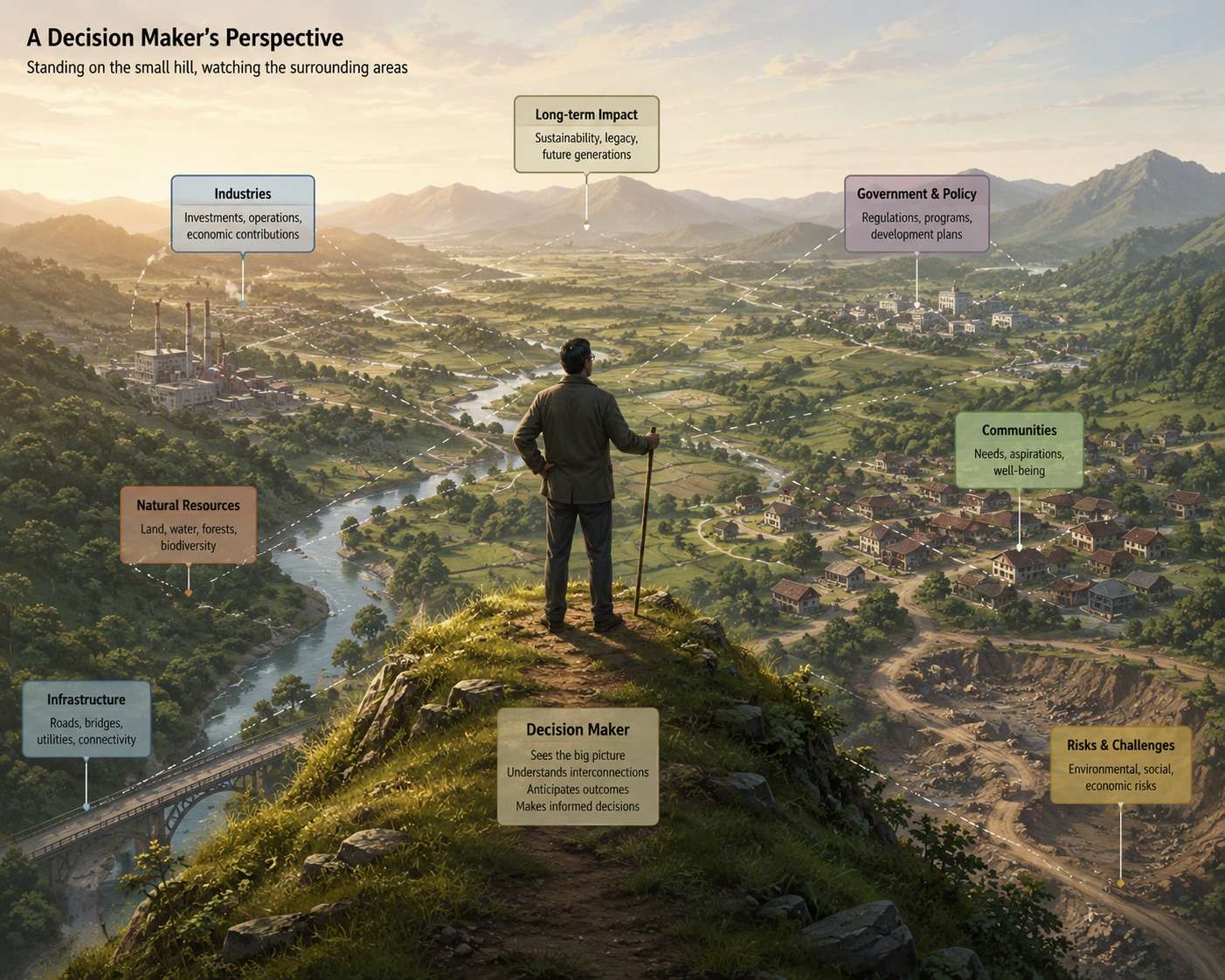
In mining areas, collaborative governance cannot be understood without recognizing informal institutions operating alongside official planning mechanisms. Ignoring these realities risks producing governance models disconnected from empirical social conditions.
MARITIMEPOSTS.COM – Development studies have long emphasized formal institutions as the foundation of effective governance.
Governments, donors, and development agencies traditionally assumed that strengthening laws, regulations, organizations, and participatory planning would naturally improve development outcomes.
However, decades of development practice revealed a persistent paradox. Countries often possessed comprehensive regulations and participatory planning systems, yet development programs frequently produced disappointing or uneven results across communities.
This paradox encouraged scholars to search beyond formal institutions. They increasingly recognized that official policies alone rarely determine development outcomes because social interactions are simultaneously shaped by unwritten rules operating outside formal governance structures.
Informality theory emerged to explain these hidden dynamics. Rather than viewing development as governed exclusively by legal institutions, it argues that formal and informal institutions coexist, interact, reinforce, or even contradict one another.
Informal institutions consist of socially shared rules that are unwritten yet widely understood and consistently followed. These rules are created, communicated, and enforced through social relationships rather than official legal authority.
Unlike random behavior or cultural habits, informal institutions possess predictable expectations and social sanctions. Individuals comply because violating these unwritten rules may threaten trust, reputation, political support, or economic opportunities.
Helmke and Levitsky define informal institutions as socially shared rules existing outside officially sanctioned channels while continuing to shape political behavior, organizational decision-making, and institutional performance across different societies.
Within development practice, informality explains why identical policies often produce different outcomes despite following the same administrative procedures. The formal design may remain constant, while informal relationships vary significantly across communities.
Village meetings illustrate this distinction clearly. Official procedures encourage inclusive participation, transparent deliberation, and collective decision-making, yet actual priorities may already be negotiated privately before formal discussions begin.
Consequently, formal deliberation sometimes functions primarily as a mechanism to legitimize decisions already reached through informal negotiations among influential actors rather than producing genuinely collective agreements.
Informality therefore redirects analytical attention from written procedures toward actual practices. It asks not merely whether participation occurs, but who influences decisions, whose voices dominate discussions, and whose interests remain excluded.
Power occupies a central position within informality theory. Decision-making is understood as the product of unequal authority, bargaining capacity, political influence, economic resources, and strategic relationships among competing actors.
This perspective differs fundamentally from traditional social capital approaches. Social capital primarily examines trust, reciprocity, cooperation, and networks, whereas informality investigates how these relationships operate within unequal structures of power.
Communities may display strong reciprocity while simultaneously reproducing patron-client relationships, elite domination, or political dependency. High social cohesion therefore does not necessarily indicate democratic participation or equitable governance.
Informality also challenges assumptions that community participation automatically reflects empowerment. Individuals frequently participate because of social obligations, political dependence, kinship expectations, or economic necessity rather than voluntary collective commitment.
Development interventions often underestimate these hidden dynamics by emphasizing procedural compliance instead of understanding local political realities. Consequently, formal participation may conceal informal exclusion operating beneath institutional arrangements.
The theory further demonstrates that states themselves frequently produce informality. Governments selectively enforce regulations, tolerate unofficial practices, and negotiate authority through relationships extending beyond formal bureaucratic boundaries.
Similarly, corporations implementing community development programs rarely interact solely through official procedures. Company representatives inevitably develop informal relationships with local elites, facilitators, brokers, and influential community members.
Mining regions particularly illustrate these complexities because development programs involve governments, corporations, consultants, facilitators, traditional authorities, and diverse community organizations possessing different interests and unequal bargaining capacities.
Within such settings, project implementation becomes a continuous negotiation among formal regulations, informal institutions, organizational interests, and shifting political alliances rather than a straightforward application of development guidelines.
James C. Scott’s concepts of public transcript and hidden transcript enrich this perspective by revealing how subordinate groups often express resistance privately while maintaining public compliance under unequal power relations.
Hidden resistance may appear through gossip, silence, avoidance, symbolic gestures, or informal conversations rather than open confrontation. These everyday practices often remain invisible within conventional evaluations of development programs.
Informality therefore complements rather than completely replaces social capital. Social capital explains available community resources, whereas informality reveals how power, institutions, and political relationships determine whether those resources become mobilized.
Together, these perspectives provide a more comprehensive understanding of community development. Social capital identifies collective capacities, while informality explains the institutional and political conditions shaping their practical realization.
For community empowerment programs, this integrated perspective offers significant analytical advantages. It recognizes that successful collaboration depends not only upon trust and participation but equally upon institutional arrangements and negotiated authority.
Collaborative governance consequently becomes more than an administrative mechanism. It represents a dynamic process requiring transparent negotiation among actors possessing different interests, resources, responsibilities, and levels of institutional power.
In mining areas, collaborative governance cannot be understood without recognizing informal institutions operating alongside official planning mechanisms. Ignoring these realities risks producing governance models disconnected from empirical social conditions.
Ultimately, informality theory encourages researchers to begin with empirical realities rather than predetermined normative models. The objective is understanding how development actually functions before proposing institutional improvements or governance innovations.
For contemporary development research, informality provides a powerful analytical bridge connecting community dynamics, institutional arrangements, power relations, and governance processes into a more realistic explanation of why development programs succeed, fail, or produce unexpected outcomes.
___
Author Kamaruddin Azis
References:
- Helmke, G., & Levitsky, S. (2004). Informal Institutions and Comparative Politics: A Research Agenda. Perspectives on Politics.
- Helmke, G., & Levitsky, S. (Eds.). (2006). Informal Institutions and Democracy: Lessons from Latin America.
- Tania Murray Li (2007). The Will to Improve: Governmentality, Development, and the Practice of Politics.
- Christian Lund (2016). Rule and Rupture: State Formation through the Production of Property and Citizenship.
- Edward Aspinall & Gerry van Klinken (Eds.) (2010). The State and Illegality in Indonesia.
- Gerry van Klinken & Joshua Barker (Eds.) (2009). State of Authority: The State in Society in Indonesia.