
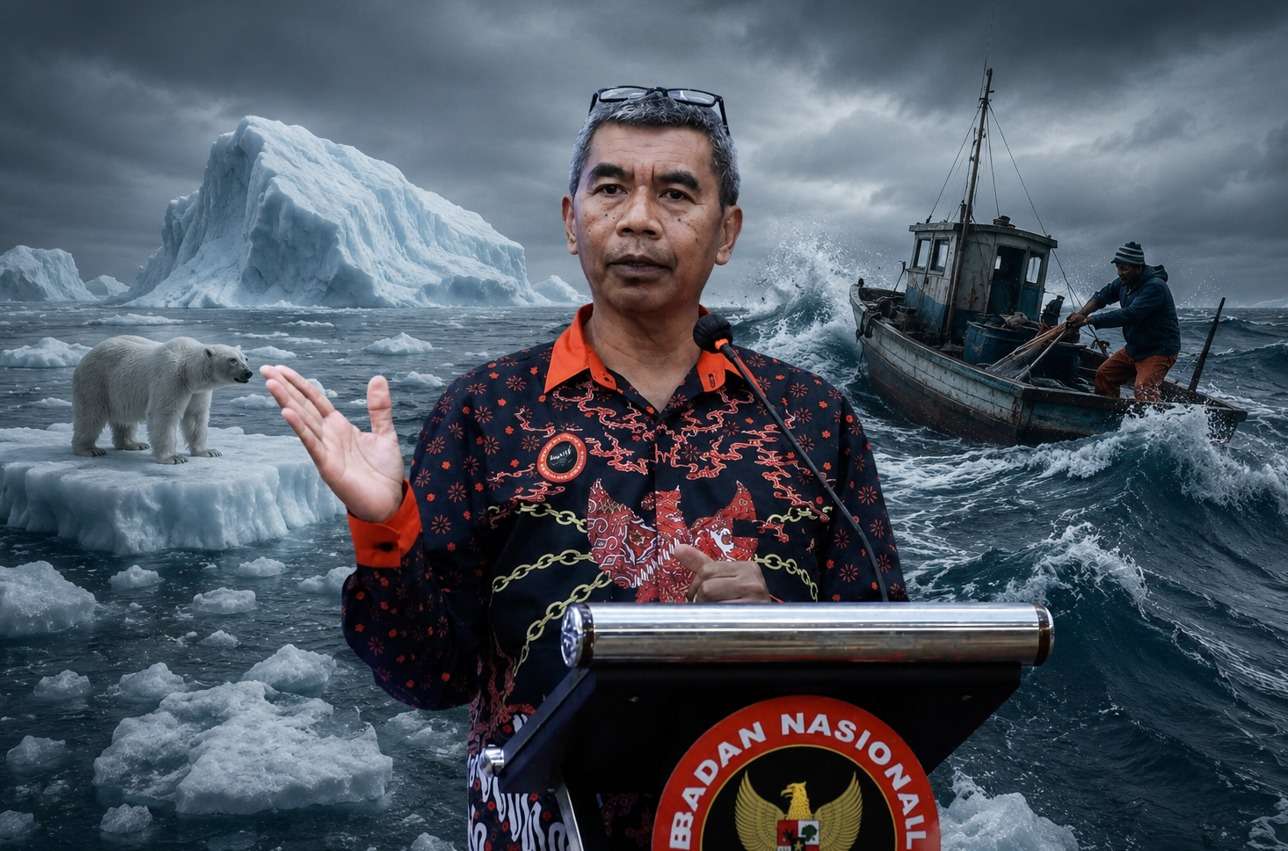
- Indonesia is a vivid portrait of the paradox of natural wealth. Through the narrative presented in Prof. Sangadji’s film, we are reminded of the grandeur of the Indonesian archipelago—from its resource-rich oceans to its fertile lands. Yet this beauty represents only one side of the coin.
- The other side reveals a harsh reality: massive environmental degradation caused by human activities and immense natural potential left untapped due to poor management.
MARIITIMEPOSTS.COM – Our failure to manage and invest in our natural wealth is not merely an environmental issue; it is a humanitarian crisis. Ironically, amid such abundant resources, many Indonesians—particularly women—have been compelled to seek employment abroad as migrant workers.
They leave in search of livelihoods that should be available within their own homeland, and many return under deeply distressing circumstances.
This reality serves as a stark reminder that neglecting our environment ultimately results in the loss of human dignity and social well-being.
The Analogy of Change: From Birds to Shorts
Awareness of the fragility of the Earth’s balance has been voiced for decades.
In 1963, Rachel Carson published her landmark work Silent Spring, a book that marked the birth of the modern environmental movement. Through this historical lens, we can see how nature often sends warning signals before major disasters occur.
Ecosystem Indicator: Birds
In North America, the silence of spring became a troubling sign. The disappearance of birdsong resulted from widespread bird mortality caused by consuming seeds contaminated with pesticides used in large-scale agricultural operations.
This was among the earliest demonstrations that disruption at the smallest levels of the food chain can trigger the collapse of entire ecosystems.
Human Adaptation Indicator: Clothing
If birds serve as signals for nature, clothing serves as a signal for humanity.
The shift from wearing long trousers to shorts reflects one of the most visible forms of human adaptation to a warming climate. It illustrates how rising global temperatures have compelled people to alter their daily behaviors in response to increasing heat.
These signals demonstrate the transition from environmental degradation occurring “out there” to disruptions affecting our everyday lives “right here.”
Reality and Science: Why Climate Change Is Truly Happening
Climate change is neither a theory nor a myth—it is an undeniable scientific reality. Historical records and scientific evidence point to three fundamental indicators:
1. Melting Ice-Covered Land Areas
Regions once covered by permanent ice are experiencing significant warming and large-scale melting.
2. Extreme Temperature Fluctuations
Global temperatures are increasingly experiencing unstable spikes and declines beyond normal thresholds.
3. The Legacy of the Industrial Revolution
Data show that since the beginning of the Industrial Revolution, greenhouse gas (GHG) emissions generated by human activities have risen dramatically, permanently altering the composition of the Earth’s atmosphere.
Understanding the Greenhouse Effect
To understand how greenhouse gases work, imagine sitting inside a car with all its windows and doors tightly closed under the blazing sun.
Sunlight enters through the glass, but the heat becomes trapped inside and cannot escape. As a result, the temperature inside the vehicle rises dramatically.
This is analogous to how greenhouse gases trap solar heat within the atmosphere, causing the Earth to develop a “fever.”
Types of Greenhouse Gases and Their Sources
Global warming is driven by various gases produced through human activities. The primary greenhouse gases and their sources include:
| Gas Type | Primary Source |
|---|---|
| Carbon Dioxide (CO₂) | Fossil fuel combustion and industrial activities |
| Methane (CH₄) | Waste and landfill sectors |
| Nitrous Oxide (N₂O) | Agricultural activities and industrial operations |
| Hydrofluorocarbons (HFCs) | Air conditioners and refrigeration systems |
| Sulfur Hexafluoride (SF₆) | Industrial processes and electrical equipment |
Important Note: The waste and household sectors contribute approximately 10% of total greenhouse gas emissions. This means that everyday household behavior has a direct impact on global climate change.
Real Impacts: Threats to the World and Indonesia
Global warming has triggered profound physical changes across the planet.
Since 1940, average global surface temperatures have risen by approximately 0.5°C, contributing to increased ocean evaporation and accelerating climate-related disruptions. Over the last decade, sea levels have risen by approximately 0.1 to 0.3 meters.
Even more concerning, the ocean’s ability to absorb carbon dioxide has declined significantly during the 21st century.
Global Scale
Rising sea levels have already inundated approximately one million square kilometers of land and threaten critical regions worldwide, including:
- The potential submergence of the Maldives and the loss of the Nile Delta.
- The risk of one-third of Bangladesh being flooded.
- Severe water shortages across the Middle East.
- The expansion of the Sahara Desert toward southern Spain and Sicily, accompanied by the erosion of Mediterranean coastlines.
Indonesia’s Vulnerability
As an archipelagic nation, Indonesia stands on the front line of climate change impacts:
- Changes in seasonal patterns and rainfall affecting agricultural productivity.
- Increasing frequency of extreme weather events.
- Rising sea levels threatening small islands and coastal communities.
- Higher sea temperatures damaging coral reef ecosystems and marine biodiversity.
Solution Strategies: Mitigation and Adaptation
To address these challenges, the Indonesian government has committed to reducing emissions by 26% through domestic efforts and by up to 46% with international support.
The strategy is divided into two key approaches:
Mitigation: Addressing the Root Causes
Efforts aimed at reducing greenhouse gas emissions and increasing the Earth’s capacity to absorb carbon include:
- Energy Conservation: Simple actions such as turning off unused lights.
- Eliminating Ozone-Depleting Substances: Phasing out harmful chemicals such as CFCs.
- Energy Transition: Replacing fossil fuels with renewable and environmentally friendly energy sources.
- Local Technologies: Utilizing biomass fuels and more efficient, eco-friendly cookstoves.
Adaptation: Preparing for and Responding to Impacts
Adaptation involves adjusting to climate impacts that are already occurring to reduce risks and vulnerability.
Examples of adaptation to sea-level rise include:
Preventive Measures
Constructing seawalls and coastal protection structures to reduce erosion and flooding.
Accommodative Measures
Modifying infrastructure, such as replacing wooden house stilts with concrete supports to withstand prolonged water exposure.
Relocation
Strategically developing new settlements farther away from vulnerable coastlines.
Recommendation: Reforming Human Behavior
Many of the climate-related disasters we witness today—including devastating floods—are not purely natural events.
They are often the consequence of unsustainable human behavior. Destructive activities such as illegal logging have exceeded the carrying capacity of natural ecosystems.
When nature can no longer absorb these pressures, it responds through what may be viewed as a form of ecological rejection—manifested in the form of disasters.
Navigating the future amid climate change is undoubtedly challenging, but it is far from impossible. The key lies in our willingness to change.
The first step must begin today: assess environmental risks in your surroundings, increase awareness, and prepare for future challenges. Nature has already issued its warnings; it is now our responsibility to respond through meaningful behavioral change.
Let us act before it is too late.
The above article is a reflection on the ideas of Prof. Dr. Ir. Mohd Nur Sangadji, M.Sc., Professor of Agriculture at Tadulako University and one of the founders of The COMMIT Foundation, delivered during a Climate Change Adaptation Workshop organized by The COMMIT Foundation and JICA-CDCCS in Wangi-Wangi, Wakatobi Regency.
Editor K. Azis