

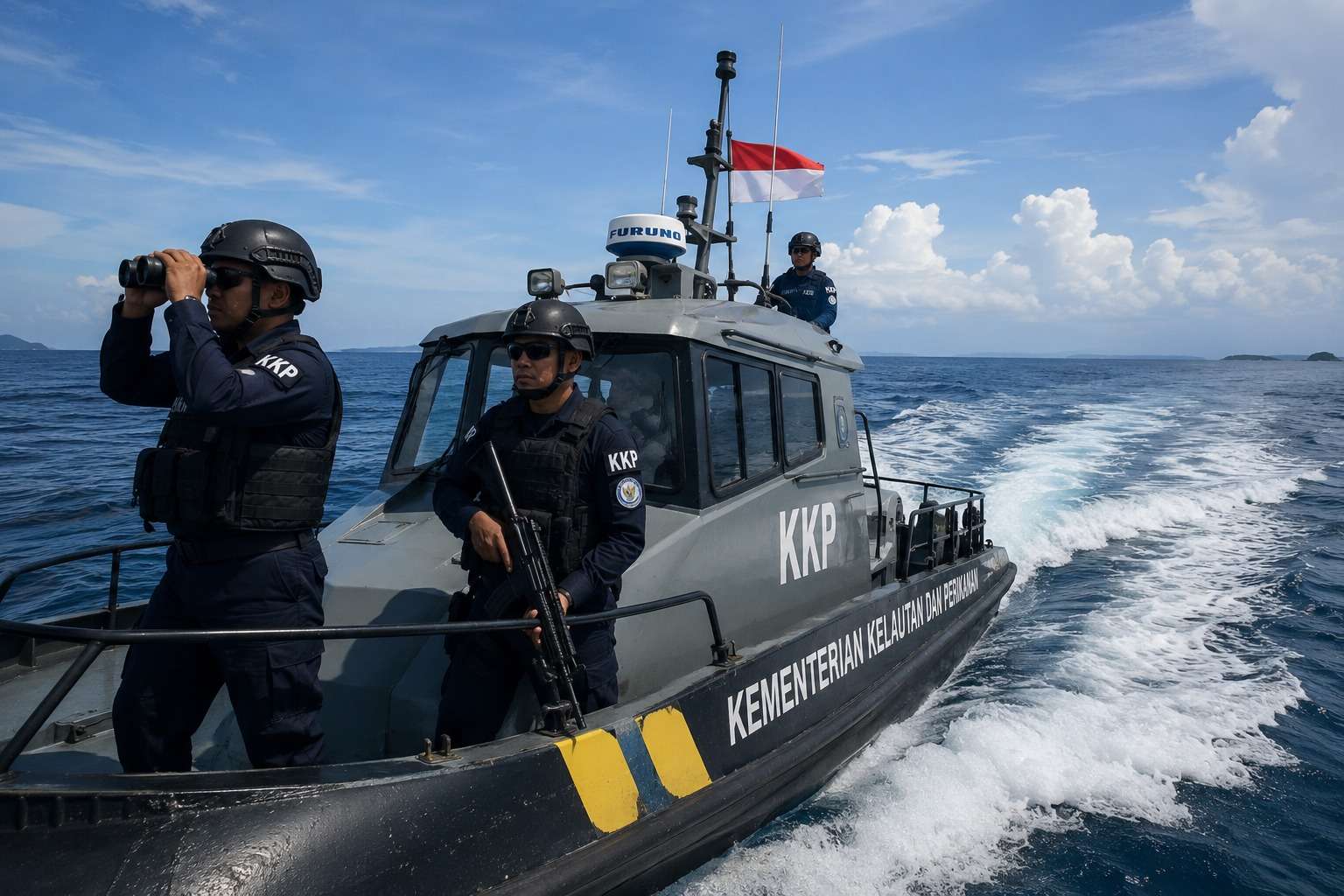
Recognizing Illegal, Unreported, and Unregulated (IUU) Fishing as a form of international blue water crime is not merely a change in terminology—it is a shift in paradigm. How we understand a threat ultimately determines how we respond to it.
Prof. Andi Adri Arief
Professor of Fisheries Sociology, Hasanuddin University

MARITIMEPOSTS.COM – Every year on June 5, the world commemorates the International Day for the Fight Against Illegal, Unreported and Unregulated (IUU) Fishing.
Established by the United Nations, this observance is more than an annual ceremonial event. It serves as a reminder that illegal fishing has evolved into a global threat to marine resource sustainability, food security, coastal economies, and even national security.
In Indonesia, this year’s commemoration coincides with ongoing efforts to strengthen fisheries governance.
One notable initiative is the issuance of the Minister of Marine Affairs and Fisheries Decree No. 79 of 2025, which provides the legal foundation for implementing Indonesia’s National Action Plan to Combat IUU Fishing 2025–2029. Such instruments demonstrate the government’s commitment to strengthening monitoring, law enforcement, and the sustainable management of fisheries resources.
This year’s International Day for the Fight Against IUU Fishing should also be a moment for reflection.
The key question is no longer whether we have sufficient regulations, but whether we truly understand the nature of the threat we are facing.
Or are we still viewing IUU Fishing merely as a fisheries violation, when in reality its character and impacts have evolved into a far more complex form of transnational organized crime?
Understanding the Problem
For many years, IUU Fishing has been viewed primarily as a fisheries violation: vessels operating without permits, illegal fishing gear, or catches that are not reported.
This perspective has long shaped fisheries management policies. It appears logical and well established. Yet therein lies the problem—we have given an overly simple name to a much more complex reality.
How we define a problem determines how we respond to it. When IUU Fishing is viewed merely as an administrative violation, the solutions tend to be administrative as well: stricter licensing systems, increased patrols, or harsher penalties.
All of these measures are important, but they do not address the root of the problem.
Organized Crime at Sea
Numerous studies have long classified IUU Fishing as an extraordinary and organized crime. Yet it still receives less attention than other forms of organized crime such as human trafficking, money laundering, drug smuggling, or illegal logging.
In reality, illegal fishing operations do not occur spontaneously.
No vessel simply drifts into another country’s waters and steals fish without planning.
These operations are carefully designed and coordinated—from logistical preparation, crew recruitment, and route planning to document falsification and the distribution of catches to international markets.
Even before a vessel leaves port, fishing grounds, destination ports, unloading points, and target markets are often predetermined. This pattern closely resembles other criminal syndicates such as illegal logging and human trafficking, involving multiple actors with different functions operating within an interconnected network.
Substantively, therefore, IUU Fishing should be understood as organized crime rather than merely a fisheries violation.
Moreover, such activities rarely stand alone. They are frequently linked to document fraud, labor exploitation, smuggling, corruption, and violence.
Traditional fishers often become victims, both economically and physically. At this point, it becomes clear that what we are confronting is not simply a fisheries offense but a complex criminal system.
Blue Water Crime: The Real Face of IUU Fishing
The seriousness of this crime becomes even more apparent when it operates across national borders.
In many cases, investors originate from one country, crews are recruited from another, vessel documents are issued by a third country, fishing operations occur in the waters of a fourth country, and the catch is sold in yet another market.
Imagine a fishing vessel owned by a businessman from Thailand, crewed by migrant workers from Vietnam and Myanmar, operating under a flag of convenience issued by Panama or Belize, fishing illegally in Indonesian waters, and exporting its catch to European markets through Spain.
Within a single operation, multiple countries become involved in different capacities.
In international law, this is recognized as transnational organized crime.
When IUU Fishing involves such cross-border networks, it can no longer be viewed solely as a fisheries-sector issue. It is, in essence, a global criminal operation that uses the ocean as its operational space.
The ocean has become a domain where international criminal networks operate discreetly yet systematically.
The use of flags of convenience, document fraud, exploitation of multinational crews, and links to fuel, weapons, and narcotics smuggling demonstrate that IUU Fishing shares many characteristics with other forms of transnational organized crime.
This is why the concept of international blue water crime is increasingly relevant.
It helps us understand that the threat is not merely fish theft but a global criminal network exploiting weaknesses in international maritime governance.