

Working together with the Yayasan Konservasi Alam Nusantara (YKAN) and the Berau Regency Government, the village developed a community-based mangrove governance model through a legally binding Village Regulation (Peraturan Kampung).
By Kamaluddin – Village Facilitator
MARITIMEPOSTS.COM – Indonesia is home to the world’s largest mangrove ecosystem. According to the 2025 National Mangrove Map published by Indonesia’s Ministry of Environment, the country possesses approximately 3.46 million hectares of mangroves, representing around 23 percent of the world’s total mangrove area.
Yet despite this extraordinary natural wealth, Indonesia continues to face serious threats from land conversion and ecosystem degradation. Data from the Peatland and Mangrove Restoration Agency (BRGM) indicate that between 637,000 and 700,000 hectares of Indonesia’s mangroves are currently classified as degraded or in critical condition. This alarming reality explains why the Indonesian government has made sustainable mangrove management a national priority.
One important milestone was the issuance of Presidential Regulation No. 73/2012 on the National Strategy for Mangrove Ecosystem Management, which later evolved into Government Regulation No. 27/2025 on the Protection and Management of Mangrove Ecosystems. These policies establish a national framework for conserving one of Indonesia’s most valuable coastal assets.
Empowering Villages Through Law
Indonesia’s Village Law (Law No. 6/2014) provides a unique opportunity by granting villages greater authority to manage their natural resources sustainably, including mangrove ecosystems.
Supporting regulations, particularly the Ministerial Regulation on Village Authority (Permendesa No. 1/2015), explicitly recognize village governments’ authority to develop participatory spatial planning and social mapping, including the management of mangrove areas.
Combined with Indonesia’s forestry legislation and regional governance framework, these legal instruments strengthen the rights of village communities to lead mangrove management in areas classified as Non-Forest Areas (APL).
In Berau Regency, East Kalimantan, these national regulations have been reinforced through Regional Regulation No. 5/2020 on Mangrove Ecosystem Management in Non-Forest Areas, providing an even stronger legal basis for community-led conservation.
Karangan Village: A Community-Led Conservation Model
A compelling example can be found in Karangan Village, Berau Regency.
Working together with the Yayasan Konservasi Alam Nusantara (YKAN) and the Berau Regency Government, the village developed a community-based mangrove governance model through a legally binding Village Regulation (Peraturan Kampung).
Karangan Village contains approximately 2,907 hectares of mangroves, covering nearly 47 percent of its total land area. For generations, local residents have depended on these mangroves to sustain fisheries, harvesting fish, shrimp, and crabs that rely on healthy mangrove habitats.
Recognizing that their livelihoods depend on conservation, the community enacted Village Regulation No. 3 of 2024 on Mangrove Ecosystem Management, Utilization, and Community Empowerment, formally adopted on 13 May 2024.
The regulation establishes three management zones: Core Conservation Zone covering 2,529 hectares. Limited Use Zone covering 115.79 hectares. General Use Zone covering 262.31 hectares
The core zone is dedicated to protecting mangrove biodiversity and wildlife, including proboscis monkeys, crocodiles, deer, and birds, while allowing only research, ecosystem restoration, and ecotourism activities. The utilization zones support sustainable fisheries and community infrastructure under clearly defined management rules.
The regulation also requires the establishment of a Mangrove Conservation Institution, composed of representatives from fishing communities, women’s groups, and youth organizations, to oversee management and monitoring of the ecosystem.
Conservation Backed by Village Investment
Unlike many conservation initiatives that depend solely on external funding, Karangan Village has committed its own village budget to support mangrove protection.
Since adopting the regulation, the village government has allocated approximately IDR 500 million for mangrove patrols, monitoring, and community economic development.
Among its achievements are: Installation of 133 boundary markers along 6.5 kilometers of protected mangrove areas. Monthly community patrols to prevent illegal logging and habitat destruction. Financial support for women’s enterprises producing crab crackers, processed shrimp, and other seafood products.
Development of an integrated ecotourism master plan linking mangrove forests with the surrounding karst landscape.
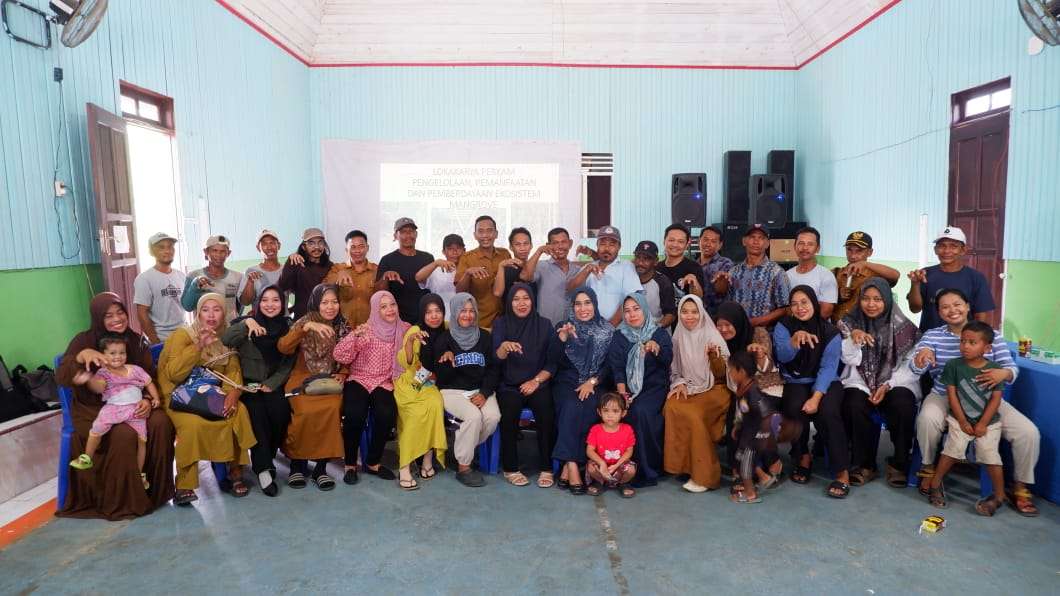
Conservation Through Local Wisdom
Perhaps the most remarkable aspect of Karangan’s experience is that conservation is built upon traditional practices rather than replacing them.
Local residents continue to harvest mangrove timber selectively for small-scale community needs—including drying platforms, fishing structures, and seaweed farming poles—only once each year and without clearing large areas of forest.
Instead of prohibiting all resource use, the village regulation formally recognizes traditional harvesting locations as limited utilization zones, balancing ecological protection with local livelihoods.
This approach has significantly reduced potential conflicts between conservation objectives and community interests while ensuring long-term stewardship of the ecosystem.
As the world commemorates World Mangrove Day on 26 July, Karangan Village demonstrates that successful mangrove conservation does not always begin with national governments or international donors.
Sometimes, it begins with empowered communities, strong village leadership, and local regulations that give people both the authority and the responsibility to protect the natural resources on which their future depends.
Karangan’s experience offers a valuable lesson for Indonesia and other coastal nations: sustainable mangrove conservation becomes far more achievable when local communities are trusted not merely as beneficiaries, but as leaders.