
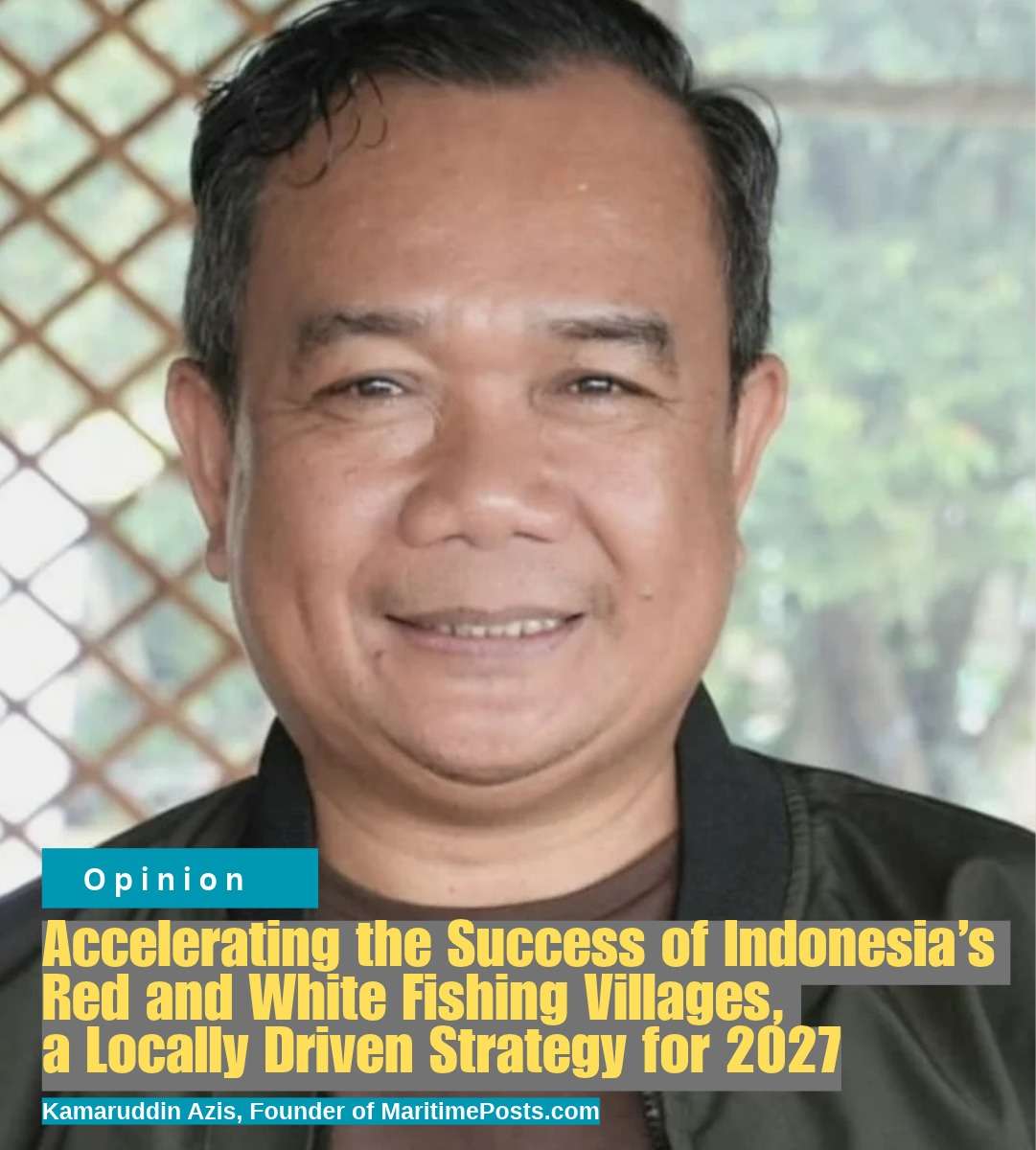
By Kamaruddin Azis, Founder of MaritimePosts.com
As global food demand rises and supply chains face growing uncertainty, Indonesia must strengthen its food sovereignty by harnessing the potential of its marine and fisheries sector. With its vast marine resources and coastal communities, the country has an opportunity to improve access to animal protein while creating sustainable livelihoods for millions of people.
MARITIMEPOSTS.COM – The Red and White Fishing Village Program (Kampung Nelayan Merah Putih, or KNMP) represents an important step toward this ambition. Championing an integrated approach to coastal development, the program seeks to address longstanding challenges facing fishers, from high operating costs and inadequate infrastructure to limited market access.
However, the success of KNMP in 2027 should not be measured simply by the number of facilities constructed. Its real impact will depend on whether fishing communities achieve higher incomes, stronger local economies, and more sustainable management of marine resources.
The central challenge is to transform fishing villages into productive economic ecosystems tailored to local needs.
Lessons from Biak: Integration Delivers Results
The KNMP pilot in Biak, Papua, illustrates the potential of an integrated development model. Before the intervention, 89 fishers supporting approximately 445 family members faced difficulties accessing ice, fuel, vessel repairs, cold storage, and essential fishing supplies.
The government responded by developing interconnected facilities, including an ice plant, a fishermen’s fuel station, cold storage, a boat repair workshop, and facilities for fishing supplies. Culinary areas and community spaces were also incorporated to stimulate local economic activity.
According to reported evaluations covering approximately two years, fishing productivity increased by more than 100%, while annual fish production reached around 295 tonnes. Buyers also helped connect the catch to wider markets in Java for industrial and export-oriented purposes.
These results highlight an important lesson: infrastructure creates greater value when facilities operate as part of a coordinated system linking production, preservation, logistics, and marketing.
Yet the Biak experience should not be replicated mechanically. Every coastal community has different fishing practices, marine resources, market opportunities, and institutional capacities. KNMP must adapt its investments to these local realities.
Four Priorities for KNMP 2027
First, prioritize local potential and community needs.
Indonesia has approximately 12,000 coastal villages, including an estimated 2,900 whose communities depend heavily on capture fisheries. With the government targeting 5,000 fishing villages, careful site selection and planning are essential.
Before construction begins, local governments should assess fishing fleets, target species, seasonal production, infrastructure gaps, transportation links, and market demand. Fishers must participate in these assessments because they understand the practical challenges of their livelihoods.
Investments should respond to demonstrated needs rather than follow a uniform infrastructure blueprint. Success indicators should include reduced operating costs, lower post-harvest losses, improved market access, and higher household incomes—not merely completed buildings.
Second, integrate the fisheries value chain and secure fair markets.
Fishing villages cannot prosper without reliable buyers and competitive prices. KNMP must connect fishers with landing facilities, processors, transportation networks, cooperatives, and distributors.
The government’s Measured Fishing policy framework (Penangkapan Ikan Terukur, or PIT) also highlights the importance of fisheries management and economic activities at designated base ports.
Reliable off-takers can help reduce uncertainty by purchasing catches and connecting producers with broader markets. However, these partnerships must be transparent and fair. Excessive dependence on a single buyer could weaken fishers’ bargaining power and concentrate economic benefits.
Strengthening cooperatives, improving market information, and encouraging competition can help ensure that more value remains within coastal communities.
Third, modernize fisheries governance and protect marine ecosystems.
Economic growth must not come at the expense of the resources that sustain it. Vessel Monitoring Systems (VMS), accurate fisheries data, and effective enforcement can strengthen oversight, improve maritime safety, and help combat illegal fishing.
Fishing intensity must also reflect the ecological capacity of marine environments. Healthy coral reefs, mangroves, and seagrass beds support biodiversity and contribute to the resilience of coastal ecosystems.
KNMP should therefore integrate conservation into economic planning. Sustainable fisheries are essential to protecting both future production and the long-term livelihoods of fishing communities.
Fourth, strengthen technological capabilities and operational efficiency.
Indonesia should develop fisheries and aquaculture industries based on its tropical marine resources, research capacity, and market opportunities. Grouper and mud crab, for example, offer potential for specialized development when supported by appropriate technology and sustainable production systems.
Research institutions, universities, businesses, and government agencies should collaborate to improve aquaculture, product quality, processing, and distribution.
Reducing fishing costs is equally important. Fuel-efficient engines and suitable hybrid propulsion technologies could help lower operating expenses, provided they are technically reliable, affordable, and supported by training and maintenance services.
Fisheries extension workers have a crucial role in helping communities adopt these innovations and improve their business management.
From Public Investment to Community Prosperity
Three additional conditions will determine whether KNMP delivers lasting benefits.
First, small-scale fishers must retain a meaningful position in the value chain. Cooperatives, access to finance, transparent purchasing arrangements, and appropriate safeguards against market concentration can help prevent local producers from becoming dependent on dominant commercial interests.
Second, facilities must be professionally managed. Ice plants, cold storage units, fuel stations, and repair workshops require trained personnel, reliable utilities, maintenance budgets, and viable business plans. Fishing cooperatives, village-owned enterprises (BUMDes), and accountable public-private partnerships may provide suitable management arrangements, depending on local circumstances.
Third, development must balance three objectives: improving fishers’ welfare, strengthening the fisheries industry, and protecting marine ecosystems. These priorities are interconnected and should be reflected in measurable performance targets.
Putting Fishers at the Center
The future of KNMP depends on a fundamental shift in perspective: fishing villages must be treated not simply as infrastructure projects, but as engines of inclusive coastal development.
Government agencies, financial institutions, businesses, universities, and fishing communities must work together to create an ecosystem that supports productive fisheries, fair markets, innovation, and environmental stewardship.
The Biak experience demonstrates the promise of integration, while Indonesia’s diverse coastal geography demands locally tailored solutions.
Ultimately, the success of KNMP 2027 will be measured not by how many buildings stand along the coast, but by how much fishing families’ lives improve, how much economic value stays in their communities, and how effectively marine resources are protected for future generations.
By placing fishers at the center of planning and implementation, Indonesia can turn the Red and White Fishing Village Program into a stronger foundation for food sovereignty, inclusive economic growth, and a resilient maritime future.
Written by Kamaruddin Azis, Founder of MaritimePosts.com