
MARITIMEPOSTS.COM – SOUTH SULAWESI — Environmental management in South Sulawesi is facing increasingly complex challenges as investment in mining, industry, infrastructure, coastal development, and various strategic projects continues to grow.
Amid these economic opportunities, the quality of environmental assessments and the ability to bridge competing sectoral interests are becoming increasingly important.
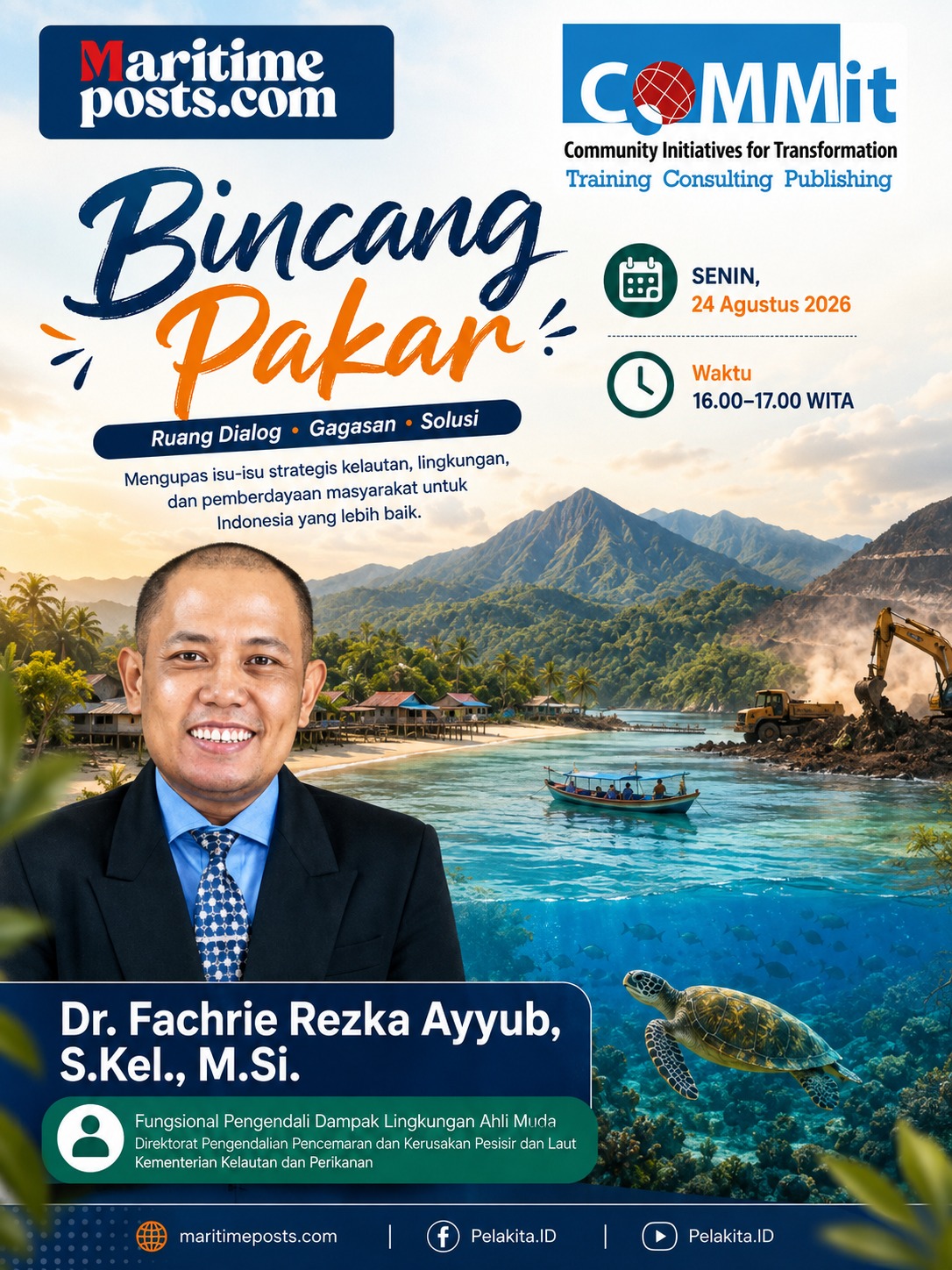
This issue emerged during a discussion with Dr. Fahrie Reska Ayyub, S.T., M.Si., a functional environmental impact control officer at the South Sulawesi Environmental and Forestry Agency (DLHK).
A graduate of Marine Science at Hasanuddin University in the 2002 cohort, Fahrie also holds a doctoral background in environmental and population studies.
The discussion explored the future of South Sulawesi’s coastal and marine areas, particularly amid the expansion of mining, industry, reclamation, port infrastructure, and national strategic projects.
According to Fahrie, South Sulawesi actually has significant potential in both mining and marine and fisheries sectors. The challenge is not simply whether the potential exists, but how different interests can be balanced so that they do not generate prolonged conflicts.
“South Sulawesi has enormous potential, both in mining and in the marine and fisheries sectors,” he said.
However, this potential exists alongside complex social challenges. When different sectors develop within the same space, conflicts of interest are almost unavoidable.
For the marine and fisheries sector, this is particularly important because industrial activities on land and at sea can affect shipping routes, fishing grounds, aquaculture areas, and the livelihoods of coastal communities.
Environmental Impacts Go Beyond Shipping Routes
Fahrie provided several examples based on his experience reviewing Environmental Impact Assessment documents, known in Indonesia as AMDAL.
He cited the development of Center Point of Indonesia in Makassar as one example of a project with implications for shipping routes and other marine-related aspects.
Other examples include activities in Pangkep, including special terminals operated by cement companies, as well as the Punagaya power plant area in Jeneponto.
According to him, environmental assessments should not only examine technical issues such as changes to shipping routes. They should also assess the consequences for fishing activities and fisheries productivity.
In fisheries management, one important aspect is Maximum Sustainable Yield (MSY). Fahrie noted that this type of analysis has not always been sufficiently developed in environmental assessments.
“Sometimes our environmental assessments do not go that far. They only look at what happens if a shipping route is disrupted and where vessels can pass instead. But they do not examine whether this could have a significant impact on fishing activities,” he explained.
For Fahrie, environmental impacts should not be concealed. Every development activity inevitably has consequences. What matters is identifying those impacts honestly and addressing them through mitigation, compensation, employment opportunities, and other appropriate management measures.
Procedurally Compliant, but Not Always Substantively Deep
One of the key issues raised was the difference between procedural compliance and substantive quality.
Fahrie said that, procedurally, environmental assessment processes generally follow existing regulations. Public consultations, announcements, and various administrative stages are carried out.
The concern, however, is the depth of the analysis.
“Procedurally, the process has generally followed the rules. But sometimes the substance is not sufficiently in-depth,” he said.
According to Fahrie, this may be related to the capacity of both those preparing and those reviewing environmental assessment documents. When analytical capacity is insufficient, impacts that should have been identified during the planning stage may not be adequately captured.
The situation becomes even more complicated when there is pressure to accelerate investment. He acknowledged that there are circumstances in which the preparation or assessment of documents must be completed under significant time pressure.
“If we are being honest, sometimes there are political pressures and other pressures for acceleration,” he said.
He also noted that regulatory changes following Indonesia’s Job Creation Law have introduced new approaches aimed at providing greater certainty for investment licensing. The AMDALNet system, for example, establishes deadlines and mechanisms that can place government agencies in a difficult position when documents remain inadequate but the process must proceed according to prescribed timelines.
Almost No Environmental Assessments Are Rejected
One of Fahrie’s most striking observations was his experience that almost no AMDAL documents are actually rejected.
“Sorry to say, it feels like there are almost no AMDAL documents that we reject,” he said.
Yet, he acknowledged that some documents remain substantively inadequate.
This situation illustrates the space for compromise between environmental interests, investment needs, political pressures, and regional development priorities.
Such pressures do not necessarily originate from a single level of government. According to Fahrie, dynamics can emerge at the district and municipal levels as well as at broader levels.
“Even at the district and municipal level, there are situations involving the families of one person or another, and conflicts of interest can sometimes emerge,” he said.
Land and Marine Spatial Planning Must Be Integrated
Fahrie also emphasized the importance of distinguishing between spatial planning issues and environmental issues.
Under the licensing system that has evolved following the Job Creation Law, land and marine spatial considerations are increasingly harmonized with environmental processes. A development activity should not proceed too deeply into the environmental assessment stage if its spatial planning issues have not yet been resolved.
He referred to developments in East Luwu as examples of situations that still need to be examined from a spatial-planning perspective before moving too deeply into the AMDAL process.
More broadly, there are also Strategic Environmental Assessments (KLHS) and Regional Environmental Protection and Management Plans (RPPLH), which should serve as the foundation for determining environmental carrying capacity.
According to Fahrie, KLHS should address spatial issues at the macro level. That way, when a project enters the AMDAL stage, the assessment does not have to repeat debates over whether an area is spatially appropriate, but can instead focus on the project site and technical impact management.
“If we can complete the KLHS properly, then the AMDAL should no longer be talking about spatial planning. It should focus on the project site,” he explained.
At the site level, discussions can then focus more specifically on water management, emissions, hazardous and toxic waste, traffic, and other project-specific impacts.
Social Aspects Remain a Weak Point
Environmental assessments cover several important dimensions, including geophysical and chemical conditions, flora and fauna, traffic, socio-economic and cultural aspects, and public health.
However, according to Fahrie, socio-economic and cultural analysis remains one of the areas that is not sufficiently developed in many of the documents he has reviewed.
“Socio-economic and cultural assessments are indeed still lacking in many AMDAL documents,” he said.
Social issues, he emphasized, should not be treated merely as an additional variable or a technical appendix. Communities have different behaviors, needs, values, local knowledge, and social characteristics.
He connected this perspective with his own academic experience during his doctoral studies. He recalled being encouraged to explore human behavior more deeply after previously relying more heavily on technical approaches.
That experience convinced him that development cannot be assessed solely through physical and technical parameters. Human factors must be taken seriously.
“Even if the technical aspects are resolved, if the socio-economic dimension is problematic, the entire project can fail,” he said.
He pointed to strategic development projects in Makassar as an important lesson. Technically, certain aspects may meet the requirements, but social opposition can ultimately halt or delay a project.
Public Consultation Must Not Become a Formality
Another issue concerns public consultation. Legally and procedurally, public consultation is an integral part of the AMDAL process.
However, Fahrie warned that fulfilling the procedure does not automatically mean that all community interests have genuinely been represented.
According to him, AMDAL preparers may invite certain groups or institutions simply to fulfill consultation requirements. The more important question is whether those participants truly represent affected communities.
“Procedurally, the legal requirements are fulfilled, public consultation is conducted, and announcements are made,” he said.
There is therefore a need to ensure that public consultation does not become merely an administrative formality.
The key questions are: Who participates? Who is absent? Who will be affected? How are vulnerable groups represented? And do community voices actually influence the analysis and recommendations?
Social Surveys Must Not Merely Fulfill a Numerical Requirement
Fahrie’s criticism also concerns the methodology used in social assessments.
He has encountered surveys involving limited numbers of respondents without adequate methodological justification. In quantitative studies, for example, sample sizes must be supported by a clear methodological basis.
“Sometimes I simply ask, how many people did you survey? They say, ‘Twenty people, Sir.’ I ask, how can you survey 20 people?” he said.
Twenty people may be appropriate when they are treated as key informants in qualitative research. But that is different from using 20 respondents to draw quantitative conclusions about broader community perceptions.
Methodological weaknesses ultimately affect the quality of recommendations.
If social problems are not properly mapped, the resulting recommendations will not be able to address their root causes.
Clear Social Mitigation Matrices Are Needed
Fahrie believes every AMDAL document should contain a clear matrix identifying potential social problems, affected groups, intervention measures, success indicators, and grievance mechanisms.
Mitigation should begin at the planning stage rather than being developed only after conflict emerges.
He offered a simple example: not all communities need the same form of assistance. Some need employment, others need business opportunities, protection of their living spaces, or certainty over the sustainability of their livelihoods.
“You cannot treat everyone the same—for example, by giving them rice every Eid. What if rice is not what they need?” he said.
Community empowerment programs should therefore be based on actual needs rather than simply consisting of activities that are easy to report.
When Marine Space Conflicts with Livelihoods
The use of marine space provides another example of why government presence is essential.
Fahrie referred to cases involving seaweed farmers who continue operating in areas that have already been allocated as concessions. When disruption or conflict occurs, the situation becomes complicated because the presence of communities is already in tension with the designated status of the space.
In such circumstances, simply describing the continued presence of communities as “local wisdom” is not enough.
According to Fahrie, the government must take a clear position from the beginning when allocating marine space. If an area has been designated for a particular activity, its social consequences must be mapped and mitigated before conflict occurs.
He stressed that the government should not only be present when collecting non-tax state revenue or issuing permits, and then leave companies and communities to resolve conflicts on their own.
“The government needs to be present there,” he emphasized.
Balancing Environmental Services and Economic Benefits
The question of regional economic benefits was another important part of the discussion.
Based on his experience, Fahrie said that detailed calculations showing the trade-off between economic benefits and losses or pressures on environmental services are not always available.
He said he had not yet found detailed calculations showing how much economic benefit a particular activity generates compared with its ecological and social consequences.
Development, he argued, should be able to demonstrate a balance between investment, regional revenue, employment, and environmental protection.
This is particularly important for areas such as East Luwu, which possess significant mineral resources while also relying on coastal and marine ecosystems as the foundation of local livelihoods.
Fahrie also recalled observing changes in the color and characteristics of coastal waters in the area. He noted that the causes may be cumulative, including activities upstream and in neighboring regions.
Therefore, establishing a direct cause-and-effect relationship is not always straightforward. Nevertheless, pressure on ecosystems must remain an important consideration in development planning.
Corporate Compliance Often Remains at the Minimum Level
Regarding corporate environmental performance, Fahrie explained the role of PROPER, an instrument used for environmental performance assessment and corporate guidance.
However, he observed that many companies remain at the level of minimum compliance.
In simple terms, companies fulfill basic obligations and meet environmental standards, but do not always move toward beyond-compliance practices.
This also affects community empowerment and CSR programs. Without stronger incentives or mechanisms, companies tend to focus on fulfilling what is mandatory.
Yet sustainable development requires companies not only to comply with environmental standards, but also to demonstrate stronger commitments to communities and ecosystems surrounding their operations.
Law Enforcement and the Ultimum Remedium Principle
From a law-enforcement perspective, Fahrie explained that regulatory developments have introduced a different approach.
The principle of ultimum remedium places criminal sanctions as a last resort, following administrative measures and fines.
This approach has consequences for law enforcement officers in the field.
When an alleged violation occurs, the process may initially proceed through administrative instruments, data collection, corrective measures, or fines before entering the criminal justice process.
Another issue is whether the proceeds from fines can return to the environment or sectors directly affected.
According to Fahrie, local governments often question why revenues generated from violations or resource utilization do not always return proportionally to the regions bearing the environmental consequences.
AMDAL Must Become a Living Document
One of Fahrie’s fundamental concerns is the tendency to separate AMDAL from other development instruments.
Historically, AMDAL was designed as a document that should capture the various consequences of a development activity. However, as sector-specific regulations have evolved, additional documents have emerged and are managed separately by different sectors.
As a result, AMDAL risks becoming merely a formal requirement if it is not used holistically as a key reference for project implementation.
“AMDAL can become merely a supporting document for formalities, so it is not developed or used holistically,” he said.
This can also result in community empowerment programs being developed separately from AMDAL recommendations.
Ideally, environmental assessment findings should serve as the foundation for community empowerment, mitigation, monitoring, and impact management throughout the life cycle of a project.
Five Key Steps Forward
The discussion identified several important agendas for strengthening environmental management in South Sulawesi.
First, deepen socio-economic and cultural assessments. Environmental studies should go beyond respondent numbers and procedural compliance. They need to understand community behavior, needs, social structures, livelihoods, and potential sources of conflict.
Second, integrate spatial planning, environmental management, and marine affairs. Spatial issues should be resolved before a project advances too far into the AMDAL process, providing both spatial certainty and clear ecological boundaries.
Third, strengthen public consultation. Consultation should ensure representation of affected communities, vulnerable groups, women, small-scale businesses, fishers, aquaculture farmers, and other groups whose livelihoods depend directly on natural resources.
Fourth, establish an operational mitigation matrix. Every identified impact should have a responsible party, mitigation measures, success indicators, grievance mechanisms, and a monitoring system that can be evaluated periodically.
Fifth, strengthen the government’s role as a mediator of competing interests. Government should not only issue permits and collect state or regional revenues, but also ensure that spatial and social conflicts are managed fairly.
From Compliance to Sustainability
The discussion demonstrates that the challenge of environmental management in South Sulawesi is not simply a matter of whether regulations exist.
The greater challenge is ensuring that regulations are translated into quality planning, substantive assessments, transparent decision-making, and consistent monitoring.
South Sulawesi has significant opportunities to develop mining, industry, marine and fisheries, tourism, and other strategic sectors. But all of these sectors depend on a healthy ecological and social environment.
Development should therefore not place the environment and the economy at opposite ends of the spectrum. Both need to be incorporated into a development framework capable of calculating economic benefits alongside social and ecological costs.
A high-quality AMDAL can become an important instrument for achieving this goal—not merely as a licensing document, but as a tool for understanding the future of a region.
If assessments are conducted thoroughly, communities are genuinely heard, spatial planning is resolved from the outset, and government plays an active role in managing conflicts, investment and environmental protection do not have to move in opposite directions.
That is precisely where South Sulawesi’s opportunity lies: to build a stronger economy while protecting its coasts, seas, forests, living spaces, and the social capital of its communities.
Editor: Denun