
The early intervention offers a broader lesson about large-scale extractive investment in island communities: social support does not necessarily have to wait until industrial production begins. Before major LNG infrastructure rises, efforts to strengthen food security, meet basic needs, and improve local productive capacity can already begin at community level.
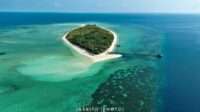
MARITIMEPOSTS.COM — The Masela Block liquefied natural gas (LNG) development project stretches across the Arafura Sea off Tanimbar Islands Regency in Maluku and stands among Indonesia’s major National Strategic Projects.
The project remains in its development and technical preparation phase and has yet to deliver its first gas to the surface. Along the Tanimbar coast, however, efforts to strengthen local livelihoods are not waiting for the project’s industrial facilities to begin commercial production.
Recognizing the socioeconomic vulnerabilities facing communities around the project area, a collaborative approach to early social investment has begun to take shape.
The strategy, built around social investment before the production phase, is being advanced by project developer INPEX Masela, Ltd., together with Destructive Fishing Watch (DFW) Indonesia as implementing partner and the Tanimbar Islands Regency Agriculture and Food Agency.
The collaboration is reaching three key villages connected to the project: Bomaki, Latdalam, and Lermatang.
The early intervention offers a broader lesson about large-scale extractive investment in island communities: social support does not necessarily have to wait until industrial production begins. Before major LNG infrastructure rises, efforts to strengthen food security, meet basic needs, and improve local productive capacity can already begin at community level.
The Socioeconomic Challenges Facing Project-Affected Villages
Communities across Tanimbar Islands Regency, particularly those living in villages connected to the Masela Block, face a combination of socioeconomic challenges that are shaped by geography, seasonal livelihoods, market conditions, and limited infrastructure.
Local economies rely heavily on seasonal agriculture and informal employment, leaving household incomes vulnerable to changes in weather, production cycles, and commodity prices such as copra. For many families, these fluctuations can quickly translate into pressure on daily purchasing power.
In an island region, food insecurity is not simply a matter of how much food farmers can produce. It is also closely connected to distribution networks and the infrastructure that moves goods between islands and regions. When supplies are disrupted, price pressures can quickly be felt in local markets.
The burden falls heavily on household economies, with women often carrying much of the responsibility for managing daily food consumption and household expenditure. Limited access to modern productive equipment, inadequate agricultural water infrastructure, and concerns over child nutrition and stunting further underline the need for interventions that connect immediate assistance with longer-term productive capacity.
In Bomaki, the central challenge is closely linked to uncertain livelihoods based on informal work and seasonal farming. Household income is strongly influenced by weather conditions and commodity price fluctuations, including copra, while limited agricultural equipment continues to constrain productivity.
These conditions can also affect household nutrition, particularly among young children who may face greater risks when family incomes become unstable. Farmers continue to rely on manual tools such as hoes, while available water sources have yet to be fully supported by adequate storage and distribution infrastructure because of the cost of building such facilities.
In Latdalam, the pressure is more visible in food security and household economic resilience, particularly because of interregional distribution constraints, limited infrastructure, and rising prices for basic commodities.
The situation places direct pressure on families, especially women who often manage household food consumption and daily expenses. At the same time, social assistance needs to be accompanied by efforts to strengthen productive capacity so that support does not become a passive dependency.
For local weaving groups and processed-food micro and small enterprises, the needs extend beyond financial assistance. They include sustained mentoring, improved production equipment, stronger business capacity, and better mapping and access to markets so that local enterprises can gradually operate more independently.
DFW Indonesia and INPEX Masela: Building a Local Support System
To address these interconnected challenges, INPEX Masela, Ltd., DFW Indonesia, and the Tanimbar Islands Regency Government have developed a set of interventions designed to reinforce one another rather than operate as isolated forms of assistance.
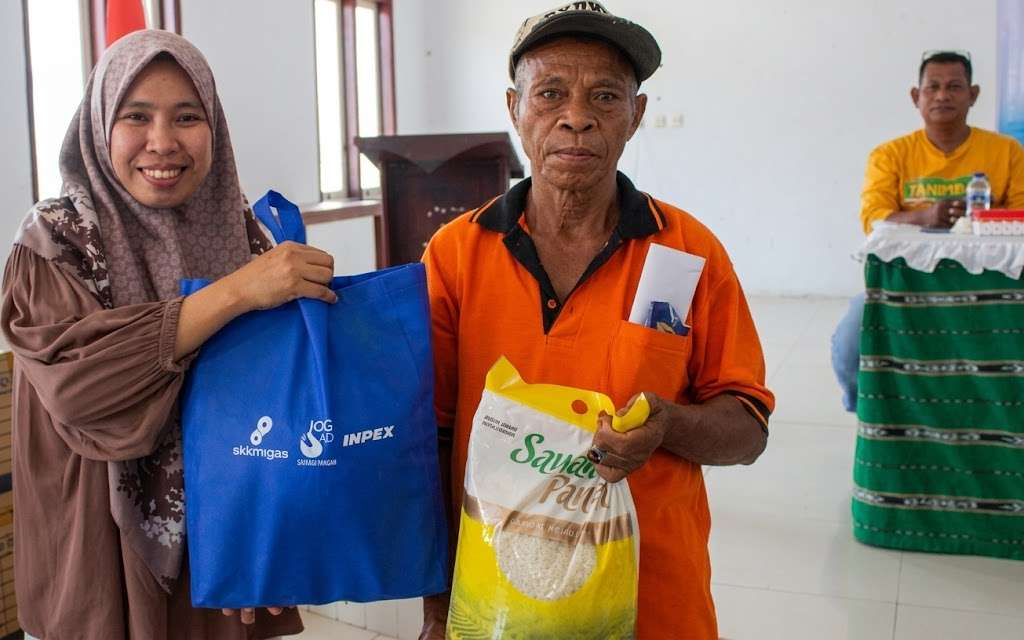
The first layer is immediate household support. Free food packages have been distributed as a social buffer against rising food prices and disruptions in supply, while helping ease household financial pressure.
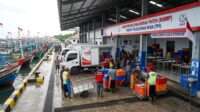
In Bomaki, the distribution reached 200 beneficiary families across 10 Rukun Tetangga (RT) through a structured community-level process. Each household received 5 kilograms of premium rice, 750 milliliters of cooking oil, one tray of eggs, and 1 kilogram of sugar.
In Latdalam, similar food assistance was directed to hundreds of families in need, providing short-term support for household nutrition while giving families, particularly women managing household budgets, some additional room to cope with rising market prices.
The second layer focuses on productive infrastructure, particularly agriculture and water access.
From Hand Tools to Agricultural Mechanization
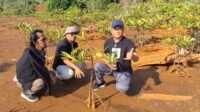
In Bomaki, manual agricultural work is gradually being supported by machinery. The Salju Farmers Group received a cultivator to improve the efficiency of land preparation and bed construction.
For group leader Yoseph Lukas Sermatan, the intervention is part of a longer personal journey. He previously worked as a driver, leaving home in the morning and returning at night, before deciding in 2020 to become a full-time farmer.
After several farmers’ groups in the village dissolved, Yoseph organized members of his own family to keep agricultural land productive and maintain farming as a viable livelihood.
The intervention also includes a water storage facility for the Salju Farmers Group, which is estimated to address around 80 percent of the group’s irrigation water needs.
There is, however, an important operational reality. The water tank has not yet been fully utilized because the improvement of the Bomaki public water supply pipeline is still underway. Once the network is restored, the facility is expected to provide more practical support for agricultural production.
Supporting Creative Enterprise and Preserving Tanimbar Culture
The social investment approach also reaches into the creative economy, where cultural heritage and local enterprise intersect.
In Bomaki, Cinta Karya, a micro and small enterprise led by Yoseph Samangun, received productive equipment including a drill, grinder, and chainsaw. The tools are intended to make the production of traditional tifa drums and ukuleles more efficient, reducing dependence on labor-intensive manual processes.
The intervention also carries a cultural dimension. Traditional craft skills depend on intergenerational transmission, and Yoseph hopes improved equipment can encourage more young people in Bomaki to learn the craft while opening greater opportunities for local enterprise.
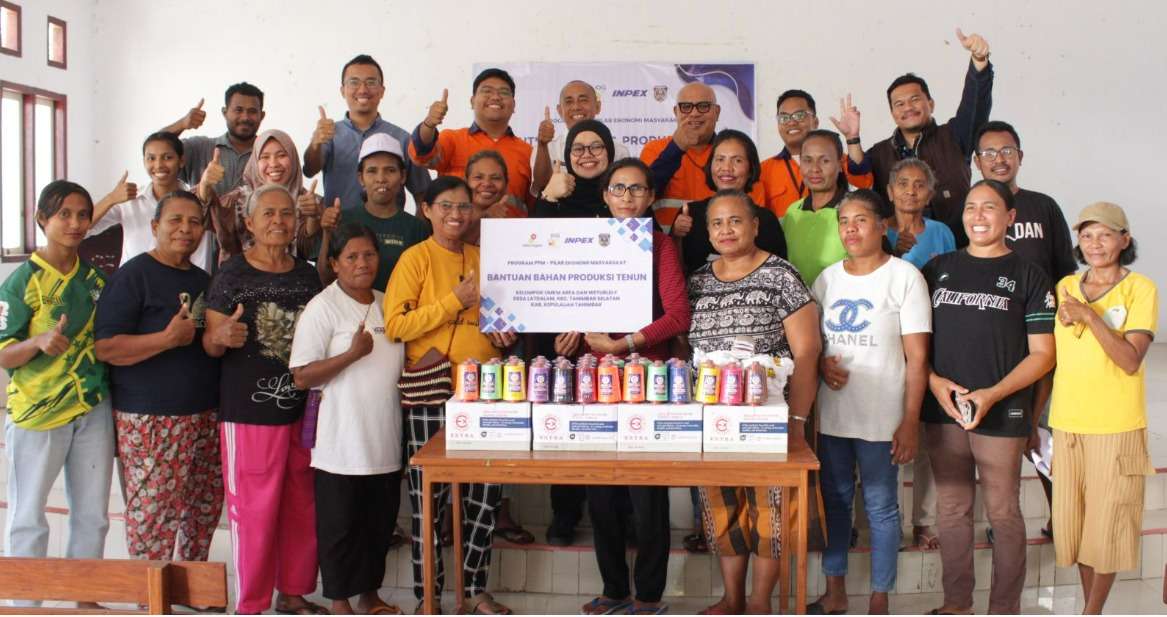
In Latdalam, support is focused on two traditional weaving groups, UMKM Afra and UMKM Weturlely, through business mentoring, product-quality improvement, and efforts to expand market access.
The same approach is being considered for local food processing, including chip production, with the intention of connecting agricultural production with downstream village enterprises. In this model, local harvests are not simply commodities but potential inputs for a wider village-based value chain.
What the Stakeholders Say: Assistance as a Stimulus, Not Dependency
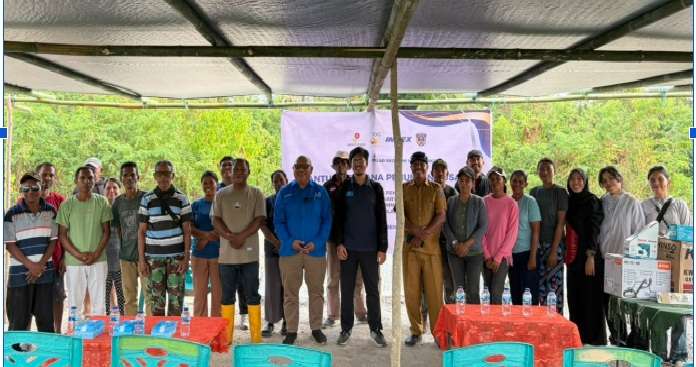
A recurring theme across the program is the idea that assistance should serve as a stimulus for independence rather than create a new form of dependency.
From the local government’s perspective, the assistance is part of a broader effort to move communities from being recipients of support toward strengthening their own productive capacity and food security.
Agus Rettob, Head of the Tanimbar Islands Agriculture Agency, argues that the value of assistance should not be measured simply by its monetary value or the amount of goods delivered, but by the benefits it creates in people’s everyday lives.
For Bomaki, the expectation is that external support can become a catalyst for greater local food production and, over time, a more self-reliant village economy.
The issue becomes more urgent when food prices and distribution pressures affect household life across Tanimbar.
Didimus Ranolati, representing the Tanimbar Islands Agriculture and Food Agency, said basic food commodities are currently facing pressure from disrupted distribution and rising market prices.
“Basic food commodities are becoming difficult to obtain and expensive, creating market instability, and women are often the ones who feel the impact most.”
Referring to the principles of Indonesia’s Law No. 18 of 2012 on Food, Ranolati described food provision as a shared responsibility involving government, communities, and other stakeholders.
He encouraged residents to make greater use of available agricultural land.
“Prepare as much land as possible, and we are ready to intervene.”
He also emphasized that food security is not solely a government responsibility.
“This is a shared responsibility, not only the government’s.”
In Bomaki, Village Head Virgilius Lamere welcomed the beneficiary identification process, which was conducted through surveys at the RT level to ensure that the 200 beneficiary families were identified more systematically.
“This assistance is very significant compared with the assistance we received in the past.”
In Latdalam, Acting Village Head Edwin Dasmasela placed the assistance within a broader relationship between communities and the private sector while warning against the emergence of dependency.
“It is because INPEX and INPEX contractors are in Tanimbar that this assistance is available.”
For Dasmasela, the support should therefore be viewed as an opportunity to strengthen household economies rather than something that communities continually wait to receive.
“I hope people will not become dependent and continue to expect assistance. This should be a stimulus to improve the economy of each beneficiary family.”
Ampi, Head of Service Affairs in Bomaki Village, similarly hopes the relationship can develop into a longer-term partnership that goes beyond assistance and encourages farmers, artisans, and small businesses in Bomaki, Latdalam, and other affected villages to strengthen their economic activities.
INPEX: From Immediate Support to Local Economic Capacity
For Hanny Grasius Gladius Tanamal, Special Regional External Relation at INPEX Masela, Ltd., the company’s commitment extends across Bomaki, Latdalam, and Lermatang.
“There are 200 food packages for Bomaki Village that we are handing over today.”
Hanny emphasized that the program should not be understood simply as a distribution of goods.
“This assistance is not only to make people happy, but to encourage them to move forward.”
The company’s approach also connects economic development with cultural continuity.
“If local production increases, we can sell our own products.”
He also stressed the importance of protecting local identity through younger generations.
“Culture will disappear if it is not preserved for the younger generation. Our identity is here.”
For Wa Ode Husmayani, Program Coordinator at DFW Indonesia, the interventions in Bomaki are designed to go beyond immediate needs.
Free food assistance provides families with some breathing room in meeting daily needs, while equipment such as drills, grinders, cultivators, and water storage facilities creates a productive foundation for local economic activities to become more efficient, independent, and sustainable.
For beneficiary communities, the support is also an opportunity to demonstrate that local potential can be developed when key infrastructure and equipment constraints begin to ease.
Yoseph Lukas Sermatan sees the challenge not only in equipment but also in changing attitudes toward farming.
“I see that Bomaki has good potential, but people have not yet had the determination to become serious farmers.”
For him, the cultivator and water storage facility are more than additional equipment. They are tools that can help his group take the productive potential of Bomaki’s land more seriously.
Yoseph Samangun views the production equipment from a longer-term perspective, particularly in relation to the continuity of tifa and ukulele craftsmanship. He hopes better equipment will encourage young people in Bomaki to learn the craft, ensuring that Tanimbar knowledge and skills remain alive while creating opportunities for local income generation.
Looking Ahead: Land, Jobs, Markets and Cultural Regeneration
The social investment program is also being linked to several longer-term pathways intended to generate effects beyond the initial assistance.
One priority is the expansion of agricultural land and local food production. The Tanimbar Islands Agriculture and Food Agency is preparing a 50-hectare dryland rice development program in Latdalam, while agricultural extension workers are verifying land for a corn program.
In Bomaki, local government support includes the provision of crop seeds and water pumps for household-level production. These initiatives are expected to connect with local food-processing activities in Latdalam, including chip production, creating a potential agricultural value chain from production to processing.
Another pathway involves local employment and access to economic opportunities associated with the Masela project.
One near-term opportunity is the construction of an access road in Lermatang, which is being undertaken by the PENK consortium — Petrosea, Environmate Technology International, and Nindya Karya — as an INPEX Masela contractor, with work scheduled to begin in October.
Such developments could provide opportunities for local residents and younger generations to participate in economic activities associated with the wider project, provided that local skills, recruitment mechanisms, and community engagement are developed alongside the physical infrastructure.
Cultural regeneration represents another dimension of the strategy. Continued mentoring for the Afra and Weturlely weaving groups, as well as tifa and ukulele artisans, is expected to focus on younger generations, product quality, business development, and independent market access.
The objective is not simply to preserve cultural products as heritage objects, but to help ensure that Tanimbar cultural knowledge can remain relevant within contemporary local economies.
A Social Investment Test Before the Gas Flows
The social investment unfolding in villages connected to the Masela Block offers a glimpse into a broader question facing large-scale development across Indonesia’s eastern coastal and island regions.
When a major LNG project has yet to enter commercial production, relationships among companies, local governments, and communities can nevertheless begin taking shape through programs that respond to the everyday realities of local people.
The more meaningful measure of such social investment lies beyond the number of food packages distributed or the visibility of ceremonial handovers. It can instead be observed in whether agricultural productivity improves, household food security becomes more resilient, local enterprises gain stronger market access, and younger generations see viable economic futures within their own communities.
A drill, grinder, cultivator, water tank, food package, or weaving support may appear modest when viewed against the scale of a national strategic LNG project. At village level, however, these interventions address very practical constraints that shape whether people can produce, earn, eat, and build livelihoods with greater confidence.
In Bomaki, Latdalam, and Lermatang, the social foundations around the Masela Block are therefore being built before the gas flows. The longer-term test will be whether these early interventions can evolve into stronger local production, resilient household economies, cultural continuity, and meaningful participation in the economic opportunities that emerge as the project advances.
Written by Kamaruddin Azis, founder of Pelakita.ID and maritimeposts.com