
- The first step is to identify a recurring and meaningful problem. The second is to determine precisely who experiences it. “Everyone” is rarely a meaningful target market; a real customer has a particular occupation, location, economic condition, and set of needs. The third step is validation through direct conversations and interviews. Entrepreneurs need to leave the comfort of their assumptions and listen to the people who actually experience the problem.
- The development of Mall Tambak and Tambakmi further illustrates the importance of building an ecosystem rather than a single product. While Mall Tambak addresses upstream needs such as construction and supplies, Tambakmi focuses more directly on technology and production. Together, they represent an attempt to connect different parts of the aquaculture value chain.
MARITIMEPOSTS.COM – Under the red-tiled roofs of Hasanuddin University in Makassar, a quiet transformation is taking place in the way young Indonesians imagine their future.
For decades, the Indonesian dream was closely associated with security: becoming a civil servant, joining the police or military, securing a permanent position in a government institution, and eventually enjoying the certainty of a pension. For many families, these were not merely career options but carefully paved roads toward a respectable and stable life.
Security was the currency of success, and entrepreneurship was often considered something to pursue only when the safer paths had failed.
Yet at the recent Bursa Wirausaha Unggulan in Makassar, that old narrative encountered a different reality. A new generation is beginning to see entrepreneurship not as a fallback plan, but as a deliberate choice to solve problems, create value, and generate employment.
Their stories suggest that resilience is not always built behind a secure desk.
Sometimes it is built in a shrimp pond, a village workshop, a laboratory, a marketplace, or a small business struggling to survive its first years. Entrepreneurship, in this sense, is less about escaping uncertainty than learning how to navigate it.
This transformation becomes particularly meaningful when viewed through the cultural concept of siri’, a deeply rooted value in Bugis-Makassar society associated with honor, dignity, and self-worth. Siri’ has sometimes been understood primarily through the lens of defending personal or collective dignity, and its historical meanings can be complex.
Minister of Micro, Small, and Medium Enterprises Maman Abdurrahman, however, offered a different direction: siri’ can become a form of cultural capital when its energy is redirected toward constructive economic action.
“Jadikan siri’ itu sebagai bagian niat kita untuk melawan dan menaklukkan masa depan yang penuh dengan tantangan,” Maman said.
The statement offers an intriguing bridge between cultural identity and entrepreneurship. Rather than allowing pride to become a source of conflict, it can be transformed into determination, discipline, and courage.
In South Sulawesi, this idea naturally resonates with the spirit of the Pinisi, the traditional sailing vessel whose history is associated with the maritime traditions of the Bugis-Makassar people.
The Pinisi does not conquer the sea by eliminating uncertainty. It survives by reading the wind, understanding the waves, adjusting its sails, and maintaining direction.
Modern entrepreneurs face a similar condition. Markets change, technology evolves, capital is limited, and consumer preferences can shift unexpectedly. The entrepreneur therefore needs not only capital and technical knowledge, but also the cultural and psychological resources to continue moving when the destination is not fully visible.
One of the clearest examples emerging from the Unhas entrepreneurial ecosystem is the story of Fikrang, an alumnus of the Faculty of Marine Science and Fisheries and founder of Tambakmi. His journey begins not with a grand business concept but with a concrete problem experienced by shrimp farmers: high mortality during the first 30 days of cultivation in traditional ponds.
That starting point is important because many businesses begin in the opposite direction. Entrepreneurs sometimes fall in love with an idea, develop a product, and only afterward search for a problem that the product might solve.
Fikrang’s approach reverses that sequence. The problem comes first, followed by the people experiencing it, the validation of their difficulties, the testing of a solution, the market response, and finally the question of sustainability.
His approach can be summarized through a six-part framework: Problem, People, Validation, Pilot Project, Response, and Sustainability.
The first step is to identify a recurring and meaningful problem.
The second is to determine precisely who experiences it. “Everyone” is rarely a meaningful target market; a real customer has a particular occupation, location, economic condition, and set of needs. The third step is validation through direct conversations and interviews. Entrepreneurs need to leave the comfort of their assumptions and listen to the people who actually experience the problem.
The fourth step is the pilot project: building a sufficiently simple version of the solution and putting it into the real world. The fifth is the response.
A product may receive compliments, attention, or social-media engagement, but the stronger validation comes when customers are willing to pay for it. Finally comes sustainability: whether the business can create a lasting ecosystem rather than depend on a temporary project or one-time transaction.
The lesson is deceptively simple: entrepreneurs should not wait for perfection. They should build, test, listen, learn, and improve. The market can become an unexpected teacher, correcting assumptions that would otherwise remain invisible inside the founder’s mind.
This way of thinking also challenges Indonesia’s broader relationship with entrepreneurship. The country has often struggled to develop a strong entrepreneurial culture, while many young people continue to associate professional success primarily with formal employment.
Maman Abdurrahman has described this situation as requiring otokritik, or self-criticism: society and the education system must reconsider the assumption that entrepreneurship belongs to those who fail to obtain formal employment.
The distinction is crucial. If entrepreneurship is always treated as a last resort, young people may approach business without the mindset required to build sustainable enterprises. If it becomes a legitimate first choice, however, entrepreneurship can become a mechanism for creating employment rather than merely seeking it.
A successful business does more than generate income for its founder. As it grows, it creates demand for workers, suppliers, logistics, technology, packaging, finance, marketing, and professional services. A small enterprise can therefore become a node in a much larger economic network.
The entrepreneur is not simply becoming self-employed; under the right conditions, the entrepreneur becomes a potential creator of opportunities for others.
This is where the university becomes particularly important. The real test of academic innovation is not simply whether a research project can be presented at a seminar. It is whether knowledge can travel beyond the campus and become useful in society.
The concept of hilirisasi, or downstreaming, captures this challenge. At Unhas, the Smart Aquaculture System and Tambakmi illustrate an attempt to move knowledge from the academic environment into commercial and productive activity.
Through the integration of Internet of Things technology, pond conditions can be monitored through digital devices and smartphone applications. The significance of this development is not merely technological. It represents a shift from decision-making based largely on estimates and experience toward decisions supported by data.
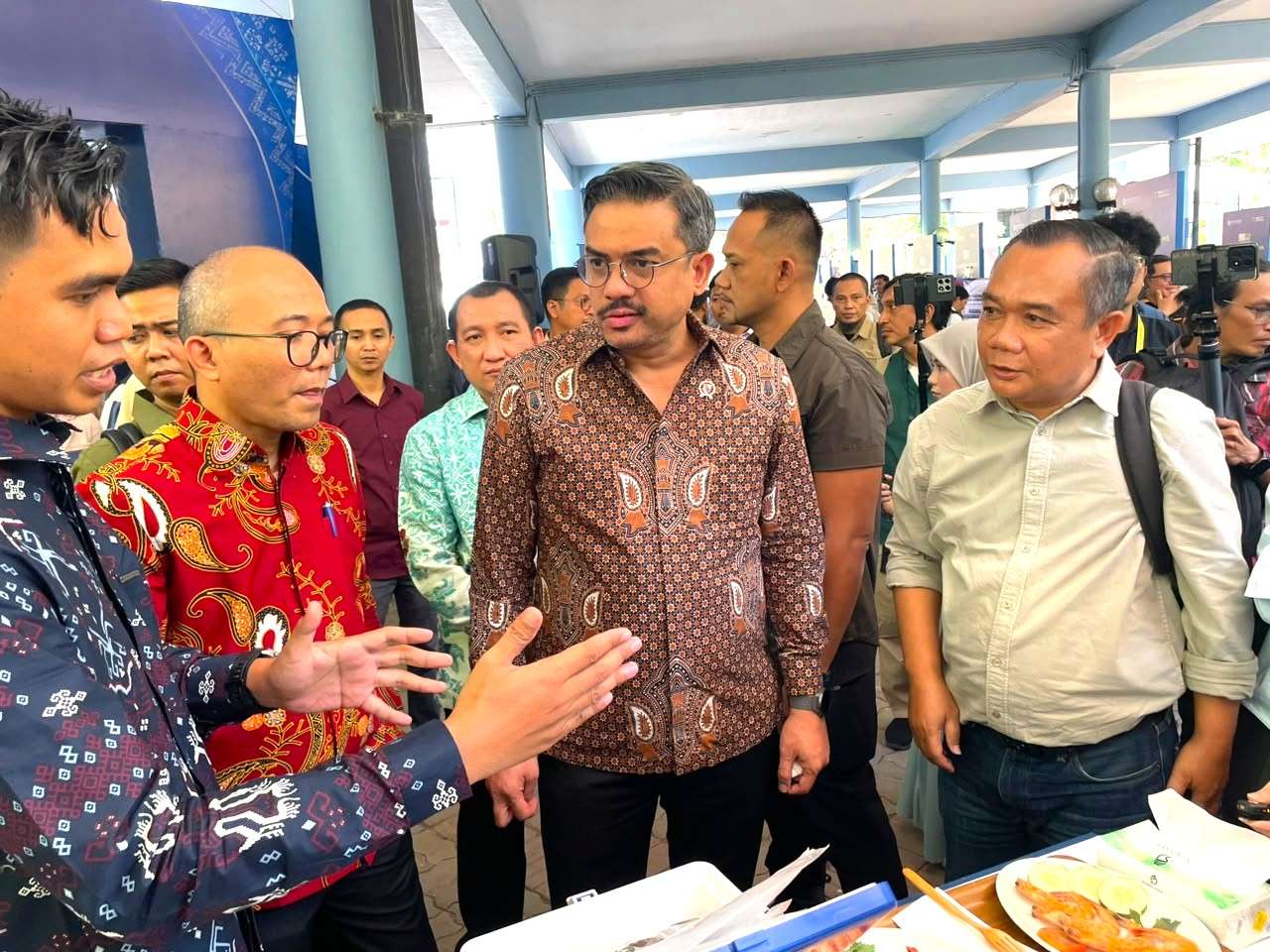
Fikrang’s innovation also extends to the biological side of shrimp cultivation. He developed herbal-infused feed intended to strengthen shrimp immunity and improve production quality. During a visit, Minister Maman tasted the shrimp, dipping three pieces into sambal bening. He observed a distinctive sweetness in the taste, which Fikrang associated with the herbal feed used in the cultivation process.
The moment may appear simple, but it illustrates an important principle of innovation: technology ultimately has to return to human experience. An algorithm, sensor, feed formula, or production system matters because it changes something tangible for farmers and consumers.
The development of Mall Tambak and Tambakmi further illustrates the importance of building an ecosystem rather than a single product. While Mall Tambak addresses upstream needs such as construction and supplies, Tambakmi focuses more directly on technology and production. Together, they represent an attempt to connect different parts of the aquaculture value chain.
Prof. Dr. Amir Ilyas has emphasized a related responsibility for universities: their mission should not end with seminars or academic publications. Research needs pathways toward finance, certification, markets, partnerships, and global networks. Without these connections, promising innovations can remain trapped inside the academic ecosystem.
But innovation also requires a realistic understanding of capital.
Money alone does not create a sustainable business. Deputy Minister for MSMEs Riza Damanik has warned that injecting capital into a business without adequate management systems can be like pouring water into a leaking bucket. The problem is not the amount of water; it is the condition of the container.
Through incubation initiatives such as Inotech, entrepreneurs can be prepared over a period of several months to understand financial management, recordkeeping, proposal development, and financing responsibilities. Partnerships involving financial institutions such as Bank Sulselbar, Mandiri, BRI, Pegadaian, and BSI can then become part of a broader financing ecosystem.
The principle expressed by Riza is worth remembering: modal usaha bukan untuk konsumsi—business capital is not for consumption. Financing should strengthen productivity, expand capacity, improve technology, and create economic value. When capital is treated merely as additional personal income, it can disappear without building the productive foundation required for growth.
This principle becomes especially relevant for local commodities. Seaweed can move beyond raw production toward higher-value processing. Candlenut can be developed into industrial-grade oil products. Sago and betel nut can potentially move beyond local trading networks toward more sophisticated commercial and export markets.
The challenge, therefore, is not simply producing more. It is creating more value from what communities already possess.
Perhaps the most compelling lesson from the entrepreneurial experience at Unhas, however, lies beyond technology, capital, or business models. It lies in the idea of a circle of impact.
Fikrang’s own journey began with educational support through zakat. Today, as an entrepreneur, he has created a foundation that provides educational assistance and laptops to high-achieving students. The person who once received support has become someone capable of creating opportunities for others.
That is a powerful way to understand entrepreneurship.
The entrepreneur is not merely someone who starts a company. The entrepreneur can become part of a social cycle in which knowledge produces innovation, innovation creates enterprise, enterprise generates income, income creates opportunities, and those opportunities return to society in new forms.
This is perhaps where the traditional idea of siri’ finds a contemporary expression. Honor does not have to be measured by status, titles, or the ability to defeat an opponent. It can also be expressed through the courage to solve a problem, the discipline to build something useful, and the willingness to ensure that success does not end with oneself.
The transformation from the “safe path” to entrepreneurship is therefore not simply a change in career preference. It is a deeper change in how a society understands work, education, culture, and economic citizenship.
The future entrepreneur may begin with a problem in a shrimp pond, a village, a laboratory, a supply chain, or a digital platform. The starting point does not need to be extraordinary. What matters is the willingness to observe carefully, ask the right questions, test assumptions, accept failure, improve the solution, and build an ecosystem around it.
From the traditional values of siri’ to the maritime resilience represented by the Pinisi, from university laboratories to commercial markets, and from financial assistance to social giving, the emerging entrepreneurial story at Unhas offers a broader proposition: innovation becomes meaningful when it connects identity, knowledge, technology, capital, and community.
The ultimate question for a young innovator is therefore not simply, “What business should I start?”
It is more fundamental:
What problem around me is worth solving, who is living with that problem, and how can I turn its solution into a sustainable enterprise that creates opportunities beyond myself?
That is where honor becomes innovation—and where entrepreneurship begins to mean more than making a living. It becomes a way of making a difference.
___
Author KamaruddinAzis