
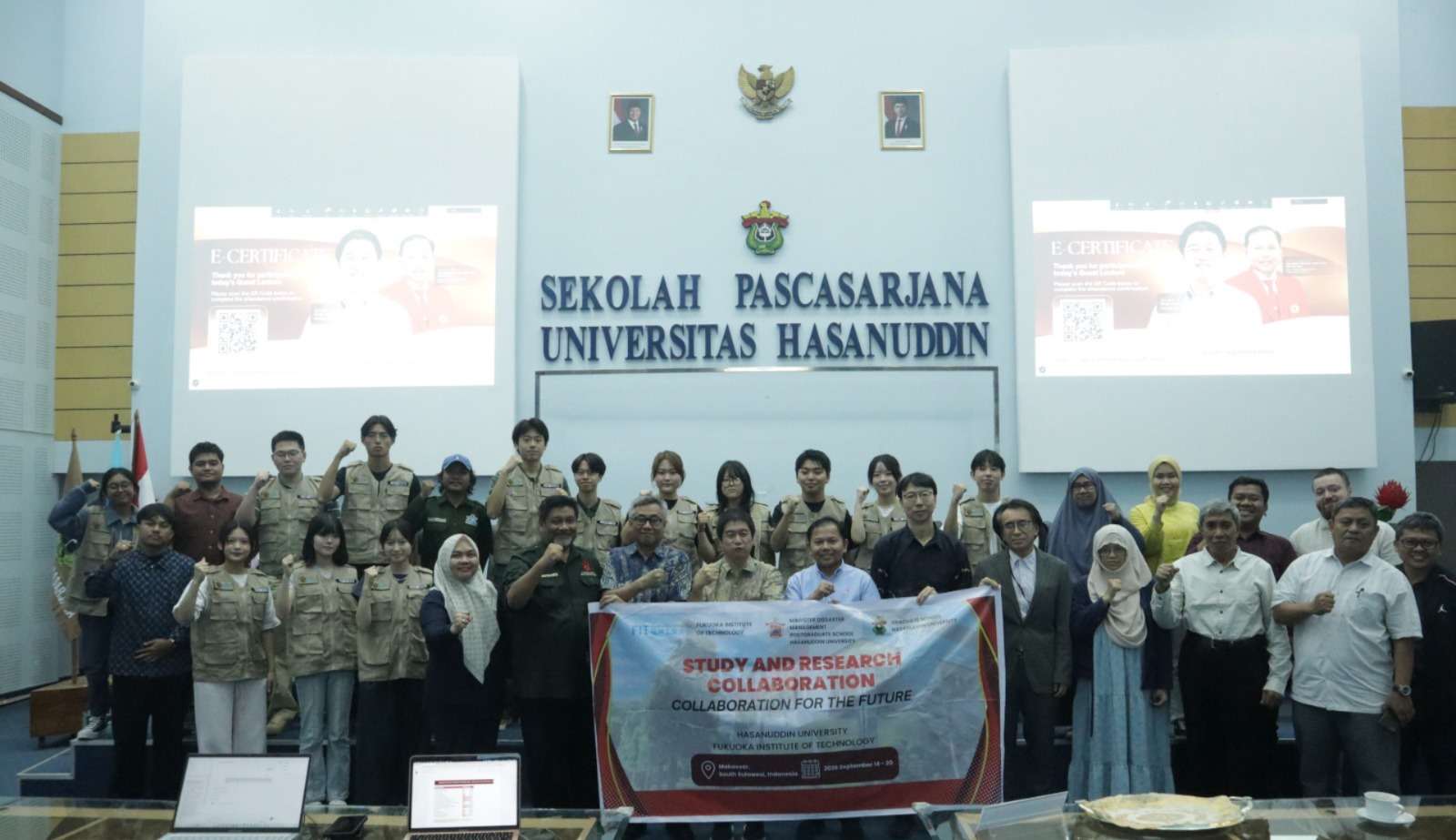
PELAKITA.ID – MAKASSAR — The Graduate School of Hasanuddin University has once again strengthened the global perspectives of its academic community by hosting a guest lecture entitled “Climate Change and Increasing Flood Risks: Challenges and Adaptation.”
The event featured Prof. Dr.Eng. Akira Tai from the Fukuoka Institute of Technology, Japan, as the keynote speaker.
The guest lecture was held in a hybrid format on Wednesday, September 16, 2026, at the Prof. Dr. Ir. Fachruddin Hall, Graduate School of Hasanuddin University, and was also broadcast online via Zoom.
The event was attended by students, lecturers, researchers, and participants from various academic disciplines with an interest in climate change, disaster risk reduction, regional development, and environmental sustainability.
Dean of the Graduate School of Hasanuddin University, Prof. Sukri Palutturi, SKM., M.Kes., M.Sc.PH., Ph.D., said in his remarks that climate change is a multidimensional challenge requiring serious attention from universities, governments, the private sector, and communities.
Its impacts extend beyond environmental conditions, affecting public health, safety, infrastructure resilience, the economy, and community well-being.
According to Prof. Sukri, the international guest lecture is part of the Graduate School’s commitment to providing learning opportunities that are relevant to global challenges while expanding international academic networks.
“Universities have a strategic role in generating knowledge, innovation, and policy recommendations that can strengthen community resilience to the impacts of climate change. Through this activity, we hope to encourage new ideas and collaborations to develop adaptation approaches that are contextual, inclusive, and sustainable,” Prof. Sukri said.
In his presentation, Prof. Dr.Eng. Akira Tai explained the relationship between climate change, the increasing intensity of extreme weather events, and flood risks.
Changes in rainfall patterns, rising global temperatures, urban development, and land-use changes are among the factors that can increase the vulnerability of an area to hydrometeorological disasters.
Prof. Akira Tai also shared Japan’s perspectives and experiences in addressing flood risks.
According to him, flood management cannot rely solely on physical infrastructure development. It also requires scientific data, risk modeling, early warning systems, spatial planning, community preparedness, and integrated governance.
Adaptation approaches need to take into account the characteristics of each region, as every area has different geographical, social, environmental, and institutional conditions.
Therefore, research findings need to be translated into policies and concrete actions capable of reducing risks while protecting the most vulnerable groups in society.
The topics discussed during the lecture are highly relevant to Indonesia as an archipelagic country facing various climate-related threats. Increasing extreme rainfall, urban flooding, coastal flooding, coastal erosion, and sea-level rise require stronger spatial planning and the development of infrastructure that is more climate-resilient.
The event, moderated by Ir. Evi Aprianti S., S.T., Ph.D., featured an interactive discussion. Participants had the opportunity to explore various issues related to increasing flood risks, water resource management, resilient infrastructure development, the use of technology, and the implementation of climate change adaptation strategies at the local level.
The discussion also highlighted the importance of cross-disciplinary collaboration. Climate change and flooding are not solely concerns for the engineering and environmental sciences, but are also closely connected to public health, public policy, economics, spatial planning, and community empowerment.
Through the guest lecture, the Graduate School of Hasanuddin University is encouraging greater climate change literacy and the development of collaborative research between Indonesia and Japan.
The academic collaboration is expected to generate innovations, scientific publications, knowledge exchange, and policy recommendations that can contribute to building safer, more resilient, and sustainable regions.
The event also reaffirmed Hasanuddin University’s commitment to supporting the achievement of the Sustainable Development Goals (SDGs), particularly SDG 11 on Sustainable Cities and Communities and SDG 13 on Climate Action.
By bringing international experts into the academic environment and strengthening scientific dialogue, the Graduate School of Hasanuddin University continues to advance its role as a higher education institution that responds to global challenges and is oriented toward developing solutions that benefit society.