
Thus, in 1972, the first international intergovernmental conference to focus on environmental problems was organised by the UN at Stockholm, with 122 countries via delegations participating. One of the key discussions was the need to address the potential conflict between environmental protection and economic development.
MARITIMEPOSTS.COM – For 50 years now, climate conferences and negotiations have been going on, and on, and on, around the world, seemingly not achieving much; and this year we will reach COP28. But how did we get here? In order to understand why conferences on climate change started, we need to go back a few hundred years.
Discoveries and experiments in the late 18th century and 19th century of a potential greenhouse gas effect created the foundations for scientists such as John Tyndall and Svante Arrhenius to understand how carbon dioxide ($CO_2$) and water vapour act as greenhouse gases.
This wasn’t yesterday; no, it was 170 years ago. Concern of this effect increased during the 20th century, with additional advancements further uncovering the disastrous effects climate change could have on society. In other words, we knew about this a long time ago.
Thus, in 1972, the first international intergovernmental conference to focus on environmental problems was organised by the UN at Stockholm, with 122 countries via delegations participating.
One of the key discussions was the need to address the potential conflict between environmental protection and economic development.
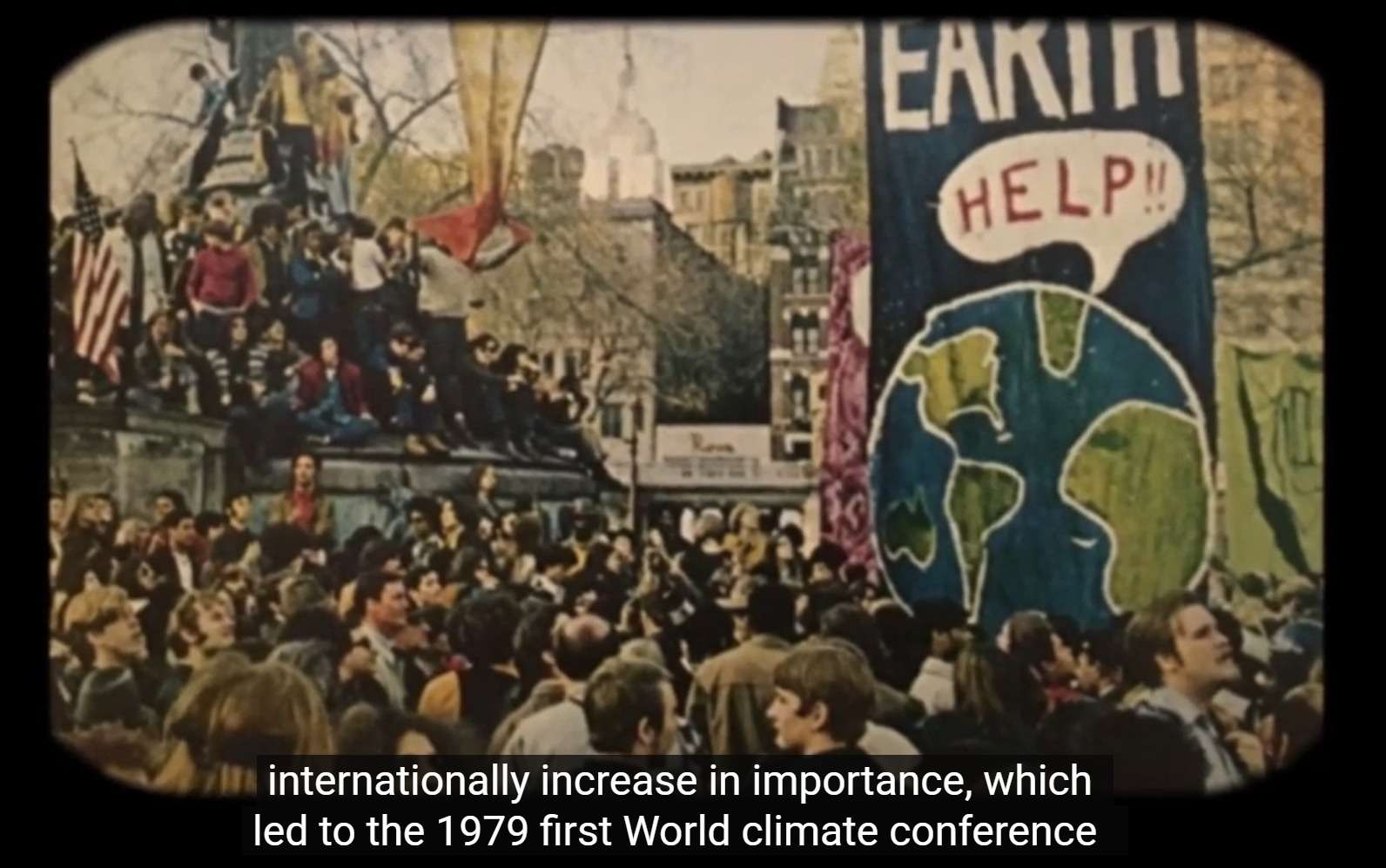
Another outcome was the formation of the United Nations Environment Program (UNEP). In the 70s, environmental and climate awareness outside of scientific circles started to internationally increase in importance, which led to the 1979 first World Climate Conference in Geneva, convened by the World Meteorological Organisation (WMO), in collaboration with the UN.
The goal of this first conference was to build an international community to use current knowledge, gather further information, and to anticipate and prevent man-made changes in climate.
Reference:
Climate Hub
Early Warning Signs and Chemical Controls
Six years later, in 1985, two important conferences took place: the 1985 Villach Conference, and the Vienna Convention for the Ozone Layer. The Villach Conference gathered many scientists who produced a statement foretelling temperature rises in the first half of the 21st century greater than any in human history.
The Vienna Convention, on the other hand, focused on the adverse effects of chlorofluorocarbon gases (CFCs) on the Ozone Layer, discussing a future protocol to introduce emission targets on these gases. Moreover, the discovery of the hole in the ozone layer, also in 1985, further prompted countries around the world to take action.
Therefore, two years later in 1987, the famous Montreal Protocol was created.
This was an international treaty that required parties other than developing countries to freeze consumption and production of CFCs at 1986 levels (the base year), to reduce them by 20 percent and then an additional 30 percent by 1999, and to freeze consumption of halons at 1986 levels.
In other words, it controlled the production and consumption of specific chemicals. CFCs, for example, were mainly used as refrigerants but also in aerosol sprays and solvents.
The Montreal Protocol is seen as an example of a successful international climate agreement, with it coming into force in 1989 after the threshold of ratifications was met. In 2009, it became the first universally ratified agreement, after Timor-Leste ratified it.
The protocol wasn’t perfect, of course, which is why five amendments have been added since its inception: these are the 1990 London, 1992 Copenhagen, 1997 Montreal, 1999 Beijing, and the 2016 Kigali Amendments.
The Rise of the IPCC and the UNFCCC
The year 1988 marked a historic milestone for climate science, as the Intergovernmental Panel on Climate Change (IPCC) was established by the UN Environment Programme (UNEP) and the World Meteorological Organisation (WMO). Its goal was to provide governments with scientific information to develop climate policies.
Thousands of experts and scientists around the world contribute to these assessment reports, with certain leading authors selected. Two years later, in 1990, the IPCC released its first report.
The First IPCC Assessment Report underlined the importance of climate change as a challenge with global consequences and requiring international cooperation. It played a decisive role in the creation of the UNFCCC a few years later, the key international treaty to reduce global warming and cope with the consequences of climate change.
Also in 1990, the Second World Climate Conference took place. The first purpose was to review the progress made under the world climate programme.
The second was to review and take into consideration the new IPCC report findings, and to start discussing negotiations for a UN framework convention on climate change (UNFCCC) at Rio.
In 1992, the Rio Earth Summit took place, which laid the foundations for the UNFCCC and Millennium Development Goals. This was the first time world leaders gathered together for a climate conference, with 117 heads of state and representatives of 178 nations attending. The main documents agreed upon are: the Convention on Biological Diversity, which was technically legally binding but its effectiveness can be debated, the Statement of Principles on Forests, and, more importantly, the UNFCCC.
The UNFCCC did not successfully bind any countries to emissions reductions though. What it gave was a qualitative goal:
“to stabilise GHG at a level that would prevent dangerous anthropogenic interference with the climate system”
What dangerous interference meant was not really explained. Another important principle in the UNFCCC is the idea of differential responsibility between countries. Even back then, it was quite obvious that the industrialised countries, such as the US or European countries, had bigger responsibilities than Tuvalu. The UNFCCC came into force in 1994 after sufficient ratifications, and marked the start of yearly conferences of the parties called COPs, with the aim to review progress and chart further steps.
The Kyoto Protocol Era
The 1995 Berlin meeting was the first COP, which started the negotiations to agree on quantitative emission reductions.
At the end of that year, the second IPCC report came out, with its main message being more or less the same one as today. I don’t know if governments were illiterate, but they probably should have read it instead of watching Titanic on repeat. Anyhow, 1997 was another important year, with the famous COP3 leading to the Kyoto Protocol being adopted.
This was the first legally binding conference with quantified emission reduction targets for six greenhouse gases. This only included Annex 1 countries, whilst other high-emitting countries were not compelled to reduce their emissions.
We also saw the emergence of different voting blocs, such as the EU, G77, and Umbrella Group. Overall, the targets added up to a 5.2% cut below 1990 levels by 2012, with 2012 being the limit of the validity of the protocol. The Protocol also added compliance systems and three flexible implementation mechanisms to reduce emissions.
These are: the International Emissions Trading mechanism, the Clean Development Mechanism (CDM), and the Joint Implementation mechanism. In order to be legal, it needed to be ratified by at least 55 Annex I signatories that together accounted for at least 55 percent of total carbon dioxide emissions in 1990.
Although this was the first conference where emission reductions were implemented, it is largely seen as a failure. First of all, many countries, including the second highest emitter,
China, were left out or did not ratify until much later, such as Australia. Then, the highest emitter, namely the US, did not ratify it at all. More importantly, the targets were totally unambitious and the effectiveness of the mechanisms is very questionable.
Diplomatic Friction and the Road to Copenhagen
In 1998, the not very well-known Aarhus Convention took place, which was an international agreement that focused on environmental democracy and access to information, which has been ratified by almost 50 countries today. In 2001, four relatively important events happened.
The IPCC released its third assessment report, which increased focus on the need for adaptation. COP6 Part 2 in Bonn discussed the rules of the market mechanisms implemented in Kyoto, including the somewhat controversial ideas of carbon credits and carbon sinks. After a heated debate, the outcome of these discussions were the Bonn Agreements.
Why did I call it COP6 Part 2? Well, because COP6 Part 1 in The Hague in 2000 was a disaster, as no agreements were reached on implementation mechanisms.
COP7 also happened this year in Marrakesh, which basically made the provisions of the Bonn Agreements legal, which were called the Marrakesh Accords. And finally, also in 2001, the US and George Bush withdrew from the Kyoto Protocol, making it two for two for crap decisions made by the US in that year. Man clearly went searching for the wrong weapon of mass destruction.
Anyway…
A few COPs happen along the years, but with no significant outcomes. In 2005, the EU emissions trading system was launched, which is now seen as a failure.
Also, 2005 marks the year the Kyoto Protocol finally comes into legal effect, as Russia—the third country with the highest emissions at the time—ratifies it, reaching the threshold needed for legal effect. In 2007, the IPCC released its fourth assessment report, further showing the effects of climate change.
Then, we also had the Bali COP13, which culminated in the adoption of the Bali Action Plan. This plan sets out the roadmap to reach a new climate agreement after the Kyoto Protocol’s expiry in 2012.
The goal was to reach this agreement by 2009. This COP also marked the start of implementing developing countries into reduction agreements.
An interesting part of the conference happened when a representative of Papua New Guinea told the US to get out of the way if they weren’t ready to lead the world. Thus, the final outcome of the COP was the parties of the conference agreeing to build a new framework in 2009. Wow, if you took a shot for every time things were postponed, you’d probably be absolutely wasted.
The Collapse of COP15
-
Here we are in Copenhagen at the COP15 to finally negotiate a successor to the Kyoto Protocol, to legally bind countries to emission reductions post-2012. There was more hope for this round of negotiations, especially when Obama was elected. But, not only were the negotiations a catastrophe, but the actual event itself was also very badly managed. Why was it a failure, you ask? For most of the event, countries could not be asked to cooperate and agree on a binding deal or framework. It wasn’t until the last day where an accord was struck to explicitly pledge to decrease emissions.
However, it wasn’t legally binding, no clear roadmap was built, nor were any pledges quantified. The Bolivian delegation called it “anti-democratic, anti-transparent and unacceptable”.
In this COP, we saw Brazil, South Africa, India, and China act as one, forming the BASIC group, being 2C and 1.5C.
Small sidenote, 1.5C is not a scientific threshold, it could have been 1.4 or 1.6, with higher temperatures having larger consequences and vice versa. Finally, It also outlined the REDD+ scheme, technology mechanisms and a climate fund.
Editorial Team