
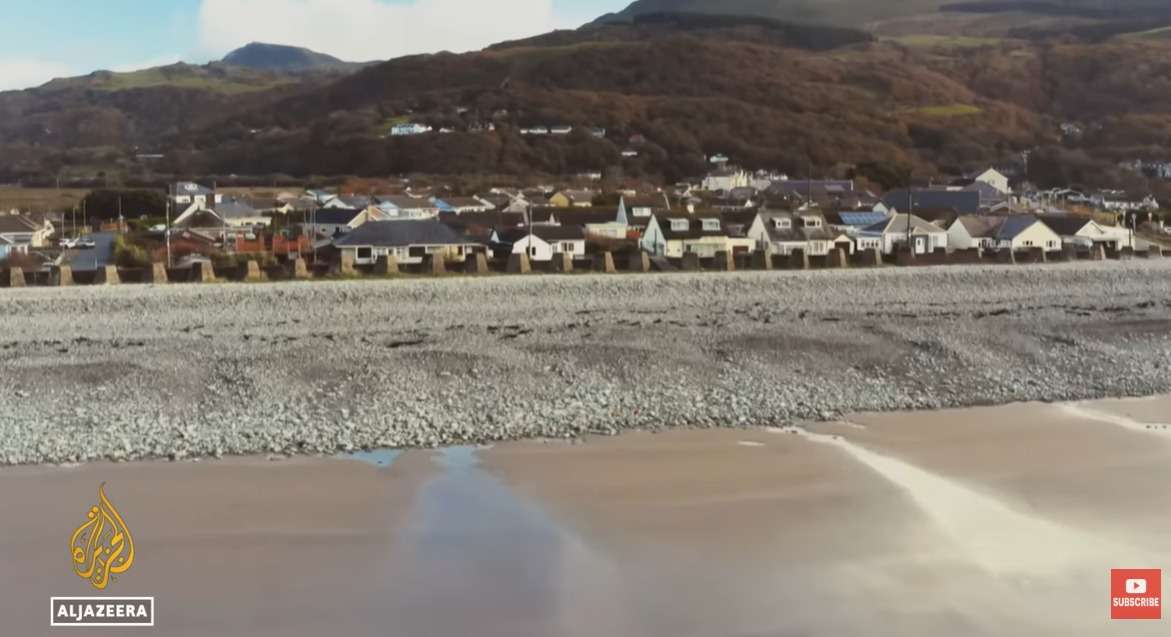
The village of Fairborne, Wales, represents the exact opposite of managed realignment. Officials announced protection would end by 2054 without offering residents relocation compensation. This decision crashed property values, creating the nation’s first internal climate refugees without an organized survival framework.
MARITIMEPOSTS.COM – Our world has turned, and climate breakdown is now a matter of fact. Famine, fire, flash floods, and killer heat waves make massive swathes of our planet uninhabitable. Within fifteen years, this hostile climate will become our permanent new baseline.
There is no stable new normal because the pace of global change is only getting worse. Historical carbon dioxide emissions will trap atmospheric heat for a millennium. Even if emissions stopped tomorrow, five meters of sea level rise remains locked in.
Two-thirds of the Netherlands is flood-prone, yet centuries of sophisticated engineering keep the Dutch safe. Storm surge barriers, pumps, and thousands of kilometers of dikes provide protection. Their most vital lesson is to accommodate water, rather than defeat it.
The Dutch “Room for the River” initiative deliberately restores natural floodplains to lower water levels safely. By looking a century ahead, they maintain safety. At Deltares, researchers actively test existing dikes to destruction, shifting completely from emergency to adaptive planning.
Engineers take physical cross-sections of dikes and pound them with massive artificial waves to measure clay erosion. This precise calculations help determine exactly how structures hold up over time, allowing society to rationally manage oncoming climate threats through empirical data.
Adaptation can also utilize soft engineering, such as constructing massive man-made sand dunes to buffer storm surges. Hard coastal defenses are too expensive to maintain globally. Preserving the natural resilience of coastlines provides a sustainable answer to accelerating erosion worldwide.
The Netherlands removed short-term political infighting from climate planning by handing major decisions over to independent experts via the Delta Program. This successful model coordinates long-term funding and infrastructure, proving that close collaboration with science stabilizes critical national survival strategies.
Giving space back to water was culturally difficult for the Dutch. They removed dikes, transforming farmland into wetlands and relocating families. Though traumatic, this process embodies the concept of polderen: sacrificing individual assets to achieve a crucial common agreement.
We must stop reacting to past floods and start planning for future certainties, moving past brief political cycles. Governments must determine immediately where to build defenses and where to execute staged retreats. Getting these monumental policy decisions wrong brings absolute devastation.
The village of Fairborne, Wales, represents the exact opposite of managed realignment. Officials announced protection would end by 2054 without offering residents relocation compensation.
This decision crashed property values, creating the nation’s first internal climate refugees without an organized survival framework.
Ignoring retreat merely ensures a far more expensive emergency evacuation later. Over the coming centuries, major coastal cities must be entirely reimagined. Crucially, wealthier nations can learn invaluable lessons from poorer countries currently facing extreme climate impacts with very limited resources.
Source:
Bangladesh faces severe coastal erosion, losing ten percent of its arable land. Rising seas have forced the agricultural Manta people to live entirely on boats. With a dense population, land is scarce, forcing hundreds of thousands into a permanent water-world existence.
Massive river systems make Bangladesh’s coastal erosion highly dramatic, driving thousands of climate refugees into urban slums daily.
Masima Begum’s former family farm now sits over a kilometer out to sea, illustrating the scale of displacement affecting millions of citizens.
Despite immense vulnerability, Bangladeshis possess highly effective disaster preparedness.
They anticipate severe storms rather than ignoring them, which dramatically minimizes casualties. This cultural proactive stance allows them to view their nation as the world’s most successfully climate-adapted country.
Dual-purpose schools double as concrete cyclone shelters, protecting local families and livestock on separate floors. Bangladesh relies heavily on social infrastructure rather than expensive engineering. Their communal mindset ensures nobody is left behind, virtually eliminating storm fatalities through deep societal solidarity.
When floodwaters recede, communities rebuild cooperatively. This social cohesion is Bangladesh’s secret weapon, focused on educating coastal youth about weather risks. We mistakenly measure adaptation by the height of walls, ignoring the vital protective power of profound human solidarity.
The United Nations expects global adaptation costs to hit hundreds of billions annually. Paradoxically, a tiny fraction of international aid would fully fund Bangladesh’s entire defensive strategy. Meanwhile, affluent Florida faces five feet of sea level rise by the year 2100.
Low-lying Florida Keys islands face severe tidal flooding that frequently submerges entire neighborhoods. Residents who elevated their homes on stilts now demand the local government raise public roads, complaining that routine flooding halts garbage pickup, mail delivery, and basic maintenance.
Elevating just a few miles of road costs forty million dollars, while a comprehensive county-wide program requires billions. Thousands of ground-level homes face complete inundation. Raising houses and roads merely buys a few decades before the ocean permanently reclaims the land.
Stranded coastal property markets bizarrely continue booming despite clear warnings. Officials must warn buyers that without massive infrastructure investments, roads will become uninhabitable within five years. Purchasing coastal real estate is now a dangerous, short-term roll of the dice.
Spending millions defending doomed infrastructure ignores the tyranny of sunk capital: places too expensive to abandon, yet too costly to protect. Climate adaptation demands ruthless common sense. Taxpayers cannot justly subsidize vulnerable coastal lifestyles indefinitely when abandonment becomes inevitable.
Rising oceans are compounded by catastrophic wildfires, which destroyed a billion acres globally in 2023. Changing weather patterns create longer growing seasons followed by severe droughts. Historically damp regions like Britain must learn to manage landscapes like vulnerable Mediterranean nations do.
Modern fire seasons last nearly all year, producing intense, fast-moving blazes with extreme behavior.
These evolving infernos severely damage local ecosystems. When flame lengths exceed two meters, standard suppression tactics become entirely unsafe, leaving emergency services no choice but evacuation.
Managing landscapes effectively reduces fire risks. Catalonia successfully deploys “fire flocks” of sheep and goats to consume fine forest undergrowth safely. This strategic agricultural grazing maintains resilient terrain and prevents catastrophic blazes far more cheaply than using heavy industrial machinery.
In sub-Saharan Africa, climate change truncates the recovery periods between cyclical droughts and intense floods. Malawi faces immense difficulties producing enough food for its population. Ensuring food security for over a billion people remains humankind’s most urgent immediate adaptation task.
Aided by NGOs, some Malawian farmers have diversified their agricultural production beyond a single annual maize crop.
By harvesting rainwater and growing a dozen varied foods, households survive an unkind climate, proving targeted agricultural adaptation prevents immediate regional starvation.
Western funding for international adaptation plans remains completely inadequate.
Without technical agricultural support and widespread irrigation infrastructure, desperate populations will inevitably migrate toward wealthier nations. Helping vulnerable countries secure their food supplies is a matter of global self-interest.
Climate migration is already distorting Malawian society, leaving certain hard-hit districts seventy percent female as men seek external work. However, low-cost irrigation projects successfully allow remaining residents to secure crops, stabilize local food supplies, and weather oncoming environmental changes.
Adapting only within our borders ignores the interconnected reality of our world; we are not safe until everyone adapts. Throughout history, great civilizations collapsed by failing to adjust. Millions now face extreme conditions that human history has never previously survived.
Humanity will endure, but our future society depends entirely on the choices we make today. Adaptation has natural limits; we must simultaneously halt global warming.
Transitioning entirely away from fossil fuels remains the most monumental task ever undertaken by humankind.
The Editorial Team
Source: Aljazeera Documentary