
This concept is not only important in geographical studies but also in fostering a stronger sense of national identity. By understanding Indonesia as a Maritime Continent, people are encouraged to move beyond the perspective that sees the sea as a divider between islands. Instead, the sea should be viewed as a connecting space that unites the entire archipelago.
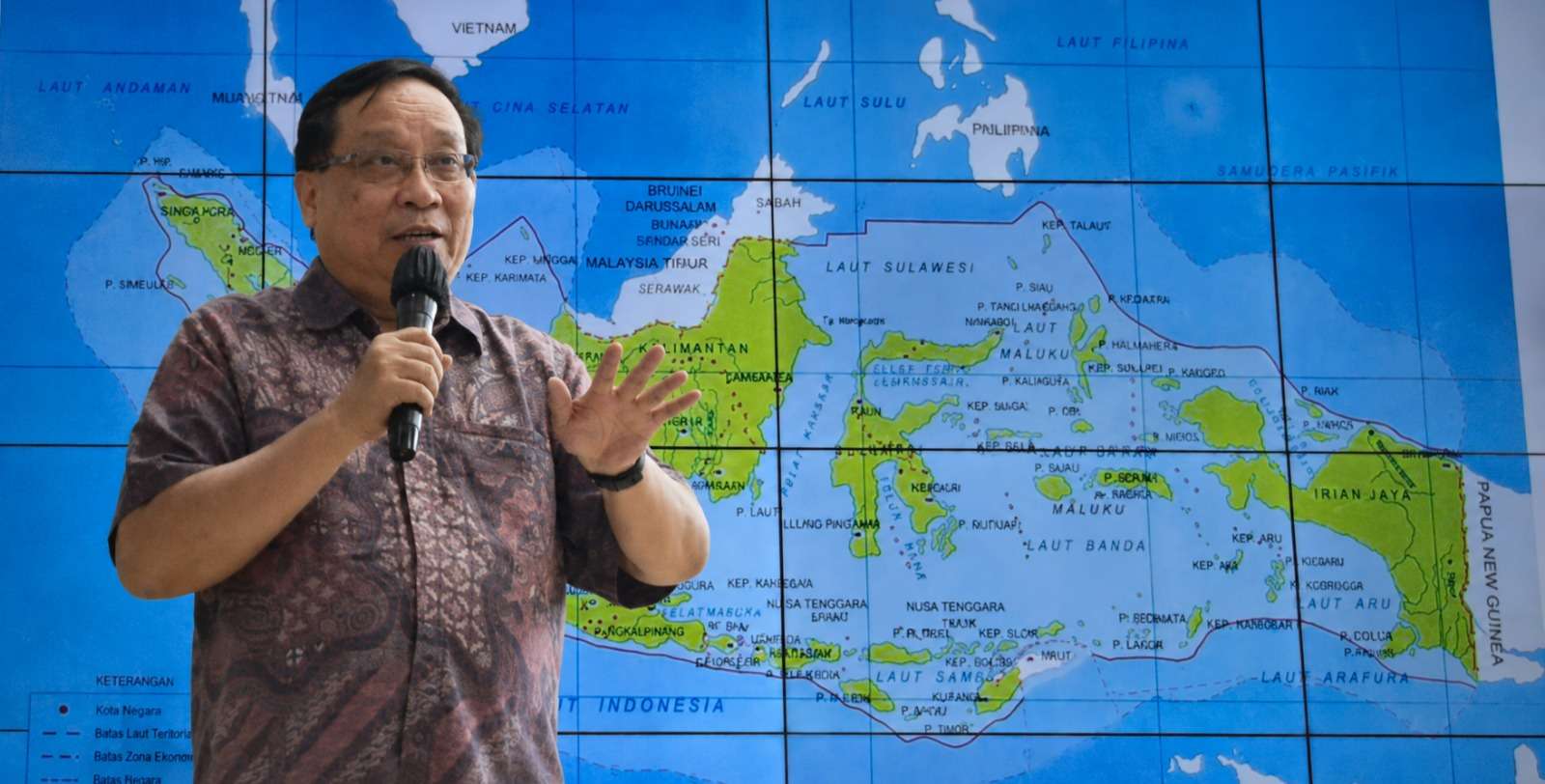
This perspective was presented by Dr. Rijal Idrus, Chair of the Indonesian Maritime Continent Institute (IBMI) at The Habibie Center, during an orientation session for students participating in Hasanuddin University’s Climate Village Program (ProKlim) community service initiative, supported by Indonesia’s Ministry of Environment and the Hans Seidel Foundation.
MARITIMEPOSTS.COM– Many people still regard the sea as a barrier separating islands. For Indonesia, however, the sea is precisely the element that binds the archipelago together.
According to Dr. Rijal Idrus, Head of the Climate Change Study Center at Hasanuddin University, this perspective forms a crucial foundation for understanding Indonesia as a Maritime Continent of Indonesia—a concept that views land, sea, and airspace as an inseparable geographical unity.
During his presentation on Indonesia’s geography, participants were invited to reconsider the map of the archipelago from a different perspective.
Rijal posed a simple question: Makassar lies between Sulawesi and Kalimantan. What function does the sea between these two islands serve?
Some participants responded that the sea functions as a divider. Yet this answer became an opportunity to challenge a common misconception.
“The sea is not a separator; it is a unifier,” Rijal Idrus emphasized.
This view aligns closely with the spirit of Indonesian nationalism expressed every week through the national anthem, Indonesia Raya.
In the anthem’s opening verse is a phrase familiar to all Indonesians: “Indonesia tanah airku” (“Indonesia, my homeland”).
According to Rijal, the phrase tanah air carries profound meaning. Land (tanah) and water (air) are not separate entities but together form the identity of the Indonesian nation.
When looking at a map of Indonesia, the green areas representing land and the blue areas representing the sea should not be understood as distinct spaces. Rather, they are components of a single living environment.
If the sea is perceived as a separator, such a perspective contradicts the national vision embodied in the Unitary State of the Republic of Indonesia (NKRI).
“Every time we sing Indonesia Raya, we say ‘Indonesia tanah airku.’ From the very beginning, the nation’s identity has been built upon the unity of land and sea,” he explained.
This perspective is especially important because Indonesia is not merely a country that happens to have many islands. It is an archipelagic nation whose very existence is defined by the sea.
The sea connects thousands of islands, serving as a pathway for human mobility, trade, cultural exchange, and the social and economic cohesion of the archipelago.
Therefore, understanding the NKRI requires more than simply looking at the country’s land territory.
“The letter ‘K’ in NKRI stands for Kesatuan (Unity), which means that all elements of Indonesia’s territory constitute a single, integrated entity. There is no separation between islands, seas, and airspace,” he said.
It is from this perspective that the concept of the Maritime Continent of Indonesia emerges.
Indonesia possesses characteristics similar to a continent because of its vast and integrated geographical system that encompasses land, waters, and the atmosphere above them. Unlike most continents, however, which are dominated by landmass, Indonesia’s defining feature is its maritime character.
For this reason, the term Maritime Continent of Indonesia is used to describe a unified territory consisting of land, water, and air within the framework of the Republic of Indonesia.
“The Maritime Continent of Indonesia is nothing other than the unity of the nation’s land, water, and airspace,” Rijal explained.
This concept is significant not only in geography but also in strengthening national consciousness.
By understanding Indonesia as a maritime continent, people are encouraged to abandon the notion that the sea separates islands. Instead, the sea should be recognized as a connective space that unifies the entire archipelago.
Amid challenges related to development, climate change, and natural resource management, the concept of the Maritime Continent of Indonesia is becoming increasingly relevant.
Goal 13 of the 17 Sustainable Development Goals (SDGs) focuses on climate action, which means taking urgent measures to combat climate change and its impacts.
This goal is referred to as Climate Action: take urgent action to combat climate change and its impacts. There is not a single country in the world that is unaffected by climate change. Greenhouse gas emissions continue to rise, and global warming is causing long-term changes to the Earth’s climate system.
Recognizing that land, Rijal said, the sea, and atmosphere form an interconnected system can help the nation design development strategies that are more integrated, sustainable, and aligned with Indonesia’s identity as the world’s largest archipelagic state.
Ultimately, when Indonesians refer to their tanah air—their homeland—they are not speaking only of the land beneath their feet. They are also referring to the seas that connect the islands and the skies that shelter the entire archipelago.
That is the essence of Indonesia as a Maritime Continent: a unified entity that cannot be divided by geographical boundaries between islands, because the sea itself serves as the nation’s principal bond.
___
Editor Kamaruddin Azis