
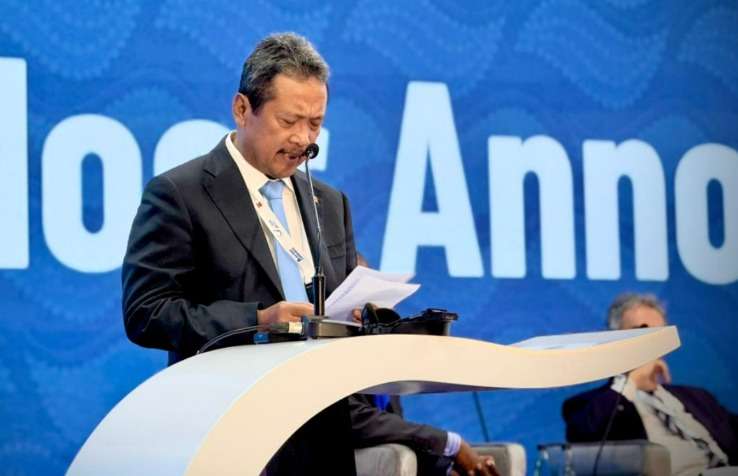
We recognize that ocean challenges are inherently transboundary, demanding robust global collaboration. Indonesia is committed to strengthening partnerships with countries around the world to safeguard healthy and productive oceans for both current and future generations.
Sakti Wahyu Trenggono, Minister of Marine Affairs and Fisheries
MARITIMEPOSTS.COM – The ocean has never recognized political boundaries. A dying coral reef in the Celebes Sea affects fisheries beyond Indonesia. Plastic waste drifting through the Makassar Strait does not stop at maritime borders.
The degradation of mangrove forests weakens one of the world’s most effective natural carbon sinks, accelerating a climate crisis that reaches every continent.
In today’s interconnected world, local environmental failures quickly become global problems.
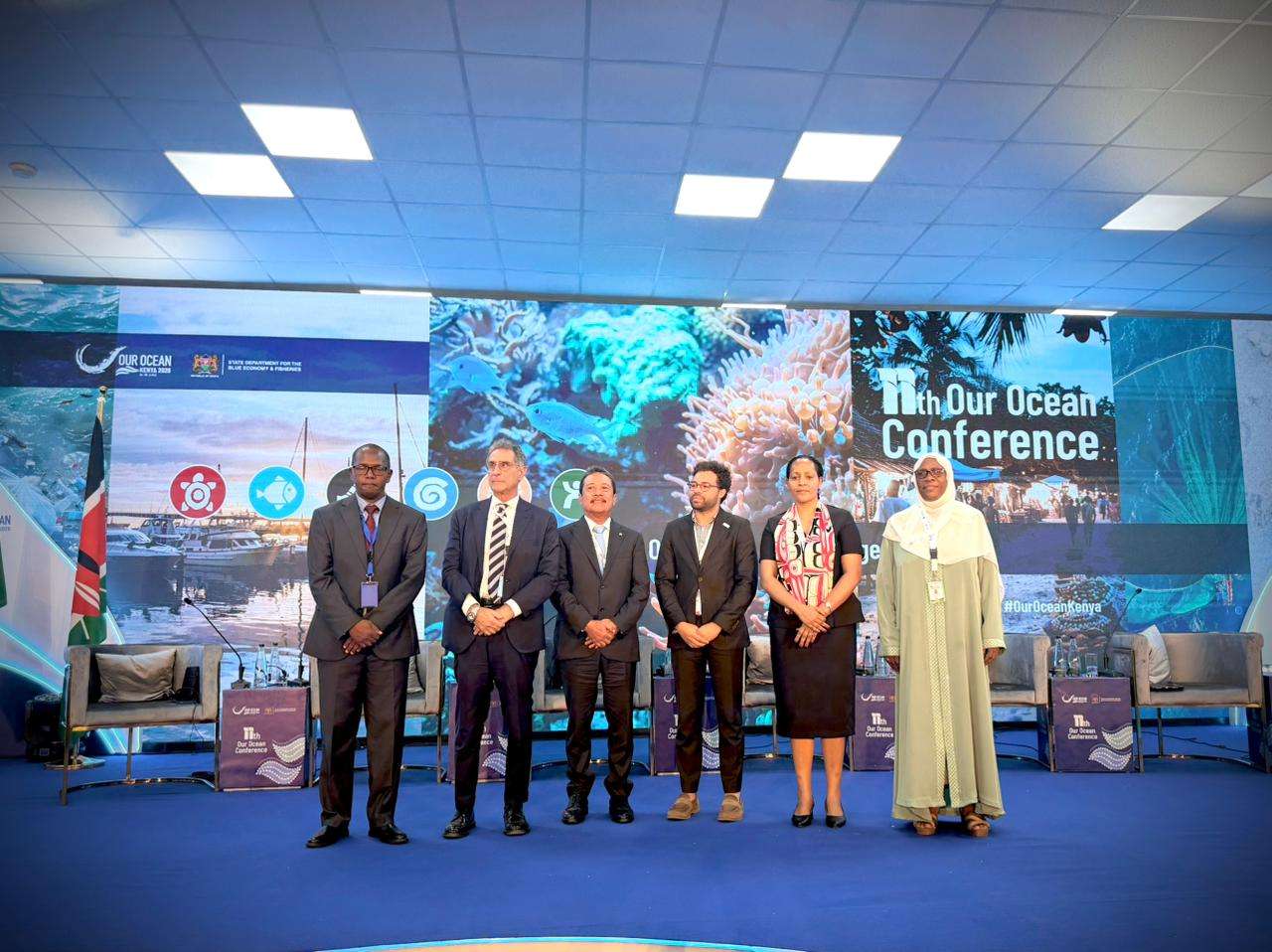
Recognizing this reality, Indonesia arrived at the 11th Our Ocean Conference (OOC) in Mombasa, Kenya, with one of its most ambitious maritime agendas to date.
More than announcing conservation targets, the country unveiled a comprehensive governance strategy that could unlock approximately USD 260 million in international cooperation and investment for marine protection.
For the world’s largest archipelagic nation, this is far more than an environmental initiative. It is a strategic investment in national resilience, food security, climate adaptation, and the future of millions whose livelihoods depend on healthy oceans.
The real challenge now is transforming international confidence into measurable local impact.
Unlocking a New Wave of Blue Financing
Indonesia’s opportunity to mobilize nearly USD 260 million comes at a crucial moment.
Among the United Nations Sustainable Development Goals, SDG 14—Life Below Water has consistently received the least financial support globally despite its enormous ecological importance. Indonesia’s success in attracting international funding therefore represents more than a financial achievement—it reflects growing confidence in the country’s evolving ocean governance.
The proposed financing will strengthen several strategic priorities, including coral reef conservation, restoration of degraded marine ecosystems, and the establishment of Ocean Centres that will provide scientific data, monitoring systems, and research capabilities for evidence-based marine management.
Rather than relying solely on government budgets, Indonesia is increasingly positioning itself within the global Blue Economy, where conservation and economic development reinforce one another. By aligning national policies with international environmental standards, the country is opening new pathways for multilateral investment and long-term sustainability financing.
First Move: Integrating Land and Sea
Perhaps Indonesia’s most transformative commitment is also its most structural.
For decades, land and marine management have operated under separate planning systems, often producing conflicting policies and fragmented governance. Coastal degradation frequently begins far inland through deforestation, pollution, and unsustainable development.
Indonesia now seeks to replace this fragmented approach with integrated spatial planning that connects terrestrial and marine ecosystems.
The strategy includes harmonizing national and provincial spatial plans, coordinating management across provincial maritime boundaries, and formally incorporating blue carbon ecosystems—particularly mangroves and seagrass meadows—into national development planning.
This “ridge-to-reef” philosophy acknowledges a simple ecological truth: healthy oceans begin with healthy watersheds.
Second Move: Expanding Marine Protection
Indonesia’s second commitment is equally ambitious in scale.
The government plans to establish 700,000 hectares of new Marine Protected Areas (MPAs) by 2026, advancing its long-term vision of protecting 30 percent of Indonesia’s marine waters by 2045.
For an archipelago spanning more than 17,000 islands, expanding marine conservation by nearly three-quarters of a million hectares within two years represents a significant policy shift.
The initiative signals a transition away from symbolic conservation toward broader ecosystem protection that safeguards biodiversity, fisheries, and coastal resilience against increasing environmental pressures.
Third Move: Measuring What Matters
Creating protected areas is only the beginning.
Around the world, many conservation zones exist only on maps, lacking effective management, enforcement, or measurable ecological benefits. Indonesia’s third commitment directly addresses this concern by launching an effectiveness assessment covering 19.10 million hectares of existing marine conservation areas.
Rather than asking how much ocean has been protected, the government is asking whether protection is actually working.
The assessment will evaluate ecological performance, including biodiversity recovery, fish stock improvement, carbon sequestration, and benefits for coastal communities.
This emphasis on accountability marks an important evolution in marine governance—from expanding protected areas to ensuring they deliver tangible environmental and social outcomes.
As Minister of Marine Affairs and Fisheries Sakti Wahyu Trenggono emphasized:
“We recognize that ocean challenges are inherently transboundary, demanding robust global collaboration. Indonesia is committed to strengthening partnerships with countries around the world to safeguard healthy and productive oceans for both current and future generations.”
His statement reflects an increasingly accepted reality: ocean governance can only succeed through international cooperation.
Fourth Move: Building Indonesia’s Blue Carbon Blueprint
The final pillar of Indonesia’s strategy focuses on one of nature’s most powerful climate solutions—blue carbon.
Mangrove forests and seagrass ecosystems can store several times more carbon per hectare than terrestrial forests while simultaneously protecting coastlines, supporting fisheries, and preserving biodiversity.
Indonesia is developing a model blue carbon project designed not as an isolated success but as a scalable framework that can be replicated throughout the archipelago.
Given the country’s immense geographic diversity, creating standardized models for ecosystem restoration, carbon accounting, and blue carbon financing could become a cornerstone of future climate policy.
If successful, Indonesia may demonstrate that marine ecosystems are not merely environmental assets but productive economic infrastructure capable of generating both climate and financial returns.
A Decade of Consistent Commitment
Indonesia’s latest commitments are not emerging in isolation.
Since joining the Our Ocean Conference in 2016, the country has steadily expanded its international leadership on marine conservation.
A defining milestone came in 2018, when Indonesia hosted the fifth Our Ocean Conference and announced 23 commitments valued at approximately USD 500 million, equivalent to around Rp7–8 trillion.
Over the past nine years, Indonesia has accumulated 73 international commitments related to ocean sustainability.
This long-term trajectory demonstrates policy continuity rather than temporary political enthusiasm. The four initiatives announced in Mombasa represent the latest chapter in Indonesia’s broader effort to align national development with SDG 14 and global climate objectives.
From Ambition to Action
Indonesia is attempting something few maritime nations have successfully achieved: proving that economic growth and large-scale marine conservation can advance together.
Its integrated planning framework, expansion of marine protected areas, effectiveness audits, and blue carbon initiatives suggest a shift away from symbolic environmental commitments toward measurable implementation.
The potential USD 260 million now available through international cooperation represents more than financial assistance. It is a vote of confidence in Indonesia’s vision for sustainable ocean governance.
Ultimately, however, global recognition is only the beginning.
The real measure of success will not be the amount of funding secured or the number of commitments announced, but whether healthier coral reefs, more resilient fisheries, restored mangrove forests, and stronger coastal communities become visible across the archipelago.
For Indonesia—and for the future of the Coral Triangle—the stakes could hardly be higher.