
- The future of Indonesia’s demersal fisheries is not merely about increasing production or protecting marine biodiversity. It is about ensuring that coastal communities continue to thrive, that seafood exports remain competitive, and that future generations inherit healthy oceans capable of sustaining livelihoods.
- The work led by ADI demonstrates that sustainability is not achieved through regulation alone. It requires trust, scientific evidence, transparent governance, community participation, and long-term commitment.
MARITIMEPOSTS.COM – Indonesia has long been recognized as one of the world’s greatest maritime nations. Stretching across more than 17,000 islands, the country possesses one of the richest marine ecosystems on Earth.
Among its most valuable fisheries are demersal species—particularly snapper and grouper—which have supported coastal livelihoods for generations while supplying premium seafood to domestic and international markets.
Yet beneath this economic success lies a growing concern. The very fish stocks that sustain thousands of fishing families are becoming increasingly vulnerable.
Declining capture fisheries, habitat degradation, international sustainability demands, and insufficient scientific data are forcing Indonesia to rethink how its demersal fisheries should be managed.
Rather than relying solely on government regulation, a new collaborative movement is emerging. Led by the Asosiasi Demersal Indonesia (ADI), government agencies, universities, researchers, NGOs, seafood companies, and fishing communities are working together to transform the management of Indonesia’s demersal fisheries into one that is science-based, transparent, and internationally recognized.
Their experience may offer one of the country’s strongest blueprints for sustainable fisheries management.
A Fishery That Supports Millions—but Faces Biological Limits
Demersal fisheries form an economic backbone for many coastal communities throughout Indonesia. Species such as snapper and grouper command high market prices and contribute significantly to exports as well as domestic food security.
However, unlike fast-growing pelagic species such as tuna, most demersal fish grow slowly. Many snapper and grouper species require three to four years before reaching sexual maturity and reproducing. This biological characteristic makes them particularly vulnerable to overfishing.
One of the greatest challenges comes from consumer preferences themselves. Markets often favor “plate-sized” fish suitable for restaurants and household consumption. Unfortunately, these marketable fish are frequently juveniles that have never reproduced.
Every juvenile harvested before spawning represents not merely one fish removed from the ocean, but the loss of countless future offspring that could have replenished the stock. Over time, continuous harvesting of immature fish gradually weakens the population’s ability to recover.
This challenge is becoming increasingly significant as Indonesia’s national capture fishery production has shown signs of stagnation and decline. Without more effective management, the long-term supply of wild seafood could become increasingly uncertain.
Habitat Matters as Much as Fishing Pressure
Unlike migratory pelagic species that travel across vast oceanic waters, demersal fish are closely tied to specific habitats, particularly coral reefs and coastal ecosystems.
Healthy reefs provide spawning grounds, nursery habitats, shelter, and feeding areas. When reefs are damaged by destructive fishing practices, pollution, sedimentation, or climate change, demersal fish populations decline almost immediately.
This ecological dependency means that fisheries management cannot focus solely on regulating catches. Protecting marine habitats must become an integral component of fishery sustainability.
The future of snapper and grouper is inseparable from the health of Indonesia’s coral reef ecosystems.
Science Still Lags Behind
Despite their economic importance, demersal fisheries have historically received far less scientific attention than pelagic fisheries.
Research funding, stock assessments, and long-term monitoring have largely focused on tuna and other highly migratory species. As a result, significant knowledge gaps remain regarding the biology, population dynamics, and spatial distribution of many demersal species.
These knowledge gaps complicate management decisions. Managers cannot effectively determine sustainable harvest levels without reliable information on fish size, age structure, reproductive status, and stock conditions.
The lack of comprehensive research also limits Indonesia’s ability to satisfy increasingly rigorous international sustainability standards.
Building Fisheries Management Through Collaboration
Recognizing these challenges, ADI has promoted a different approach to fisheries governance—one based on collaboration rather than top-down regulation.
The approach embraces co-management, where responsibility is shared among government institutions, seafood companies, fishing communities, researchers, universities, and civil society organizations.
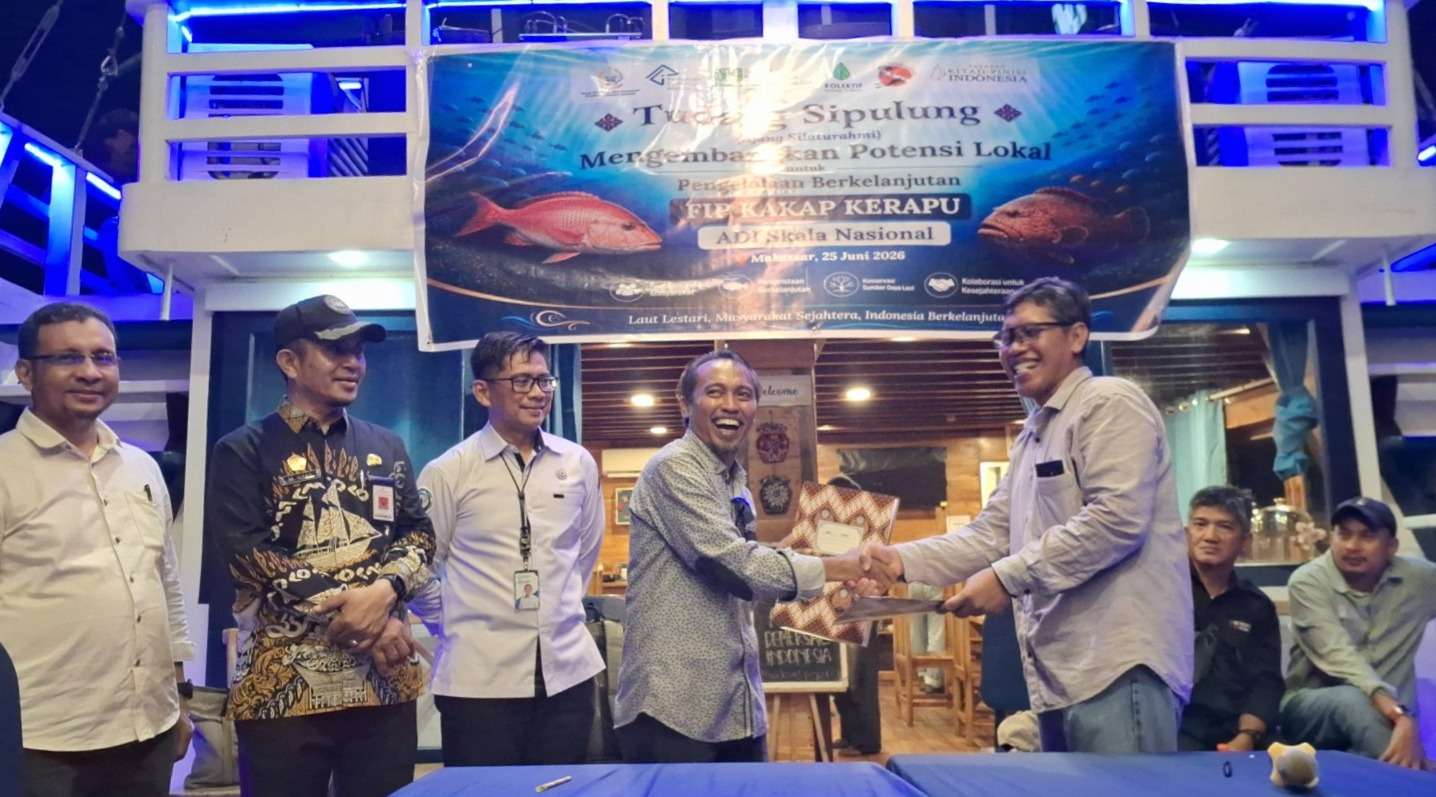
This collaborative framework has already demonstrated promising results in South Sulawesi. A multi-stakeholder fisheries management committee has successfully brought together diverse actors to discuss scientific findings, evaluate management measures, and jointly develop recommendations.
Instead of imposing regulations from above, stakeholders participate directly in designing solutions.
This participatory model has strengthened trust among fishers, industry, researchers, and government while improving the legitimacy of fisheries management decisions. Because of its success, the South Sulawesi model is now being incorporated into broader National Fisheries Management Plans.
Fisheries Improvement Project: Preparing for Global Standards
Central to ADI’s sustainability strategy is the Fisheries Improvement Project (FIP), which has been operating since 2019. An FIP is not a certification itself but a structured, multi-year roadmap designed to improve fisheries management through measurable actions.
The project emphasizes improved biological monitoring, catch documentation, traceability systems, stakeholder engagement, and scientific data collection.
Ultimately, these improvements aim to prepare Indonesia’s demersal fisheries for the Marine Stewardship Council (MSC) Full Assessment—the world’s most widely recognized certification for sustainable fisheries.
Achieving MSC certification would strengthen Indonesia’s competitiveness in international seafood markets, where buyers increasingly require independently verified sustainability credentials.
However, certification demands robust evidence. Reliable data, transparent governance, effective compliance, and continuous scientific monitoring are essential prerequisites.
The Data Challenge
One persistent obstacle remains data availability. Many fishers willingly report the quantity of fish they catch. Yet they often hesitate to disclose the precise locations where fishing occurs.
Their reluctance is understandable. Fishing grounds represent years of accumulated experience and local knowledge. Sharing spatial information may expose productive fishing areas to competitors, threatening livelihoods.
This creates a delicate balance between protecting fishermen’s economic interests and generating the scientific information needed for sustainable management.
Addressing this challenge requires building trust, ensuring confidentiality where appropriate, and demonstrating that better data ultimately benefits fishing communities themselves.
Policy Reform Supporting Sustainability
Indonesia’s fisheries policies are increasingly aligning with broader national priorities under the Blue Economy agenda. Government initiatives seek to integrate sustainable fisheries management with food security, economic development, and marine conservation. Several complementary policy reforms are reinforcing these objectives.
Licensing services are being brought closer to fishing communities to improve legal compliance and reduce bureaucratic obstacles.
Meanwhile, regulations now require publicly funded scientific research to be submitted to national research repositories, making information more accessible for policymakers, researchers, and practitioners.
Greater transparency in scientific information supports evidence-based decision making while reducing duplication of research efforts.
Community-Based Innovation
Beyond national policies, local innovations are demonstrating practical solutions. One notable example comes from Pulau Lanjukang, where communities have implemented temporary fishing closures for octopus.
Known as an “open-close” management system, fishing areas are periodically closed to allow stocks to recover before being reopened for harvest. The approach has produced encouraging ecological and economic outcomes.
Many experts believe similar community-led management systems could be adapted for selected demersal fisheries, particularly where local participation and compliance are strong. Such approaches reinforce the principle that conservation and livelihoods need not be opposing objectives.
Aquaculture as Part of the Future
Even with improved management, wild capture fisheries alone may struggle to meet Indonesia’s growing seafood demand. Developing sustainable aquaculture for snapper and grouper therefore represents an increasingly important strategy.
Responsible fish farming can reduce pressure on wild populations while providing additional income opportunities for coastal communities.
Rather than replacing capture fisheries, aquaculture should complement them, allowing wild stocks sufficient time to recover while maintaining seafood production.
Strengthening the Path Forward
Several priorities emerge from ADI’s ongoing experience.
First, the collaborative fisheries committees established in South Sulawesi should be replicated throughout Indonesia’s major demersal fishing regions.
Second, demersal fisheries and aquaculture deserve greater recognition as national research priorities. Increased investment in science would generate the evidence needed for adaptive management and international certification.
Third, universities should become more deeply involved through structured internship programs that place students directly in fishing communities and seafood companies. Such programs would simultaneously strengthen education, expand scientific data collection, and build future fisheries professionals.
Fourth, Indonesia’s national research repository should be fully optimized so that existing studies become easily accessible to policymakers, researchers, industry, and fishing communities.
Finally, stronger implementation of minimum catch-size regulations is essential to ensure fish have the opportunity to reach maturity and reproduce before harvest.
A Shared Responsibility
The transformation of Indonesia’s demersal fisheries illustrates that sustainability cannot be achieved by any single institution acting alone.
Government agencies—including the Ministry of Marine Affairs and Fisheries (KKP), BP2MHKP, and the South Sulawesi Marine and Fisheries Service (DKP Sulsel)—provide regulatory direction.
ADI and its member companies contribute industry leadership and operational experience. Universitas Hasanuddin, particularly the Faculty of Marine Science and Fisheries (FIKP), together with the National Research and Innovation Agency (BRIN), strengthen the scientific foundation.
Organizations such as Sustainable Fisheries Partnership (SFP), YKL, and Sangkarrang Ocean Dive (SOD) provide technical support, community engagement, and conservation expertise.
The Himpunan Nelayan Seluruh Indonesia (HNSI), local fishing communities from Pulau Langkai, Pulau Lanjukang, Galesong, and other coastal areas contribute invaluable local knowledge and stewardship.
Meanwhile, media organizations play an indispensable role in raising public awareness and promoting accountability. Together, these stakeholders are redefining fisheries governance in Indonesia.
Beyond Fish
The future of Indonesia’s demersal fisheries is not merely about increasing production or protecting marine biodiversity. It is about ensuring that coastal communities continue to thrive, that seafood exports remain competitive, and that future generations inherit healthy oceans capable of sustaining livelihoods.
The work led by ADI demonstrates that sustainability is not achieved through regulation alone. It requires trust, scientific evidence, transparent governance, community participation, and long-term commitment.
As Indonesia advances its Blue Economy agenda, the lessons emerging from South Sulawesi suggest that collaborative fisheries management is no longer an experimental concept—it is becoming an essential pathway toward resilient oceans, prosperous coastal communities, and sustainable national development.