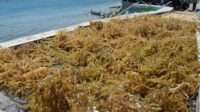

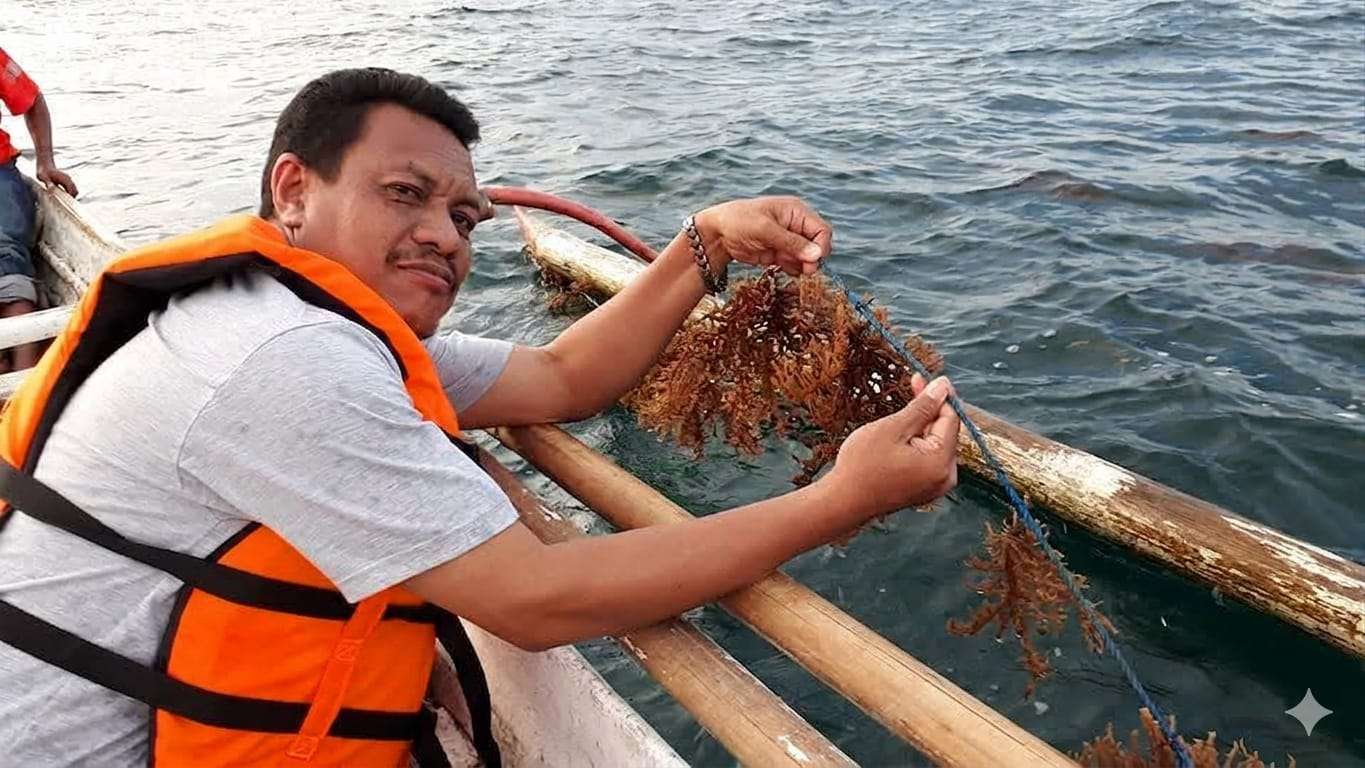
MARITIMEPOSTS.COM – Along the sunlit coastlines of South Sulawesi, rows of bamboo racks stretch toward the sea, draped with tangled strands of drying seaweed.
To outsiders, it may appear like little more than salt-crusted marine debris. But for thousands of coastal families, these green-brown strands represent something far more valuable: survival, resilience, and hope.
In fishing villages scattered across South Sulawesi, seaweed has quietly become the backbone of local economies.
While industrial fisheries and deep-sea ventures often dominate conversations about Indonesia’s maritime future, it is seaweed cultivation—simple, accessible, and deeply rooted in community life—that has emerged as one of the region’s most sustainable economic lifelines.
Locals call it “green gold.”
At the center of this growing industry is Eucheuma cottonii, a species of seaweed widely cultivated across Indonesia’s eastern waters.
Unlike fish stocks that fluctuate with seasons and overfishing pressures, seaweed offers a relatively stable market. Its value lies not only in food production, but also in its role as a crucial industrial raw material.
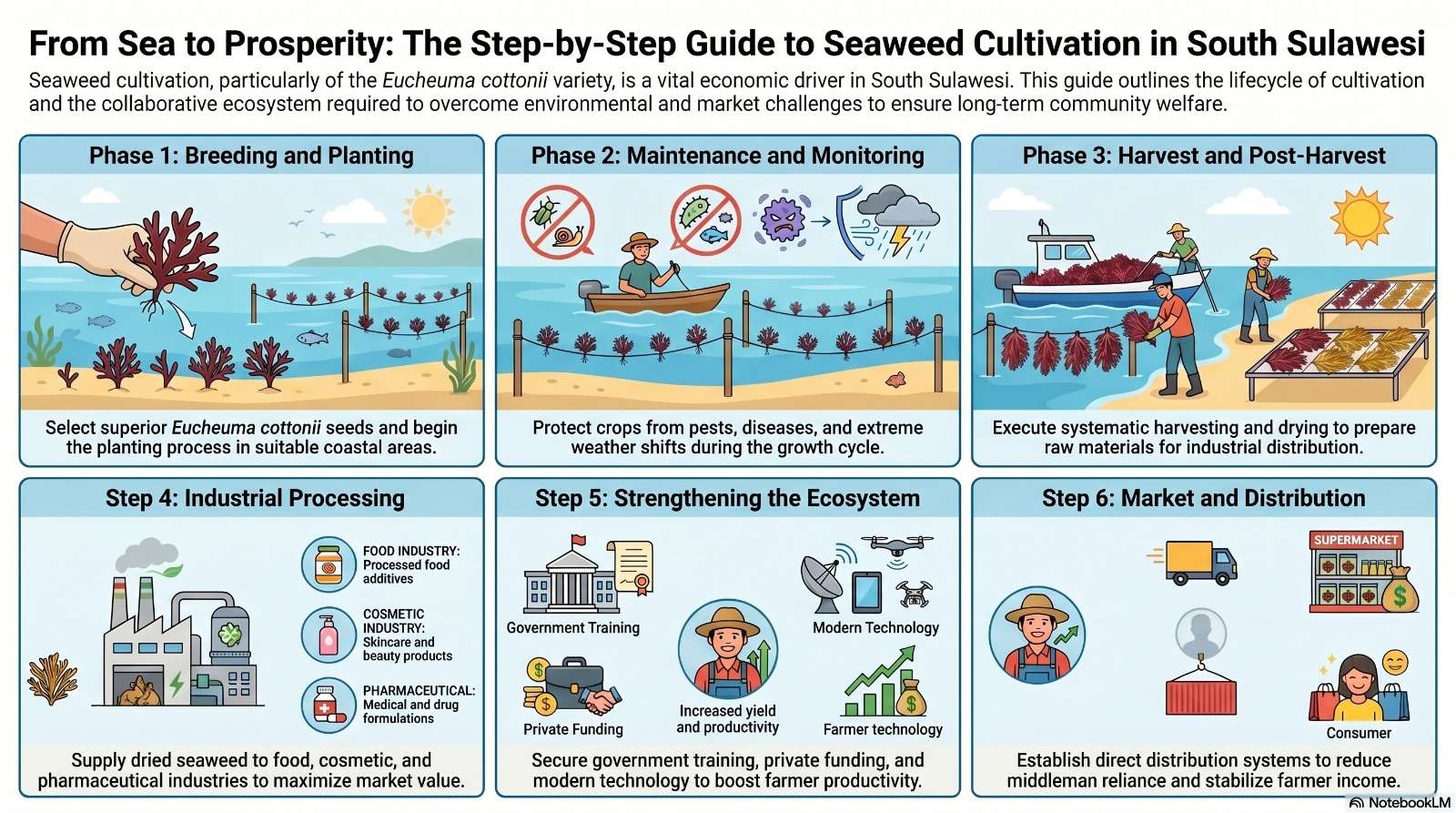
Processed into carrageenan, a natural thickening and stabilizing agent, E. cottonii has become indispensable to global manufacturing. It is found in products consumed daily around the world: toothpaste, cosmetics, processed dairy products, pharmaceuticals, and personal care items.
Every tube of toothpaste or bottle of moisturizer on supermarket shelves may carry traces of labor from the coastlines of Sulawesi.
This expanding global demand has transformed seaweed into one of Indonesia’s most promising blue economy commodities. Yet beyond export statistics and industrial supply chains lies another story—one about families, women, and small coastal communities redefining their futures.
A Family-Based Economy
Unlike deep-sea fishing, which requires expensive boats, fuel, and physically demanding labor, seaweed farming is relatively accessible. The cultivation methods are simple enough to involve entire households.
Women often lead the post-harvest process, from sorting and cleaning to drying the seaweed under the tropical sun.
Young people help prepare seedlings and tie cultivation lines in shallow coastal waters. The result is not merely individual income, but what many communities describe as a “local economic rotation,” where money continues circulating within the village rather than flowing outward to urban centers.
In many coastal areas of South Sulawesi, seaweed farming has become one of the few economic sectors capable of sustaining households without forcing migration to cities.
The industry also offers opportunities for younger generations who are increasingly searching for alternatives to unstable fisheries or low-paying informal jobs. For women in particular, seaweed cultivation provides a rare avenue for economic participation within maritime communities traditionally dominated by male labor.
Yet behind this promising narrative lies a difficult paradox.
The Middleman Trap
Despite the growing global appetite for seaweed products, many farmers remain trapped at the lowest end of the value chain.
The problem is not production—it is power.
Most farmers rely heavily on middlemen, known locally as tengkulak, who control purchasing prices, transportation, and market access. Without direct connections to processing industries or exporters, farmers are often forced to accept low prices immediately after harvest.
As a result, the highest profits are frequently captured further up the supply chain, while coastal producers absorb the risks of cultivation itself.
The imbalance leaves many farming communities vulnerable to sudden price drops and debt dependency. Even when international demand rises, the economic benefits often fail to fully reach the people cultivating the crop.
For many farmers, seaweed remains profitable enough to survive—but not enough to truly prosper.
Climate Risks and Fragile Production
Seaweed cultivation is also becoming increasingly vulnerable to environmental instability.
Extreme weather shifts, rising sea temperatures, and unpredictable currents have intensified the risks faced by coastal farmers. A sudden storm or prolonged heatwave can destroy entire cultivation areas within days. Disease outbreaks and pests remain persistent threats, while inconsistent seed quality often leads to unstable yields.
The absence of modern drying facilities and cultivation technology further limits productivity, especially in remote islands where infrastructure remains weak.
According to M. Aminullah, Partnership Officer at PT. Daur Algae Indonesia, addressing these vulnerabilities requires stronger collaboration between government institutions, private companies, and local communities.
Farmers cannot close the resilience gap alone.
Without better technology, stronger financial support, and improved access to superior seedlings, seaweed cultivation may struggle to meet the growing pressures of climate change and industrial demand simultaneously.
Building a Sustainable Blue Economy
Despite the challenges, the future of seaweed cultivation in South Sulawesi remains remarkably promising.
The global market for seaweed-derived products continues to expand, driven by increasing demand from food, pharmaceutical, and cosmetic industries.
Indonesia, as one of the world’s largest seaweed producers, holds enormous strategic potential within the emerging blue economy.
But transforming seaweed into a genuine engine of regional welfare requires more than production growth alone.
Experts and community advocates argue that four pillars are essential for long-term sustainability: access to superior seedlings, technical training for farmers, inclusive financing systems, and stronger market structures that reduce dependency on middlemen.
Equally important is ensuring that coastal communities are positioned not merely as raw material suppliers, but as active participants in processing and value-added industries.
Through sustainable management and equitable economic policies, seaweed cultivation could become more than a commodity sector. It could evolve into a model for inclusive coastal development—one that balances environmental stewardship with community welfare.
The Human Side of “Green Gold”
The story of South Sulawesi’s seaweed industry ultimately reflects a larger question facing the global blue economy.
As international demand for seaweed-based products continues to rise, who truly benefits from this growth?
Behind every processed cosmetic, pharmaceutical ingredient, or packaged food product lies the labor of coastal communities working under the heat of the tropical sun, tying seaweed lines by hand and waiting anxiously for favorable tides.
The challenge for the future is not only increasing production, but ensuring dignity and prosperity for the people at the beginning of the supply chain.
Because the true value of South Sulawesi’s “green gold” should not be measured solely by export volumes or industrial profits—but by whether it can secure a better future for the families who cultivate it along the shore.
___
Written by Kamaruddin Azis