
MARITIMEPOSTS.COM – MAKASSAR, Indonesia — Around the world, universities are facing a defining question: How can higher education remain relevant in an era marked by climate change, technological disruption, geopolitical uncertainty, and widening social inequality?
The traditional model of the university as an “ivory tower”—isolated from society and focused primarily on theoretical pursuits—is increasingly being challenged by demands for practical solutions to real-world problems.
At Indonesia’s Graduate School of Hasanuddin University (Sekolah Pascasarjana Universitas Hasanuddin/SPs Unhas), that transformation is already underway.
Rather than competing by replicating academic models developed elsewhere, the institution has embraced a distinctive identity rooted in the Indonesian Maritime Continent (Benua Maritim Indonesia/BMI). This geographical and intellectual orientation has become the cornerstone of its strategy to build internationally respected research while remaining deeply connected to Indonesia’s development priorities.
Research Guided by Geography
Indonesia is the world’s largest archipelagic nation, where development challenges are shaped not only by land but also by oceans, coastlines, islands, biodiversity, and maritime communities.
Recognizing this reality, SPs Unhas has positioned the Indonesian Maritime Continent as its primary research laboratory.
Rather than following generic global research trends, the Graduate School encourages scholars to investigate issues such as coastal resilience, maritime governance, sustainable fisheries, blue economy development, environmental health, regional planning, disaster mitigation, transportation systems, and climate adaptation.
This approach allows research to respond directly to the country’s unique geographical and socio-economic characteristics while contributing to broader international scientific discussions.
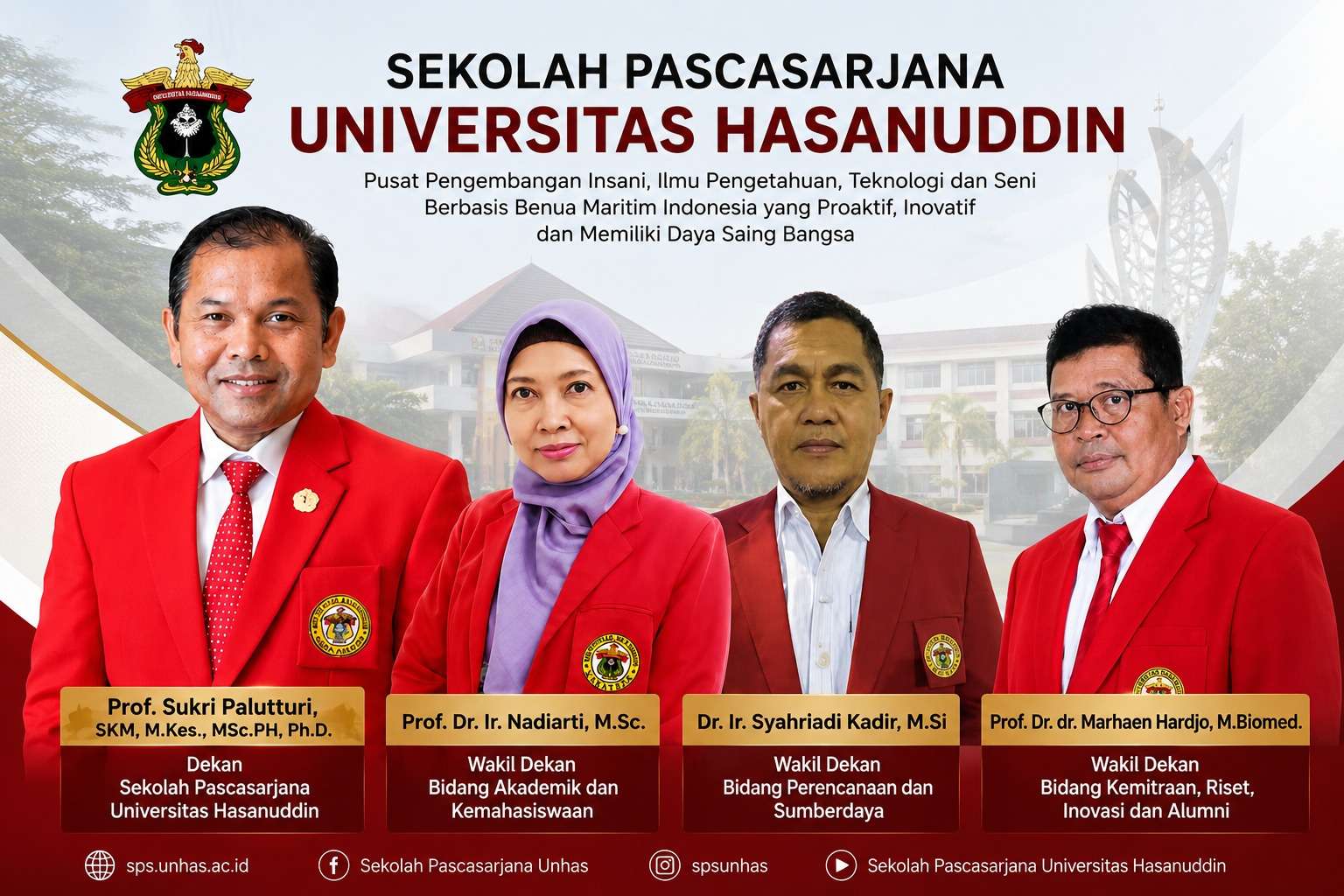
According to Prof. Sukri Palutturi, Dean of the Graduate School, academic excellence must always be accompanied by social relevance.
“The construction of a quality academic atmosphere is the main foundation in producing graduates who are not only academically superior but also able to provide a real contribution to the resolution of various development problems, especially those related to the characteristics of the Indonesian Maritime Continent.”
His statement reflects a philosophy that research should extend beyond publication metrics to create measurable impacts on society.
Leadership Designed for a Complex World
Institutional innovation at SPs Unhas is not limited to research themes. The Graduate School has also adopted a leadership structure that distributes responsibility across specialized academic domains, enabling greater institutional agility.
Academic and Student Affairs are coordinated by Prof. Nadiarti, focusing on curriculum quality, learning innovation, and student development. Planning and Resources are managed by Dr. Syahriadi Kadir, ensuring efficient governance, financial sustainability, and institutional capacity.
Meanwhile, Prof. Marhaen Hardjo leads Partnership, Research, Innovation, and Alumni Affairs, strengthening research collaboration, innovation ecosystems, and international partnerships.
This governance model reflects Indonesia’s Tridharma of Higher Education—education, research, and community service—while allowing each strategic area to develop with greater focus and responsiveness.
Research That Shapes Public Policy
As governments increasingly rely on scientific evidence to formulate public policy, SPs Unhas aims to position itself as a trusted source of evidence-based solutions.
The Graduate School emphasizes research capable of informing government decision-making, supporting sustainable industry, strengthening regional development, and addressing environmental challenges. Publications remain important, but they are viewed as part of a broader mission to generate knowledge that directly benefits society.
This orientation reflects an understanding that universities should not merely observe development from a distance; they should actively participate in designing better policies and improving public welfare.
Breaking Academic Silos
Many of today’s most pressing challenges cannot be solved within a single academic discipline. Climate resilience requires engineers, ecologists, economists, and social scientists to work together. Sustainable fisheries demand collaboration among marine biologists, legal scholars, policy analysts, and public health experts.
Recognizing this reality, SPs Unhas has embedded multidisciplinary collaboration into its academic culture. The Graduate School encourages researchers from diverse backgrounds to work collectively, generating innovative solutions that are both scientifically rigorous and socially applicable.
This collaborative approach also enhances research quality, expands international publication opportunities, and prepares graduates to become adaptive leaders capable of addressing increasingly complex global issues.
A Global Vision Built on Local Strength
Many universities pursue international recognition by imitating established Western models. Hasanuddin University’s Graduate School has chosen a different path.
Its strategy suggests that global competitiveness is achieved not through uniformity, but through authenticity. By embracing the Indonesian Maritime Continent as its intellectual foundation, SPs Unhas has created a distinctive academic identity that few institutions elsewhere can replicate.
This approach demonstrates that local relevance and international excellence are not competing ambitions—they are mutually reinforcing. Research grounded in Indonesia’s maritime realities contributes not only to national development but also to global conversations about sustainability, resilience, and inclusive development.
As SPs Unhas continues expanding international collaborations, strengthening interdisciplinary research, and producing evidence-based policy recommendations, it offers an alternative vision for the future of higher education.
Rather than asking how Indonesian universities can resemble institutions abroad, the Graduate School poses a more compelling question: What if the world’s most innovative universities are those that fully embrace the unique characteristics of their own environments?
For Hasanuddin University’s Graduate School, the answer lies not beyond the ocean—but within it. The Indonesian Maritime Continent is more than a geographical setting; it is a living laboratory where science, policy, innovation, and society converge to shape a more sustainable future.