
MARITIMEPOSTS.COM — FAKFAK — A new technology-based approach to nutmeg drying, a process that has traditionally depended heavily on weather conditions, has been introduced by Team 15 of the 2026 Patriot Expedition of Hasanuddin University (TEP Unhas).
Through a Nutmeg Postharvest Workshop and Smart Solar Biomass Dryer Demonstration held on Thursday, 17 September 2026, farmers in the Weri-Saharey Transmigration Area of Fakfak Regency learned how to dry nutmeg using a system that combines solar energy, biomass, and Internet of Things (IoT) technology.
The workshop was attended by members of independent farmer groups, administrators of Village-Owned Enterprises (BUMKam), and Village Cooperatives (Kopdes) from two villages in the Weri-Saharey area.
The activity forms part of a community empowerment programme designed around local needs and aspirations previously identified through a Focus Group Discussion (FGD). One of the key issues raised was postharvest management, particularly the drying of nutmeg, which remains highly dependent on weather conditions.
Before the technology demonstration, participants received training on postharvest handling and standard operating procedures for nutmeg storage, delivered by Irham Rasyid.
The session highlighted the importance of proper postharvest handling to maintain seed quality, prevent fungal growth, reduce the risk of physical damage, and preserve the market value of the commodity.
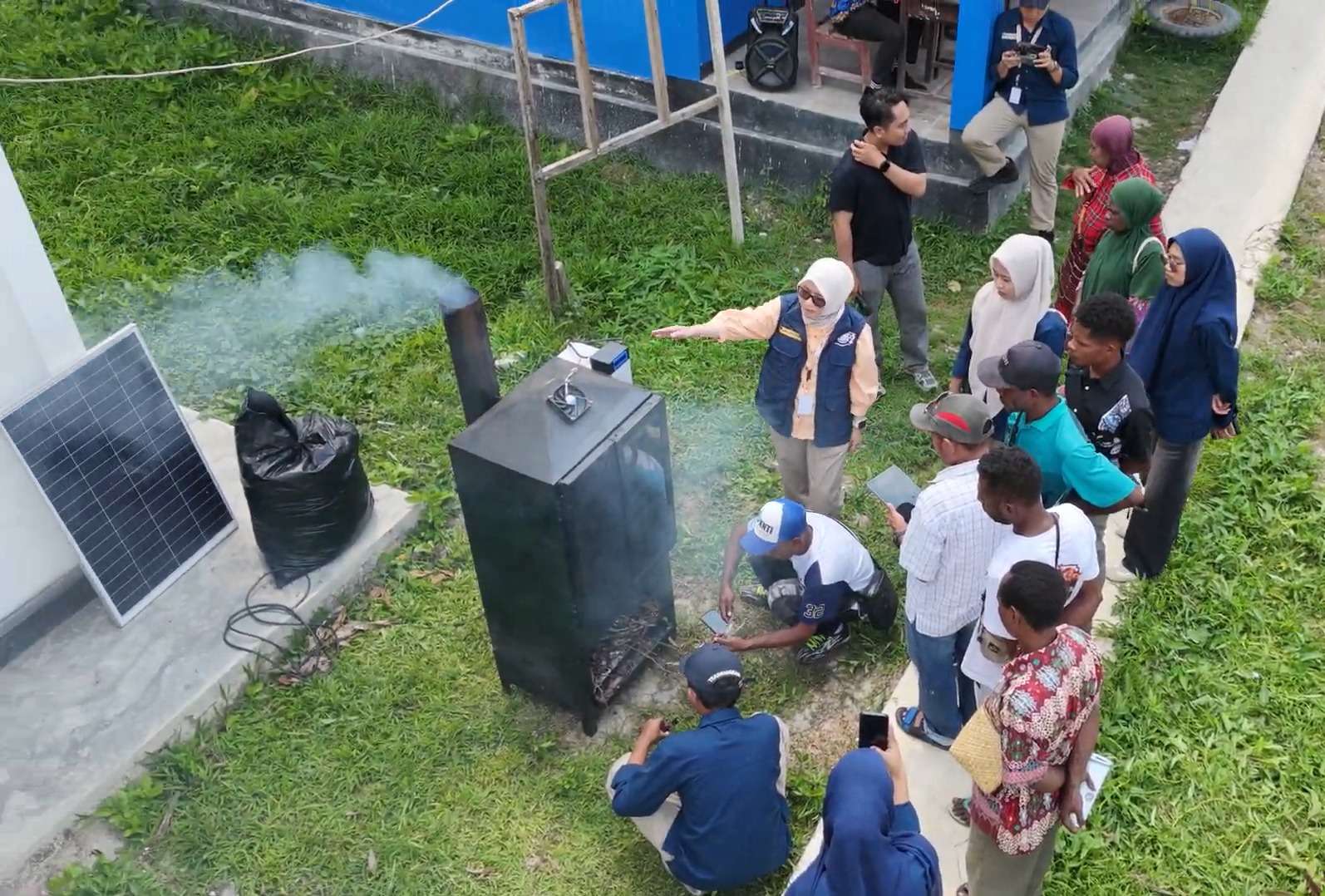
Participants then observed and practised the operation of the Smart Solar Biomass Dryer, a drying machine that combines solar energy with biomass fuel. The practical session was led by Team 15 Patriot Expedition UNHAS Chair Ir. Sahriyanti Saad, S.Hut., M.Si., Ph.D., together with members of the team.
Sahriyanti explained that the system differs from conventional drying methods, particularly because it incorporates Internet of Things (IoT) technology. Through a mobile phone, users can monitor conditions inside the drying chamber in real time, especially temperature and humidity, while also adjusting the fan speed.
“In practice, participants are trained to maintain the ideal nutmeg drying temperature at around 50–60°C. The control mechanism is hybrid. If the application detects that the temperature has fallen below 50°C, farmers need to add biomass. Conversely, if the temperature exceeds 60°C, the amount of burning fuel must be reduced,” Sahriyanti said.
To assess changes in participants’ understanding, Team 15 also conducted evaluations through pre-tests and post-tests. Participants showed strong enthusiasm throughout the demonstration and hands-on operation of the equipment.
“Previously, whenever we wanted to dry nutmeg, we were always worried that it might suddenly rain. It turns out there is equipment like this that uses solar heat and locally available materials, so it is very helpful,” said Aher Samai, Head of the Rangkum Farmer Group.
“The equipment is easy to use, especially for monitoring the temperature and moisture content of the nutmeg. We hope its capacity can be increased so that more nutmeg can be dried. Ideally, each village would have two units, allowing farmers to use them directly while producing cleaner dried nutmeg,” said Dahlan, Head of the Pancoran Farmer Group.
The introduction of the technology not only offers an alternative solution to the challenges of nutmeg drying but also opens a broader discussion about how technological innovations can be adapted to better meet the needs of local communities.
The UNHAS Patriot Expedition Team acknowledged that the prototype currently operates at a household scale, with a capacity of approximately 1,000 nutmeg seeds per drying cycle. Local residents hope the innovation can serve as an initial reference for developing communal-scale drying machines capable of handling farmers’ harvests collectively in the future.
The community empowerment programme in the Weri-Saharey Transmigration Area is expected not only to strengthen the management of Fakfak’s flagship commodity but also to provide a blueprint for agricultural modernisation in other transmigration areas across Indonesia.