
MARITIMEPOSTS.COM– MAKASSAR – Hasanuddin University (Unhas) is expanding its academic presence on the international stage, with nine of its scientists included in the World’s Top 2% Scientists 2026, a global ranking compiled through collaboration between Stanford University and international academic publisher Elsevier BV. The latest edition was released on Thursday, October 8, 2026.
The achievement reflects growing recognition of Unhas researchers over the past three years. The number of scientists from the university featured on the list has increased from six in 2024 to seven in 2025 and nine in 2026. This upward trend signals the expanding presence of Unhas researchers in the international landscape of scientific publications and citations.
The World’s Top 2% Scientists list is compiled using bibliometric indicators drawn from the Scopus database, taking into account publication productivity, citation performance, and other measures of scientific influence.
The ranking assesses researchers within their respective fields of expertise, offering an overview of the influence their scholarly work has on the advancement of global scientific knowledge.
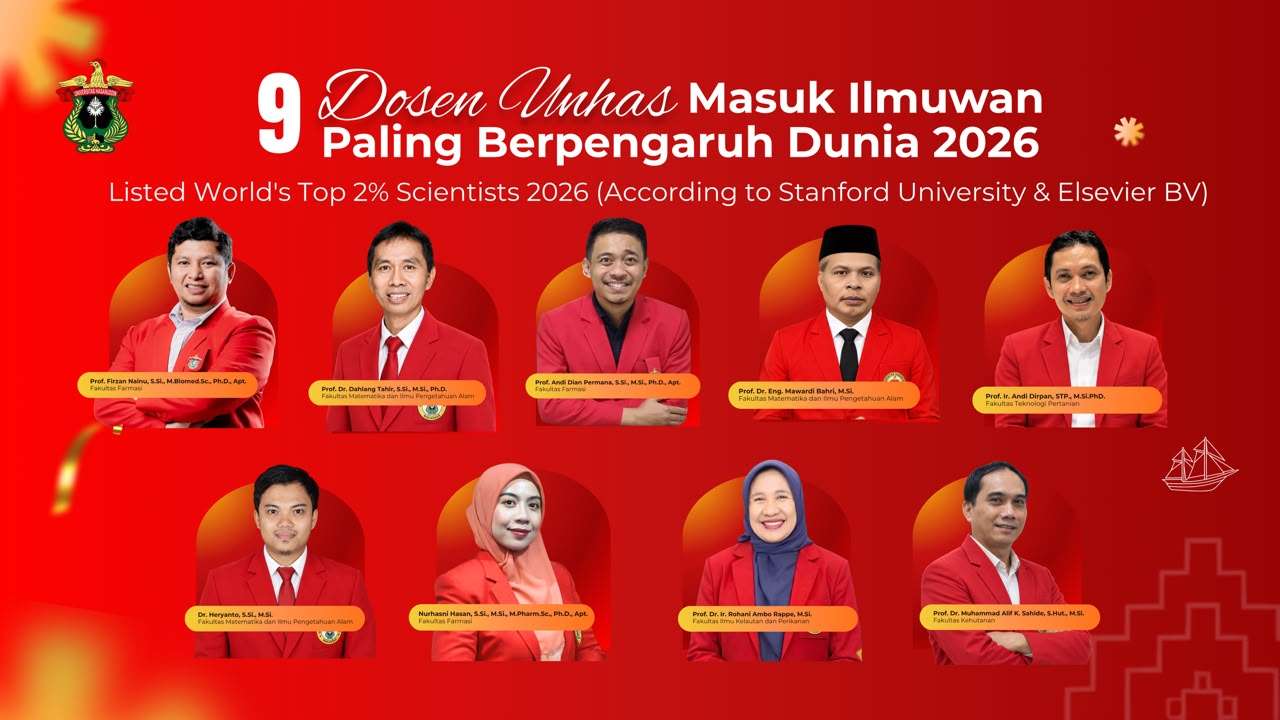
The nine Unhas scientists featured in this year’s list represent five faculties, reflecting the university’s growing research contributions across multiple disciplines.
They include Prof. Firzan Nainu, S.Si., M.Biomed.Sc., Ph.D., Apt., and Prof. Andi Dian Permana, S.Si., M.Si., Ph.D., Apt., from the Faculty of Pharmacy; Prof. Dr. Dahlang Tahir, S.Si., M.Si., Prof. Dr. Eng. Mawardi Bahri, M.Si., and Dr. Heryanto, S.Si., M.Si., from the Faculty of Mathematics and Natural Sciences.
The other scientists are Prof. Ir. Andi Dirpan, S.TP., M.Si., Ph.D., from the Faculty of Agricultural Technology; Prof. Dr. Ir. Rohani Ambo Rappe, M.Si., from the Faculty of Marine Science and Fisheries; and Prof. Dr. Muhammad Alif K. Sahide, S.Hut., M.Si., from the Faculty of Forestry. Nurhasni Hasan, S.Si., M.Si., M.Pharm.Sc., Ph.D., Apt., also represents the Faculty of Pharmacy.
Scientific Recognition Opens Doors to Collaboration
Unhas Vice Rector for Partnerships, Internationalization, and Alumni Affairs, Prof. Ir. Suharman Hamzah, S.T., M.T., Ph.D. (Eng), said the growing number of Unhas scientists featured on the list demonstrates the increasing international recognition of the university’s academic and research capabilities.
He noted that the achievement goes beyond individual accomplishments, strengthening the university’s visibility through research contributions across various disciplines. Greater international recognition can serve as a foundation for expanding academic networks and developing stronger research partnerships with universities and research institutions both in Indonesia and abroad.
“This increase shows that more Unhas scientists across various disciplines are gaining recognition within the global academic community. The achievement represents not only individual performance but also contributes to enhancing the broader visibility of Unhas scholarship,” Prof. Suharman explained.
He added that greater international visibility for Unhas researchers could create opportunities for collaboration in various forms, including joint research, co-authored scientific publications, and academic knowledge exchange. These networks could also support educational activities and capacity development, including student supervision and participation in academic activities as external examiners.
“As Unhas researchers and their fields of expertise become better known within global academic networks, opportunities for collaboration also expand. These may take various forms, from collaborative research and joint publications to student supervision and participation in academic activities such as serving as external examiners,” he said.
For students, stronger international research networks can enrich the learning environment and broaden access to the latest scientific developments. Connections between faculty members, researchers, and the global academic community can also create opportunities for cross-institutional learning and expose students to diverse research approaches and practices.
Prof. Suharman added that researchers’ reputations and the strength of their academic disciplines also contribute to a university’s appeal. As more Unhas scientists gain international recognition, the university has greater opportunities to showcase its academic capabilities to prospective students, educational partners, and international research institutions.
“For students, the reputation of researchers and the strength of their academic disciplines are important considerations when choosing a university. As more Unhas researchers gain recognition and establish international networks, this also enhances Unhas’s appeal as an institution for education and research,” he said.
At the institutional level, greater scientific visibility can serve as a gateway to strategic partnerships with universities, research centers, and industry. Such cooperation is important for strengthening research capacity, facilitating knowledge exchange, and connecting research findings with development priorities and technological advances.
“From an institutional perspective, this academic visibility can strengthen Unhas’s reputation and create broader partnership opportunities. As our academic capabilities become more widely recognized, opportunities to work with universities, research institutions, and industry partners also increase,” he explained.
Nevertheless, Prof. Suharman emphasized that international recognition should be viewed within the broader context of scientific advancement. Research quality cannot be measured solely by publications and citations; it must also be assessed in terms of relevance, practical value, and contributions to addressing societal challenges.
Unhas Rector: Research Must Deliver Real-World Impact
Unhas Rector Prof. Dr. Ir. Jamaluddin Jompa, M.Sc., welcomed the achievement with pride. He views the growing number of Unhas scientists featured in the international ranking as recognition of their academic contributions and a reflection of the university’s continuing efforts to strengthen its academic and research ecosystem.
“Congratulations to our researchers. Beyond individual achievements, this accomplishment also reflects the academic and research ecosystem that we continue to build at Unhas,” said Prof. Jamaluddin Jompa, widely known as Prof. JJ.
He hopes the achievement will encourage the university community to improve research quality, expand international collaboration, and develop innovations that address societal needs. He stressed that a strong research culture must be sustained so that more Unhas researchers can produce high-quality work and earn recognition on the global stage.
“Looking ahead, we want more Unhas researchers to produce high-quality publications, expand collaboration with international partners, and develop innovations that contribute to development,” he said.
Prof. JJ emphasized that the ambitions of a research university must extend beyond academic achievements reflected in publication records or citation counts. Knowledge generated through research should ultimately be translated into solutions for communities, support industrial innovation, and make tangible contributions to national development.
Accordingly, the achievement of these nine Unhas scientists is expected to inspire early-career researchers to strengthen their capabilities, uphold academic integrity, and pursue new questions through high-quality research. Sustaining research excellence requires an academic environment that encourages creativity, collaboration, and the development of knowledge across disciplines.
“Unhas will continue to grow—and must continue to grow—as a globally competitive research university, rooted in the needs of the nation and committed to delivering tangible benefits to society,” Prof. JJ emphasized.
With nine scientists included in the World’s Top 2% Scientists 2026, Unhas has an opportunity to further strengthen its research reputation while expanding the benefits of scientific knowledge. The next challenge is to sustain research quality, deepen collaboration, and ensure that the university’s growing academic capabilities contribute more substantially to communities in Indonesia and the wider global community.